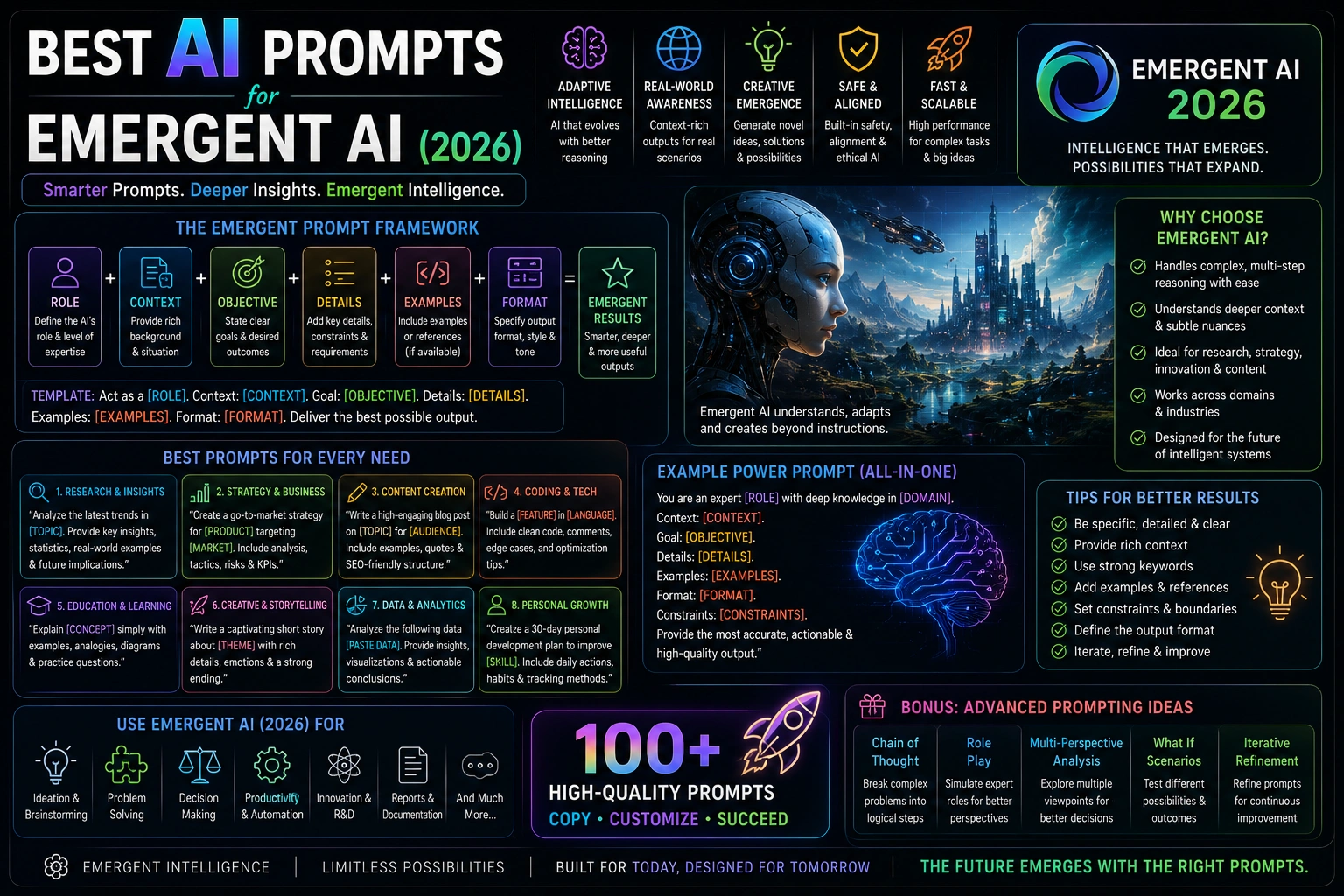
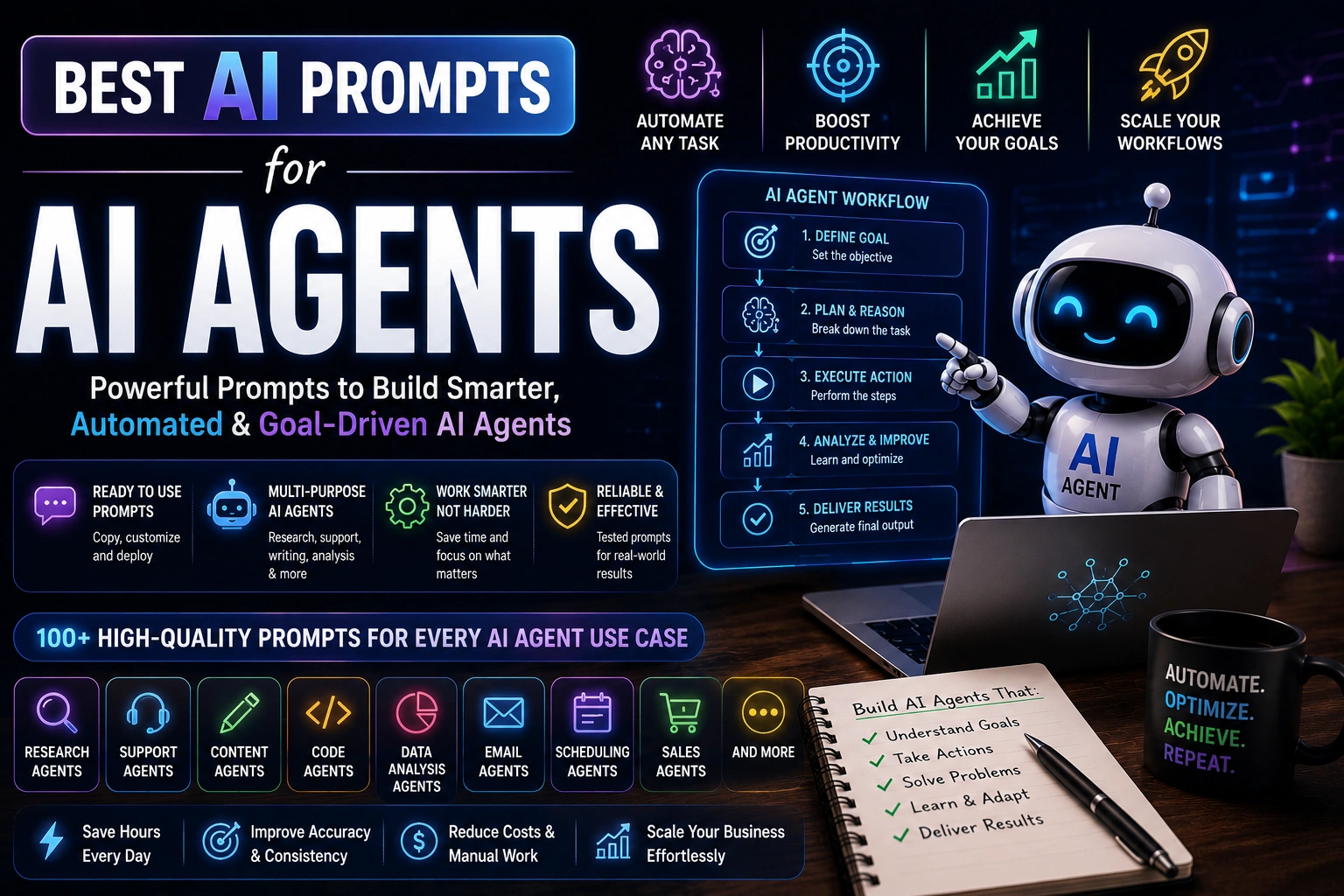
Advanced Prompts That Unlock Emergent Reasoning, Planning & Creativity
Written by Adnan Khan Published July 25, 2026 Updated Oct 18, 2026 10 min read
Explore practical prompts for building and evaluating adaptive workflows, multi-agent simulations, feedback loops, software systems, and research plans. These templates define objectives, constraints, interaction rules, evaluation criteria, and review checkpoints. Adapt them to your model and tools, then verify outputs in a controlled environment before relying on them in real workflows.
Updated for 2026 AI Tools Practical Prompt Templates Beginner Friendly Free to Copy & Use
AI Prompts for Reasoning, Analysis, Coding & Research
Select a category or browse all Emergent AI prompts below
1. Full-Stack SaaS App Builder
APP BUILDING
Turn a product idea into a production-ready full-stack SaaS application.
Build a production-ready SaaS application for [business idea]. Include a responsive frontend, secure authentication, user dashboard, database schema, API layer, subscription-ready architecture, error handling, loading states, admin panel, testing and deployment configuration. First create a clear implementation plan, then build and verify the complete application.
Build a production-ready SaaS application for [business idea]. Include a responsive frontend, secure authentication, user dashboard, database schema, API layer, subscription-ready architecture, error handling, loading states, admin panel, testing and deployment configuration. First create a clear implementation plan, then build and verify the complete application.
Recommended Tech Stack
Python, LangChain or AutoGen where orchestration is needed, an approved OpenAI or Anthropic API, NetworkX for relationship graphs when relevant, and PyTorch only for custom neural feedback loops.
Quick Implementation Guide
Define the objective, inputs, environmental constraints, interaction rules, expected output format, and success criteria in the prompt. Replace every bracketed placeholder with specific context.
Run the prompt in a controlled, repeatable workflow or simulation. If outputs feed into later steps, set explicit iteration limits and keep tool access scoped to the task.
Evaluate results against test cases and measurable criteria; log errors, drift, and unexpected behavior. Add human review for consequential decisions and rerun after changes.
Real-World Use Case Example
Apply 1. Full-Stack SaaS App Builder to a small pilot for a real workflow—for example, modeling a business process, stress-testing software behavior, comparing research hypotheses, or coordinating review agents. Treat generated outcomes as hypotheses until verified with evidence or tests.
2. Autonomous AI Agent Builder
AI AGENTS
Create an AI agent that can plan tasks, use tools and complete workflows.
Build an autonomous AI agent for [objective]. Give it clear goals, available tools, structured memory, task planning, error recovery, verification steps and human approval checkpoints. The agent should break complex requests into smaller actions and report progress and final results clearly.
Build an autonomous AI agent for [objective]. Give it clear goals, available tools, structured memory, task planning, error recovery, verification steps and human approval checkpoints. The agent should break complex requests into smaller actions and report progress and final results clearly.
Recommended Tech Stack
Python, LangChain or AutoGen, an approved OpenAI or Anthropic API, structured logging, and a sandboxed tool layer; use NetworkX when agent relationships need graph analysis.
Quick Implementation Guide
Define the objective, inputs, environmental constraints, interaction rules, expected output format, and success criteria in the prompt. Replace every bracketed placeholder with specific context.
Run the prompt in a controlled, repeatable workflow or simulation. If outputs feed into later steps, set explicit iteration limits and keep tool access scoped to the task.
Evaluate results against test cases and measurable criteria; log errors, drift, and unexpected behavior. Add human review for consequential decisions and rerun after changes.
Real-World Use Case Example
Apply 2. Autonomous AI Agent Builder to a small pilot for a real workflow—for example, modeling a business process, stress-testing software behavior, comparing research hypotheses, or coordinating review agents. Treat generated outcomes as hypotheses until verified with evidence or tests.
3. Idea-to-Production Vibe Coding
VIBE CODING
Describe an idea naturally and let Emergent turn it into a working application.
Turn this idea into a complete working application: [idea]. Make reasonable product decisions where details are missing. Build the UI, application logic, database, APIs and core workflows. Keep the design modern and responsive. Test the major user journeys and fix obvious issues before presenting the finished build.
Turn this idea into a complete working application: [idea]. Make reasonable product decisions where details are missing. Build the UI, application logic, database, APIs and core workflows. Keep the design modern and responsive. Test the major user journeys and fix obvious issues before presenting the finished build.
Recommended Tech Stack
Python, LangChain or AutoGen, an approved OpenAI or Anthropic API, structured logging, and a sandboxed tool layer; use NetworkX when agent relationships need graph analysis.
Quick Implementation Guide
Define the objective, inputs, environmental constraints, interaction rules, expected output format, and success criteria in the prompt. Replace every bracketed placeholder with specific context.
Run the prompt in a controlled, repeatable workflow or simulation. If outputs feed into later steps, set explicit iteration limits and keep tool access scoped to the task.
Evaluate results against test cases and measurable criteria; log errors, drift, and unexpected behavior. Add human review for consequential decisions and rerun after changes.
Real-World Use Case Example
Apply 3. Idea-to-Production Vibe Coding to a small pilot for a real workflow—for example, modeling a business process, stress-testing software behavior, comparing research hypotheses, or coordinating review agents. Treat generated outcomes as hypotheses until verified with evidence or tests.
4. AI Business Dashboard
WEB APP
Build an interactive business dashboard from real operational data.
Build a responsive business dashboard for [business]. Connect [data source] and create KPI cards, interactive charts, filters, tables, search, date ranges and role-based views. Include empty states, error handling and mobile responsiveness. Make the dashboard visually clean and optimized for daily business decisions.
Build a responsive business dashboard for [business]. Connect [data source] and create KPI cards, interactive charts, filters, tables, search, date ranges and role-based views. Include empty states, error handling and mobile responsiveness. Make the dashboard visually clean and optimized for daily business decisions.
Recommended Tech Stack
Python, LangChain or AutoGen where orchestration is needed, an approved OpenAI or Anthropic API, NetworkX for relationship graphs when relevant, and PyTorch only for custom neural feedback loops.
Quick Implementation Guide
Define the objective, inputs, environmental constraints, interaction rules, expected output format, and success criteria in the prompt. Replace every bracketed placeholder with specific context.
Run the prompt in a controlled, repeatable workflow or simulation. If outputs feed into later steps, set explicit iteration limits and keep tool access scoped to the task.
Evaluate results against test cases and measurable criteria; log errors, drift, and unexpected behavior. Add human review for consequential decisions and rerun after changes.
Real-World Use Case Example
Apply 4. AI Business Dashboard to a small pilot for a real workflow—for example, modeling a business process, stress-testing software behavior, comparing research hypotheses, or coordinating review agents. Treat generated outcomes as hypotheses until verified with evidence or tests.
5. AI-Powered Knowledge Base
AI APPS
Create an AI knowledge system that answers questions from business content.
Build an AI knowledge-base application for [business]. Allow administrators to upload and organize documents, index the content, search it semantically and ask questions through a conversational interface. Cite relevant source documents, clearly distinguish missing information and include an admin workflow for updating outdated knowledge.
Build an AI knowledge-base application for [business]. Allow administrators to upload and organize documents, index the content, search it semantically and ask questions through a conversational interface. Cite relevant source documents, clearly distinguish missing information and include an admin workflow for updating outdated knowledge.
Recommended Tech Stack
Python, LangChain or AutoGen, an approved OpenAI or Anthropic API, structured logging, and a sandboxed tool layer; use NetworkX when agent relationships need graph analysis.
Quick Implementation Guide
Define the objective, inputs, environmental constraints, interaction rules, expected output format, and success criteria in the prompt. Replace every bracketed placeholder with specific context.
Run the prompt in a controlled, repeatable workflow or simulation. If outputs feed into later steps, set explicit iteration limits and keep tool access scoped to the task.
Evaluate results against test cases and measurable criteria; log errors, drift, and unexpected behavior. Add human review for consequential decisions and rerun after changes.
Real-World Use Case Example
Apply 5. AI-Powered Knowledge Base to a small pilot for a real workflow—for example, modeling a business process, stress-testing software behavior, comparing research hypotheses, or coordinating review agents. Treat generated outcomes as hypotheses until verified with evidence or tests.
6. MCP-Connected AI Application
MCP
Build an application that connects AI workflows with external tools and services.
Build an AI application for [use case] using MCP-compatible tools where appropriate. Define the tools the agent needs, their inputs and outputs, permissions, failure handling and verification rules. Keep sensitive actions behind explicit approval and show users what actions the agent performed.
Build an AI application for [use case] using MCP-compatible tools where appropriate. Define the tools the agent needs, their inputs and outputs, permissions, failure handling and verification rules. Keep sensitive actions behind explicit approval and show users what actions the agent performed.
Recommended Tech Stack
Python, LangChain or AutoGen, an approved OpenAI or Anthropic API, structured logging, and a sandboxed tool layer; use NetworkX when agent relationships need graph analysis.
Quick Implementation Guide
Define the objective, inputs, environmental constraints, interaction rules, expected output format, and success criteria in the prompt. Replace every bracketed placeholder with specific context.
Run the prompt in a controlled, repeatable workflow or simulation. If outputs feed into later steps, set explicit iteration limits and keep tool access scoped to the task.
Evaluate results against test cases and measurable criteria; log errors, drift, and unexpected behavior. Add human review for consequential decisions and rerun after changes.
Real-World Use Case Example
Apply 6. MCP-Connected AI Application to a small pilot for a real workflow—for example, modeling a business process, stress-testing software behavior, comparing research hypotheses, or coordinating review agents. Treat generated outcomes as hypotheses until verified with evidence or tests.
7. Visual UI Transformation
VISUAL EDITS
Upgrade an existing application's interface through targeted visual changes.
Improve the existing UI of [application]. Keep the current functionality intact while redesigning [specific section]. Improve spacing, typography, hierarchy, responsiveness, accessibility and visual consistency. Make the changes modular so they do not break existing components or workflows, then verify the affected screens.
Improve the existing UI of [application]. Keep the current functionality intact while redesigning [specific section]. Improve spacing, typography, hierarchy, responsiveness, accessibility and visual consistency. Make the changes modular so they do not break existing components or workflows, then verify the affected screens.
Recommended Tech Stack
Python, LangChain or AutoGen, an approved OpenAI or Anthropic API, structured logging, and a sandboxed tool layer; use NetworkX when agent relationships need graph analysis.
Quick Implementation Guide
Define the objective, inputs, environmental constraints, interaction rules, expected output format, and success criteria in the prompt. Replace every bracketed placeholder with specific context.
Run the prompt in a controlled, repeatable workflow or simulation. If outputs feed into later steps, set explicit iteration limits and keep tool access scoped to the task.
Evaluate results against test cases and measurable criteria; log errors, drift, and unexpected behavior. Add human review for consequential decisions and rerun after changes.
Real-World Use Case Example
Apply 7. Visual UI Transformation to a small pilot for a real workflow—for example, modeling a business process, stress-testing software behavior, comparing research hypotheses, or coordinating review agents. Treat generated outcomes as hypotheses until verified with evidence or tests.
8. Production Database Architecture
DATABASE
Design a scalable database architecture for a real-world application.
Design and implement the database architecture for [application]. Define entities, relationships, indexes, validation rules, permissions, migrations and seed data. Optimize for reliability and future growth. If using MongoDB Atlas, structure collections and indexes for the application's most important queries and workflows.
Design and implement the database architecture for [application]. Define entities, relationships, indexes, validation rules, permissions, migrations and seed data. Optimize for reliability and future growth. If using MongoDB Atlas, structure collections and indexes for the application's most important queries and workflows.
Recommended Tech Stack
Python, LangChain or AutoGen, an approved OpenAI or Anthropic API, structured logging, and a sandboxed tool layer; use NetworkX when agent relationships need graph analysis.
Quick Implementation Guide
Define the objective, inputs, environmental constraints, interaction rules, expected output format, and success criteria in the prompt. Replace every bracketed placeholder with specific context.
Run the prompt in a controlled, repeatable workflow or simulation. If outputs feed into later steps, set explicit iteration limits and keep tool access scoped to the task.
Evaluate results against test cases and measurable criteria; log errors, drift, and unexpected behavior. Add human review for consequential decisions and rerun after changes.
Real-World Use Case Example
Apply 8. Production Database Architecture to a small pilot for a real workflow—for example, modeling a business process, stress-testing software behavior, comparing research hypotheses, or coordinating review agents. Treat generated outcomes as hypotheses until verified with evidence or tests.
9. Autonomous App Testing & Repair
TESTING
Let the AI systematically test an application and repair detected problems.
Test this application: [application]. Identify broken user journeys, UI defects, API failures, validation problems, edge cases and inconsistent states. Prioritize critical issues, fix them without changing intended behavior, rerun the affected tests and provide a concise summary of what was verified.
Test this application: [application]. Identify broken user journeys, UI defects, API failures, validation problems, edge cases and inconsistent states. Prioritize critical issues, fix them without changing intended behavior, rerun the affected tests and provide a concise summary of what was verified.
Recommended Tech Stack
Python, LangChain or AutoGen, an approved OpenAI or Anthropic API, structured logging, and a sandboxed tool layer; use NetworkX when agent relationships need graph analysis.
Quick Implementation Guide
Define the objective, inputs, environmental constraints, interaction rules, expected output format, and success criteria in the prompt. Replace every bracketed placeholder with specific context.
Run the prompt in a controlled, repeatable workflow or simulation. If outputs feed into later steps, set explicit iteration limits and keep tool access scoped to the task.
Evaluate results against test cases and measurable criteria; log errors, drift, and unexpected behavior. Add human review for consequential decisions and rerun after changes.
Real-World Use Case Example
Apply 9. Autonomous App Testing & Repair to a small pilot for a real workflow—for example, modeling a business process, stress-testing software behavior, comparing research hypotheses, or coordinating review agents. Treat generated outcomes as hypotheses until verified with evidence or tests.
10. Web-to-Mobile Product Builder
MOBILE
Transform a product concept into a responsive web and mobile experience.
Build [product] as a polished web and mobile experience. Reuse the same product logic and data model where practical while adapting navigation, layouts, touch interactions and forms for smaller screens. Include authentication, core workflows, responsive states and production-ready error handling.
Build [product] as a polished web and mobile experience. Reuse the same product logic and data model where practical while adapting navigation, layouts, touch interactions and forms for smaller screens. Include authentication, core workflows, responsive states and production-ready error handling.
Recommended Tech Stack
Python, LangChain or AutoGen, an approved OpenAI or Anthropic API, structured logging, and a sandboxed tool layer; use NetworkX when agent relationships need graph analysis.
Quick Implementation Guide
Define the objective, inputs, environmental constraints, interaction rules, expected output format, and success criteria in the prompt. Replace every bracketed placeholder with specific context.
Run the prompt in a controlled, repeatable workflow or simulation. If outputs feed into later steps, set explicit iteration limits and keep tool access scoped to the task.
Evaluate results against test cases and measurable criteria; log errors, drift, and unexpected behavior. Add human review for consequential decisions and rerun after changes.
Real-World Use Case Example
Apply 10. Web-to-Mobile Product Builder to a small pilot for a real workflow—for example, modeling a business process, stress-testing software behavior, comparing research hypotheses, or coordinating review agents. Treat generated outcomes as hypotheses until verified with evidence or tests.
11. Business Workflow Automation Agent
AUTOMATION
Automate repetitive business processes with an AI agent and approval controls.
Build an AI workflow for [business process]. Detect incoming tasks, classify them, gather required information, execute approved actions, record results and escalate exceptions to a human. Add validation, retry logic, audit logs and explicit approval before irreversible actions.
Build an AI workflow for [business process]. Detect incoming tasks, classify them, gather required information, execute approved actions, record results and escalate exceptions to a human. Add validation, retry logic, audit logs and explicit approval before irreversible actions.
Recommended Tech Stack
Python, LangChain or AutoGen, an approved OpenAI or Anthropic API, structured logging, and a sandboxed tool layer; use NetworkX when agent relationships need graph analysis.
Quick Implementation Guide
Define the objective, inputs, environmental constraints, interaction rules, expected output format, and success criteria in the prompt. Replace every bracketed placeholder with specific context.
Run the prompt in a controlled, repeatable workflow or simulation. If outputs feed into later steps, set explicit iteration limits and keep tool access scoped to the task.
Evaluate results against test cases and measurable criteria; log errors, drift, and unexpected behavior. Add human review for consequential decisions and rerun after changes.
Real-World Use Case Example
Apply 11. Business Workflow Automation Agent to a small pilot for a real workflow—for example, modeling a business process, stress-testing software behavior, comparing research hypotheses, or coordinating review agents. Treat generated outcomes as hypotheses until verified with evidence or tests.
12. Production Launch & Deployment
DEPLOYMENT
Prepare an AI-built application for a reliable production launch.
Prepare [application] for production. Review security, environment variables, database configuration, authentication, API failures, performance, responsive behavior, logging, error handling and deployment settings. Fix high-priority issues, verify the critical workflows and provide a concise production-readiness checklist.
Prepare [application] for production. Review security, environment variables, database configuration, authentication, API failures, performance, responsive behavior, logging, error handling and deployment settings. Fix high-priority issues, verify the critical workflows and provide a concise production-readiness checklist.
Recommended Tech Stack
Python, LangChain or AutoGen, an approved OpenAI or Anthropic API, structured logging, and a sandboxed tool layer; use NetworkX when agent relationships need graph analysis.
Quick Implementation Guide
Define the objective, inputs, environmental constraints, interaction rules, expected output format, and success criteria in the prompt. Replace every bracketed placeholder with specific context.
Run the prompt in a controlled, repeatable workflow or simulation. If outputs feed into later steps, set explicit iteration limits and keep tool access scoped to the task.
Evaluate results against test cases and measurable criteria; log errors, drift, and unexpected behavior. Add human review for consequential decisions and rerun after changes.
Real-World Use Case Example
Apply 12. Production Launch & Deployment to a small pilot for a real workflow—for example, modeling a business process, stress-testing software behavior, comparing research hypotheses, or coordinating review agents. Treat generated outcomes as hypotheses until verified with evidence or tests.
13. Always-On Business Assistant
AI ASSISTANT
Create a proactive assistant that monitors tasks and helps keep work moving.
Build an always-on AI assistant for [business/team]. Give it access to approved workflows and relevant context. Let it identify pending tasks, summarize important changes, suggest next actions and proactively surface issues while respecting user permissions. Require confirmation before sensitive or irreversible actions.
Build an always-on AI assistant for [business/team]. Give it access to approved workflows and relevant context. Let it identify pending tasks, summarize important changes, suggest next actions and proactively surface issues while respecting user permissions. Require confirmation before sensitive or irreversible actions.
Recommended Tech Stack
Python, LangChain or AutoGen, an approved OpenAI or Anthropic API, structured logging, and a sandboxed tool layer; use NetworkX when agent relationships need graph analysis.
Quick Implementation Guide
Define the objective, inputs, environmental constraints, interaction rules, expected output format, and success criteria in the prompt. Replace every bracketed placeholder with specific context.
Run the prompt in a controlled, repeatable workflow or simulation. If outputs feed into later steps, set explicit iteration limits and keep tool access scoped to the task.
Evaluate results against test cases and measurable criteria; log errors, drift, and unexpected behavior. Add human review for consequential decisions and rerun after changes.
Real-World Use Case Example
Apply 13. Always-On Business Assistant to a small pilot for a real workflow—for example, modeling a business process, stress-testing software behavior, comparing research hypotheses, or coordinating review agents. Treat generated outcomes as hypotheses until verified with evidence or tests.
14. Second-Order Effect Cascades
ANALYSIS
Trace ripple effects beyond the obvious.
Analyze the decision: [decision]. First, list the immediate effects. Then, for each immediate effect, derive two second-order effects. Continue to third-order effects and identify any feedback loops. Highlight non-obvious emergent consequences.
Analyze the decision: [decision]. First, list the immediate effects. Then, for each immediate effect, derive two second-order effects. Continue to third-order effects and identify any feedback loops. Highlight non-obvious emergent consequences.
Recommended Tech Stack
Python, NumPy, PyTorch where custom model training is needed, NetworkX for relationship graphs, and a reproducible simulation/test harness.
Quick Implementation Guide
Define the objective, inputs, environmental constraints, interaction rules, expected output format, and success criteria in the prompt. Replace every bracketed placeholder with specific context.
Run the prompt in a controlled, repeatable workflow or simulation. If outputs feed into later steps, set explicit iteration limits and keep tool access scoped to the task.
Evaluate results against test cases and measurable criteria; log errors, drift, and unexpected behavior. Add human review for consequential decisions and rerun after changes.
Real-World Use Case Example
Apply 14. Second-Order Effect Cascades to a small pilot for a real workflow—for example, modeling a business process, stress-testing software behavior, comparing research hypotheses, or coordinating review agents. Treat generated outcomes as hypotheses until verified with evidence or tests.
15. Ethical Dilemma Resolution with Competing Frameworks
ANALYSIS
Evaluate a moral problem using deontology, utilitarianism, and virtue ethics.
Resolve this ethical dilemma: [dilemma]. Apply three frameworks: utilitarianism, deontology, and virtue ethics. For each, state the decision, the reasoning, and one critique. Then propose a meta-solution that reconciles the frameworks.
Resolve this ethical dilemma: [dilemma]. Apply three frameworks: utilitarianism, deontology, and virtue ethics. For each, state the decision, the reasoning, and one critique. Then propose a meta-solution that reconciles the frameworks.
Recommended Tech Stack
Python, LangChain or AutoGen where orchestration is needed, an approved OpenAI or Anthropic API, NetworkX for relationship graphs when relevant, and PyTorch only for custom neural feedback loops.
Quick Implementation Guide
Define the objective, inputs, environmental constraints, interaction rules, expected output format, and success criteria in the prompt. Replace every bracketed placeholder with specific context.
Run the prompt in a controlled, repeatable workflow or simulation. If outputs feed into later steps, set explicit iteration limits and keep tool access scoped to the task.
Evaluate results against test cases and measurable criteria; log errors, drift, and unexpected behavior. Add human review for consequential decisions and rerun after changes.
Real-World Use Case Example
Apply 15. Ethical Dilemma Resolution with Competing Frameworks to a small pilot for a real workflow—for example, modeling a business process, stress-testing software behavior, comparing research hypotheses, or coordinating review agents. Treat generated outcomes as hypotheses until verified with evidence or tests.
16. Multi-Agent Negotiation with Hidden Agendas
ANALYSIS
Simulate a negotiation where each agent has private goals.
Simulate a 3-way negotiation between [Agent A], [Agent B], [Agent C]. Each has a hidden agenda. Run 5 rounds of offers and counteroffers. After the simulation, reveal the hidden agendas and analyze the emergent outcome fair or manipulated?
Simulate a 3-way negotiation between [Agent A], [Agent B], [Agent C]. Each has a hidden agenda. Run 5 rounds of offers and counteroffers. After the simulation, reveal the hidden agendas and analyze the emergent outcome fair or manipulated?
Recommended Tech Stack
Python, LangChain or AutoGen, an approved OpenAI or Anthropic API, structured logging, and a sandboxed tool layer; use NetworkX when agent relationships need graph analysis.
Quick Implementation Guide
Define the objective, inputs, environmental constraints, interaction rules, expected output format, and success criteria in the prompt. Replace every bracketed placeholder with specific context.
Run the prompt in a controlled, repeatable workflow or simulation. If outputs feed into later steps, set explicit iteration limits and keep tool access scoped to the task.
Evaluate results against test cases and measurable criteria; log errors, drift, and unexpected behavior. Add human review for consequential decisions and rerun after changes.
Real-World Use Case Example
Apply 16. Multi-Agent Negotiation with Hidden Agendas to a small pilot for a real workflow—for example, modeling a business process, stress-testing software behavior, comparing research hypotheses, or coordinating review agents. Treat generated outcomes as hypotheses until verified with evidence or tests.
17. Causal Loop Diagram from Text
ANALYSIS
Extract a system dynamics map from a narrative description.
Read this description of a problematic system: [paste text]. Construct a causal loop diagram (text-based) showing reinforcing and balancing loops. Label the polarity of each link and identify the leverage points for intervention.
Read this description of a problematic system: [paste text]. Construct a causal loop diagram (text-based) showing reinforcing and balancing loops. Label the polarity of each link and identify the leverage points for intervention.
Recommended Tech Stack
Python, NumPy, PyTorch where custom model training is needed, NetworkX for relationship graphs, and a reproducible simulation/test harness.
Quick Implementation Guide
Define the objective, inputs, environmental constraints, interaction rules, expected output format, and success criteria in the prompt. Replace every bracketed placeholder with specific context.
Run the prompt in a controlled, repeatable workflow or simulation. If outputs feed into later steps, set explicit iteration limits and keep tool access scoped to the task.
Evaluate results against test cases and measurable criteria; log errors, drift, and unexpected behavior. Add human review for consequential decisions and rerun after changes.
Real-World Use Case Example
Apply 17. Causal Loop Diagram from Text to a small pilot for a real workflow—for example, modeling a business process, stress-testing software behavior, comparing research hypotheses, or coordinating review agents. Treat generated outcomes as hypotheses until verified with evidence or tests.
18. What-If Machine (Counterfactual History)
ANALYSIS
Explore alternative historical timelines with rigorous logic.
What if [historical event] had never happened? Construct a plausible alternative timeline from that point to 2026. Use chain-of-reasoning for each major deviation, and evaluate the overall plausibility of the scenario.
What if [historical event] had never happened? Construct a plausible alternative timeline from that point to 2026. Use chain-of-reasoning for each major deviation, and evaluate the overall plausibility of the scenario.
Recommended Tech Stack
Python, LangChain or AutoGen where orchestration is needed, an approved OpenAI or Anthropic API, NetworkX for relationship graphs when relevant, and PyTorch only for custom neural feedback loops.
Quick Implementation Guide
Define the objective, inputs, environmental constraints, interaction rules, expected output format, and success criteria in the prompt. Replace every bracketed placeholder with specific context.
Run the prompt in a controlled, repeatable workflow or simulation. If outputs feed into later steps, set explicit iteration limits and keep tool access scoped to the task.
Evaluate results against test cases and measurable criteria; log errors, drift, and unexpected behavior. Add human review for consequential decisions and rerun after changes.
Real-World Use Case Example
Apply 18. What-If Machine (Counterfactual History) to a small pilot for a real workflow—for example, modeling a business process, stress-testing software behavior, comparing research hypotheses, or coordinating review agents. Treat generated outcomes as hypotheses until verified with evidence or tests.
19. Self-Healing Code Architecture
CODING
Design a system that detects and repairs its own runtime errors.
Design a self-healing microservice architecture for [use case]. Include a health monitor, circuit breakers, and automated rollback logic. Generate the Python/Node.js stubs with detailed comments explaining the emergent resilience patterns.
Design a self-healing microservice architecture for [use case]. Include a health monitor, circuit breakers, and automated rollback logic. Generate the Python/Node.js stubs with detailed comments explaining the emergent resilience patterns.
Recommended Tech Stack
Python, LangChain or AutoGen where orchestration is needed, an approved OpenAI or Anthropic API, NetworkX for relationship graphs when relevant, and PyTorch only for custom neural feedback loops.
Quick Implementation Guide
Define the objective, inputs, environmental constraints, interaction rules, expected output format, and success criteria in the prompt. Replace every bracketed placeholder with specific context.
Run the prompt in a controlled, repeatable workflow or simulation. If outputs feed into later steps, set explicit iteration limits and keep tool access scoped to the task.
Evaluate results against test cases and measurable criteria; log errors, drift, and unexpected behavior. Add human review for consequential decisions and rerun after changes.
Real-World Use Case Example
Apply 19. Self-Healing Code Architecture to a small pilot for a real workflow—for example, modeling a business process, stress-testing software behavior, comparing research hypotheses, or coordinating review agents. Treat generated outcomes as hypotheses until verified with evidence or tests.
20. Genetic Algorithm Generator
CODING
Write an evolutionary algorithm that solves a specified problem.
Write a Python genetic algorithm to solve [problem]. Define the fitness function, selection, crossover, and mutation operators. Run a mental simulation of 10 generations and explain how the solution evolves.
Write a Python genetic algorithm to solve [problem]. Define the fitness function, selection, crossover, and mutation operators. Run a mental simulation of 10 generations and explain how the solution evolves.
Recommended Tech Stack
Python, NumPy, PyTorch where custom model training is needed, NetworkX for relationship graphs, and a reproducible simulation/test harness.
Quick Implementation Guide
Define the objective, inputs, environmental constraints, interaction rules, expected output format, and success criteria in the prompt. Replace every bracketed placeholder with specific context.
Run the prompt in a controlled, repeatable workflow or simulation. If outputs feed into later steps, set explicit iteration limits and keep tool access scoped to the task.
Evaluate results against test cases and measurable criteria; log errors, drift, and unexpected behavior. Add human review for consequential decisions and rerun after changes.
Real-World Use Case Example
Apply 20. Genetic Algorithm Generator to a small pilot for a real workflow—for example, modeling a business process, stress-testing software behavior, comparing research hypotheses, or coordinating review agents. Treat generated outcomes as hypotheses until verified with evidence or tests.
21. Emergent Game AI Behavior Trees
CODING
Create NPC behavior that produces lifelike emergent actions.
Design a behavior tree for an NPC in a survival game. The NPC must autonomously balance hunger, safety, and socialization. Explain the priority system and show how emergent narratives can arise from simple rule interactions.
Design a behavior tree for an NPC in a survival game. The NPC must autonomously balance hunger, safety, and socialization. Explain the priority system and show how emergent narratives can arise from simple rule interactions.
Recommended Tech Stack
Python, LangChain or AutoGen, an approved OpenAI or Anthropic API, structured logging, and a sandboxed tool layer; use NetworkX when agent relationships need graph analysis.
Quick Implementation Guide
Define the objective, inputs, environmental constraints, interaction rules, expected output format, and success criteria in the prompt. Replace every bracketed placeholder with specific context.
Run the prompt in a controlled, repeatable workflow or simulation. If outputs feed into later steps, set explicit iteration limits and keep tool access scoped to the task.
Evaluate results against test cases and measurable criteria; log errors, drift, and unexpected behavior. Add human review for consequential decisions and rerun after changes.
Real-World Use Case Example
Apply 21. Emergent Game AI Behavior Trees to a small pilot for a real workflow—for example, modeling a business process, stress-testing software behavior, comparing research hypotheses, or coordinating review agents. Treat generated outcomes as hypotheses until verified with evidence or tests.
22. Autonomous Agent with Reflection Loop
CODING
Build a LangChain-style agent that reviews and adjusts its own plan.
Write a Python agent using a ReAct pattern that can answer questions about a given document. After providing an answer, it must critique its own search process, refine the query, and try again if confidence is below 90%. Paste the document: [paste].
Write a Python agent using a ReAct pattern that can answer questions about a given document. After providing an answer, it must critique its own search process, refine the query, and try again if confidence is below 90%. Paste the document: [paste].
Recommended Tech Stack
Python, LangChain or AutoGen, an approved OpenAI or Anthropic API, structured logging, and a sandboxed tool layer; use NetworkX when agent relationships need graph analysis.
Quick Implementation Guide
Define the objective, inputs, environmental constraints, interaction rules, expected output format, and success criteria in the prompt. Replace every bracketed placeholder with specific context.
Run the prompt in a controlled, repeatable workflow or simulation. If outputs feed into later steps, set explicit iteration limits and keep tool access scoped to the task.
Evaluate results against test cases and measurable criteria; log errors, drift, and unexpected behavior. Add human review for consequential decisions and rerun after changes.
Real-World Use Case Example
Apply 22. Autonomous Agent with Reflection Loop to a small pilot for a real workflow—for example, modeling a business process, stress-testing software behavior, comparing research hypotheses, or coordinating review agents. Treat generated outcomes as hypotheses until verified with evidence or tests.
23. Neural Network from Scratch with Math Derivation
CODING
Implement backpropagation with full mathematical justification.
Write a Python implementation of a 2-layer neural network for XOR from scratch (only NumPy). For each forward and backward pass step, add comments with the calculus derivation. Then explain the emergent decision boundary.
Write a Python implementation of a 2-layer neural network for XOR from scratch (only NumPy). For each forward and backward pass step, add comments with the calculus derivation. Then explain the emergent decision boundary.
Recommended Tech Stack
Python, NumPy, PyTorch where custom model training is needed, NetworkX for relationship graphs, and a reproducible simulation/test harness.
Quick Implementation Guide
Define the objective, inputs, environmental constraints, interaction rules, expected output format, and success criteria in the prompt. Replace every bracketed placeholder with specific context.
Run the prompt in a controlled, repeatable workflow or simulation. If outputs feed into later steps, set explicit iteration limits and keep tool access scoped to the task.
Evaluate results against test cases and measurable criteria; log errors, drift, and unexpected behavior. Add human review for consequential decisions and rerun after changes.
Real-World Use Case Example
Apply 23. Neural Network from Scratch with Math Derivation to a small pilot for a real workflow—for example, modeling a business process, stress-testing software behavior, comparing research hypotheses, or coordinating review agents. Treat generated outcomes as hypotheses until verified with evidence or tests.
24. Code Review as a Senior Architect
CODING
Review a pull request with a focus on emergent complexity.
Review the following code: [paste code]. Focus on architectural decisions, potential emergent bugs under load, and maintainability. Provide a structured review with "Must Fix", "Nice to Have", and "Educational Note" sections.
Review the following code: [paste code]. Focus on architectural decisions, potential emergent bugs under load, and maintainability. Provide a structured review with "Must Fix", "Nice to Have", and "Educational Note" sections.
Recommended Tech Stack
Python for data handling, LangChain or AutoGen only if orchestration is needed, an approved OpenAI or Anthropic API, and a source-tracking/evaluation workflow.
Quick Implementation Guide
Define the objective, inputs, environmental constraints, interaction rules, expected output format, and success criteria in the prompt. Replace every bracketed placeholder with specific context.
Run the prompt in a controlled, repeatable workflow or simulation. If outputs feed into later steps, set explicit iteration limits and keep tool access scoped to the task.
Evaluate results against test cases and measurable criteria; log errors, drift, and unexpected behavior. Add human review for consequential decisions and rerun after changes.
Real-World Use Case Example
Apply 24. Code Review as a Senior Architect to a small pilot for a real workflow—for example, modeling a business process, stress-testing software behavior, comparing research hypotheses, or coordinating review agents. Treat generated outcomes as hypotheses until verified with evidence or tests.
25. Zero-Shot SQL from Ambiguous Request
CODING
Convert a vague business question into a precise, optimized query.
A manager asks: "[vague data request]". Infer the database schema, ask clarifying questions implicitly, then produce the SQL query with CTEs and indexes. Explain the reasoning and any assumptions made.
A manager asks: "[vague data request]". Infer the database schema, ask clarifying questions implicitly, then produce the SQL query with CTEs and indexes. Explain the reasoning and any assumptions made.
Recommended Tech Stack
Python, LangChain or AutoGen where orchestration is needed, an approved OpenAI or Anthropic API, NetworkX for relationship graphs when relevant, and PyTorch only for custom neural feedback loops.
Quick Implementation Guide
Define the objective, inputs, environmental constraints, interaction rules, expected output format, and success criteria in the prompt. Replace every bracketed placeholder with specific context.
Run the prompt in a controlled, repeatable workflow or simulation. If outputs feed into later steps, set explicit iteration limits and keep tool access scoped to the task.
Evaluate results against test cases and measurable criteria; log errors, drift, and unexpected behavior. Add human review for consequential decisions and rerun after changes.
Real-World Use Case Example
Apply 25. Zero-Shot SQL from Ambiguous Request to a small pilot for a real workflow—for example, modeling a business process, stress-testing software behavior, comparing research hypotheses, or coordinating review agents. Treat generated outcomes as hypotheses until verified with evidence or tests.
26. Test Case Generator with Boundary Analysis
CODING
Generate a comprehensive test suite by analyzing the function's logic.
Generate unit tests for this function: [paste code]. Use equivalence partitioning and boundary value analysis. Include tests for happy path, edge cases, error states, and concurrency. Write the tests in Jest/Mocha.
Generate unit tests for this function: [paste code]. Use equivalence partitioning and boundary value analysis. Include tests for happy path, edge cases, error states, and concurrency. Write the tests in Jest/Mocha.
Recommended Tech Stack
Python, LangChain or AutoGen where orchestration is needed, an approved OpenAI or Anthropic API, NetworkX for relationship graphs when relevant, and PyTorch only for custom neural feedback loops.
Quick Implementation Guide
Define the objective, inputs, environmental constraints, interaction rules, expected output format, and success criteria in the prompt. Replace every bracketed placeholder with specific context.
Run the prompt in a controlled, repeatable workflow or simulation. If outputs feed into later steps, set explicit iteration limits and keep tool access scoped to the task.
Evaluate results against test cases and measurable criteria; log errors, drift, and unexpected behavior. Add human review for consequential decisions and rerun after changes.
Real-World Use Case Example
Apply 26. Test Case Generator with Boundary Analysis to a small pilot for a real workflow—for example, modeling a business process, stress-testing software behavior, comparing research hypotheses, or coordinating review agents. Treat generated outcomes as hypotheses until verified with evidence or tests.
27. Fully-Typed API Client from OpenAPI Spec
CODING
Generate a TypeScript SDK with automatic emergent type safety.
Given this OpenAPI spec (paste JSON/YAML): [paste]. Generate a fully-typed TypeScript API client using axios. Include request/response types, error handling, and a readme. Ensure all endpoints are covered.
Given this OpenAPI spec (paste JSON/YAML): [paste]. Generate a fully-typed TypeScript API client using axios. Include request/response types, error handling, and a readme. Ensure all endpoints are covered.
Recommended Tech Stack
Python, LangChain or AutoGen where orchestration is needed, an approved OpenAI or Anthropic API, NetworkX for relationship graphs when relevant, and PyTorch only for custom neural feedback loops.
Quick Implementation Guide
Define the objective, inputs, environmental constraints, interaction rules, expected output format, and success criteria in the prompt. Replace every bracketed placeholder with specific context.
Run the prompt in a controlled, repeatable workflow or simulation. If outputs feed into later steps, set explicit iteration limits and keep tool access scoped to the task.
Evaluate results against test cases and measurable criteria; log errors, drift, and unexpected behavior. Add human review for consequential decisions and rerun after changes.
Real-World Use Case Example
Apply 27. Fully-Typed API Client from OpenAPI Spec to a small pilot for a real workflow—for example, modeling a business process, stress-testing software behavior, comparing research hypotheses, or coordinating review agents. Treat generated outcomes as hypotheses until verified with evidence or tests.
28. Explainable AI (XAI) Report for Model Predictions
CODING
Provide an explanation for a black-box model output.
This model predicted [prediction] for input [features]. Using LIME/SHAP mental simulation, explain which features contributed most and propose a counterfactual: what minimal change would flip the prediction?
This model predicted [prediction] for input [features]. Using LIME/SHAP mental simulation, explain which features contributed most and propose a counterfactual: what minimal change would flip the prediction?
Recommended Tech Stack
Python, NumPy, PyTorch where custom model training is needed, NetworkX for relationship graphs, and a reproducible simulation/test harness.
Quick Implementation Guide
Define the objective, inputs, environmental constraints, interaction rules, expected output format, and success criteria in the prompt. Replace every bracketed placeholder with specific context.
Run the prompt in a controlled, repeatable workflow or simulation. If outputs feed into later steps, set explicit iteration limits and keep tool access scoped to the task.
Evaluate results against test cases and measurable criteria; log errors, drift, and unexpected behavior. Add human review for consequential decisions and rerun after changes.
Real-World Use Case Example
Apply 28. Explainable AI (XAI) Report for Model Predictions to a small pilot for a real workflow—for example, modeling a business process, stress-testing software behavior, comparing research hypotheses, or coordinating review agents. Treat generated outcomes as hypotheses until verified with evidence or tests.
29. Research Gap Discovery with Contradiction Mining
RESEARCH
Find conflicting findings across papers to uncover new hypotheses.
I uploaded 5 paper abstracts on [topic]: [paste abstracts]. Find contradictory claims or results between any two papers. For each contradiction, propose a research hypothesis that would resolve the conflict.
I uploaded 5 paper abstracts on [topic]: [paste abstracts]. Find contradictory claims or results between any two papers. For each contradiction, propose a research hypothesis that would resolve the conflict.
Recommended Tech Stack
Python for data handling, LangChain or AutoGen only if orchestration is needed, an approved OpenAI or Anthropic API, and a source-tracking/evaluation workflow.
Quick Implementation Guide
Define the objective, inputs, environmental constraints, interaction rules, expected output format, and success criteria in the prompt. Replace every bracketed placeholder with specific context.
Run the prompt in a controlled, repeatable workflow or simulation. If outputs feed into later steps, set explicit iteration limits and keep tool access scoped to the task.
Evaluate results against test cases and measurable criteria; log errors, drift, and unexpected behavior. Add human review for consequential decisions and rerun after changes.
Real-World Use Case Example
Apply 29. Research Gap Discovery with Contradiction Mining to a small pilot for a real workflow—for example, modeling a business process, stress-testing software behavior, comparing research hypotheses, or coordinating review agents. Treat generated outcomes as hypotheses until verified with evidence or tests.
30. Emergent Theory Builder
RESEARCH
Synthesize disparate observations into a unified theory.
Here are 10 seemingly unrelated facts: [list facts]. Weave them into a coherent, novel theory. State the theory, explain how each fact supports it, and propose one experiment that could falsify it.
Here are 10 seemingly unrelated facts: [list facts]. Weave them into a coherent, novel theory. State the theory, explain how each fact supports it, and propose one experiment that could falsify it.
Recommended Tech Stack
Python for data handling, LangChain or AutoGen only if orchestration is needed, an approved OpenAI or Anthropic API, and a source-tracking/evaluation workflow.
Quick Implementation Guide
Define the objective, inputs, environmental constraints, interaction rules, expected output format, and success criteria in the prompt. Replace every bracketed placeholder with specific context.
Run the prompt in a controlled, repeatable workflow or simulation. If outputs feed into later steps, set explicit iteration limits and keep tool access scoped to the task.
Evaluate results against test cases and measurable criteria; log errors, drift, and unexpected behavior. Add human review for consequential decisions and rerun after changes.
Real-World Use Case Example
Apply 30. Emergent Theory Builder to a small pilot for a real workflow—for example, modeling a business process, stress-testing software behavior, comparing research hypotheses, or coordinating review agents. Treat generated outcomes as hypotheses until verified with evidence or tests.
31. Meta-Analysis of Mixed-Methods Studies
RESEARCH
Combine quantitative and qualitative findings into a single narrative.
Analyze these mixed-methods study summaries: [paste summaries]. Extract quantitative effect sizes and qualitative themes. Show where the themes explain the numeric effect, and where they contradict. Provide a joint display table.
Analyze these mixed-methods study summaries: [paste summaries]. Extract quantitative effect sizes and qualitative themes. Show where the themes explain the numeric effect, and where they contradict. Provide a joint display table.
Recommended Tech Stack
Python for data handling, LangChain or AutoGen only if orchestration is needed, an approved OpenAI or Anthropic API, and a source-tracking/evaluation workflow.
Quick Implementation Guide
Define the objective, inputs, environmental constraints, interaction rules, expected output format, and success criteria in the prompt. Replace every bracketed placeholder with specific context.
Run the prompt in a controlled, repeatable workflow or simulation. If outputs feed into later steps, set explicit iteration limits and keep tool access scoped to the task.
Evaluate results against test cases and measurable criteria; log errors, drift, and unexpected behavior. Add human review for consequential decisions and rerun after changes.
Real-World Use Case Example
Apply 31. Meta-Analysis of Mixed-Methods Studies to a small pilot for a real workflow—for example, modeling a business process, stress-testing software behavior, comparing research hypotheses, or coordinating review agents. Treat generated outcomes as hypotheses until verified with evidence or tests.
32. Patent Prior Art & Novelty Evaluator
RESEARCH
Assess an invention description against known prior art.
Here is an invention disclosure: [paste]. Search your knowledge base for prior art. Determine if the invention is novel and non-obvious. Provide a patentability assessment with reasoning and a recommended claim strategy.
Here is an invention disclosure: [paste]. Search your knowledge base for prior art. Determine if the invention is novel and non-obvious. Provide a patentability assessment with reasoning and a recommended claim strategy.
Recommended Tech Stack
Python for data handling, LangChain or AutoGen only if orchestration is needed, an approved OpenAI or Anthropic API, and a source-tracking/evaluation workflow.
Quick Implementation Guide
Define the objective, inputs, environmental constraints, interaction rules, expected output format, and success criteria in the prompt. Replace every bracketed placeholder with specific context.
Run the prompt in a controlled, repeatable workflow or simulation. If outputs feed into later steps, set explicit iteration limits and keep tool access scoped to the task.
Evaluate results against test cases and measurable criteria; log errors, drift, and unexpected behavior. Add human review for consequential decisions and rerun after changes.
Real-World Use Case Example
Apply 32. Patent Prior Art & Novelty Evaluator to a small pilot for a real workflow—for example, modeling a business process, stress-testing software behavior, comparing research hypotheses, or coordinating review agents. Treat generated outcomes as hypotheses until verified with evidence or tests.
33. Systematic Review PRISMA Flow Generator
RESEARCH
Create a PRISMA-compliant diagram from search results.
I searched [database] with terms [search terms]. I found [X] records. After deduplication, screening, and full-text review, provide the PRISMA flow diagram numbers and a narrative explaining exclusions.
I searched [database] with terms [search terms]. I found [X] records. After deduplication, screening, and full-text review, provide the PRISMA flow diagram numbers and a narrative explaining exclusions.
Recommended Tech Stack
Python, NumPy, PyTorch where custom model training is needed, NetworkX for relationship graphs, and a reproducible simulation/test harness.
Quick Implementation Guide
Define the objective, inputs, environmental constraints, interaction rules, expected output format, and success criteria in the prompt. Replace every bracketed placeholder with specific context.
Run the prompt in a controlled, repeatable workflow or simulation. If outputs feed into later steps, set explicit iteration limits and keep tool access scoped to the task.
Evaluate results against test cases and measurable criteria; log errors, drift, and unexpected behavior. Add human review for consequential decisions and rerun after changes.
Real-World Use Case Example
Apply 33. Systematic Review PRISMA Flow Generator to a small pilot for a real workflow—for example, modeling a business process, stress-testing software behavior, comparing research hypotheses, or coordinating review agents. Treat generated outcomes as hypotheses until verified with evidence or tests.
34. Interview Transcript Thematic Analysis with Emergent Coding
RESEARCH
Apply grounded theory to identify emerging themes.
Code this interview transcript using emergent thematic analysis: [paste transcript]. Start with open coding, then axial coding, then selective coding. Show the code tree and illustrate the final thematic map.
Code this interview transcript using emergent thematic analysis: [paste transcript]. Start with open coding, then axial coding, then selective coding. Show the code tree and illustrate the final thematic map.
Recommended Tech Stack
Python, LangChain or AutoGen where orchestration is needed, an approved OpenAI or Anthropic API, NetworkX for relationship graphs when relevant, and PyTorch only for custom neural feedback loops.
Quick Implementation Guide
Define the objective, inputs, environmental constraints, interaction rules, expected output format, and success criteria in the prompt. Replace every bracketed placeholder with specific context.
Run the prompt in a controlled, repeatable workflow or simulation. If outputs feed into later steps, set explicit iteration limits and keep tool access scoped to the task.
Evaluate results against test cases and measurable criteria; log errors, drift, and unexpected behavior. Add human review for consequential decisions and rerun after changes.
Real-World Use Case Example
Apply 34. Interview Transcript Thematic Analysis with Emergent Coding to a small pilot for a real workflow—for example, modeling a business process, stress-testing software behavior, comparing research hypotheses, or coordinating review agents. Treat generated outcomes as hypotheses until verified with evidence or tests.
35. Future Scenario Wheel for 2040
RESEARCH
Project the far-reaching consequences of a trend.
The trend is: [trend]. Build a scenario wheel with first-order, second-order, and third-order consequences. Highlight two possible futures: one optimistic, one pessimistic. Which signals should we watch to determine the path?
The trend is: [trend]. Build a scenario wheel with first-order, second-order, and third-order consequences. Highlight two possible futures: one optimistic, one pessimistic. Which signals should we watch to determine the path?
Recommended Tech Stack
Python, LangChain or AutoGen where orchestration is needed, an approved OpenAI or Anthropic API, NetworkX for relationship graphs when relevant, and PyTorch only for custom neural feedback loops.
Quick Implementation Guide
Define the objective, inputs, environmental constraints, interaction rules, expected output format, and success criteria in the prompt. Replace every bracketed placeholder with specific context.
Run the prompt in a controlled, repeatable workflow or simulation. If outputs feed into later steps, set explicit iteration limits and keep tool access scoped to the task.
Evaluate results against test cases and measurable criteria; log errors, drift, and unexpected behavior. Add human review for consequential decisions and rerun after changes.
Real-World Use Case Example
Apply 35. Future Scenario Wheel for 2040 to a small pilot for a real workflow—for example, modeling a business process, stress-testing software behavior, comparing research hypotheses, or coordinating review agents. Treat generated outcomes as hypotheses until verified with evidence or tests.
36. Research Protocol with Adaptive Design
RESEARCH
Design a clinical/experimental protocol that adapts based on interim results.
Design a research protocol for [research question]. Include an adaptive design: after N participants, if interim analysis shows [condition], the protocol will switch to [alternative]. Provide a statistical plan and decision rules.
Design a research protocol for [research question]. Include an adaptive design: after N participants, if interim analysis shows [condition], the protocol will switch to [alternative]. Provide a statistical plan and decision rules.
Recommended Tech Stack
Python for data handling, LangChain or AutoGen only if orchestration is needed, an approved OpenAI or Anthropic API, and a source-tracking/evaluation workflow.
Quick Implementation Guide
Define the objective, inputs, environmental constraints, interaction rules, expected output format, and success criteria in the prompt. Replace every bracketed placeholder with specific context.
Run the prompt in a controlled, repeatable workflow or simulation. If outputs feed into later steps, set explicit iteration limits and keep tool access scoped to the task.
Evaluate results against test cases and measurable criteria; log errors, drift, and unexpected behavior. Add human review for consequential decisions and rerun after changes.
Real-World Use Case Example
Apply 36. Research Protocol with Adaptive Design to a small pilot for a real workflow—for example, modeling a business process, stress-testing software behavior, comparing research hypotheses, or coordinating review agents. Treat generated outcomes as hypotheses until verified with evidence or tests.
37. Scientific Claim Verification with Confidence
RESEARCH
Check a statement against the scientific consensus.
Is the following claim supported by current scientific evidence? "[claim]". Provide a confidence score, list the key studies pro/con, and note the level of evidence (meta-analysis, RCT, observational, expert opinion).
Is the following claim supported by current scientific evidence? "[claim]". Provide a confidence score, list the key studies pro/con, and note the level of evidence (meta-analysis, RCT, observational, expert opinion).
Recommended Tech Stack
Python for data handling, LangChain or AutoGen only if orchestration is needed, an approved OpenAI or Anthropic API, and a source-tracking/evaluation workflow.
Quick Implementation Guide
Define the objective, inputs, environmental constraints, interaction rules, expected output format, and success criteria in the prompt. Replace every bracketed placeholder with specific context.
Run the prompt in a controlled, repeatable workflow or simulation. If outputs feed into later steps, set explicit iteration limits and keep tool access scoped to the task.
Evaluate results against test cases and measurable criteria; log errors, drift, and unexpected behavior. Add human review for consequential decisions and rerun after changes.
Real-World Use Case Example
Apply 37. Scientific Claim Verification with Confidence to a small pilot for a real workflow—for example, modeling a business process, stress-testing software behavior, comparing research hypotheses, or coordinating review agents. Treat generated outcomes as hypotheses until verified with evidence or tests.
38. Cross-Lingual Knowledge Transfer
RESEARCH
Synthesize information from sources in multiple languages.
Here are abstracts in English, Chinese, and Spanish on [topic]: [paste]. Identify themes that appear across languages but are absent in English-only literature. Discuss the importance of multilingual research for this topic.
Here are abstracts in English, Chinese, and Spanish on [topic]: [paste]. Identify themes that appear across languages but are absent in English-only literature. Discuss the importance of multilingual research for this topic.
Recommended Tech Stack
Python for data handling, LangChain or AutoGen only if orchestration is needed, an approved OpenAI or Anthropic API, and a source-tracking/evaluation workflow.
Quick Implementation Guide
Define the objective, inputs, environmental constraints, interaction rules, expected output format, and success criteria in the prompt. Replace every bracketed placeholder with specific context.
Run the prompt in a controlled, repeatable workflow or simulation. If outputs feed into later steps, set explicit iteration limits and keep tool access scoped to the task.
Evaluate results against test cases and measurable criteria; log errors, drift, and unexpected behavior. Add human review for consequential decisions and rerun after changes.
Real-World Use Case Example
Apply 38. Cross-Lingual Knowledge Transfer to a small pilot for a real workflow—for example, modeling a business process, stress-testing software behavior, comparing research hypotheses, or coordinating review agents. Treat generated outcomes as hypotheses until verified with evidence or tests.
39. Cognitive Task Analysis
ANALYSIS
Deconstruct a human expert's decision-making process.
Interview an expert [firefighter/doctor/pilot] about how they made a critical decision in [scenario]. Extract the cues, patterns, and mental models they used. Build a decision-tree model that captures their intuitive expertise.
Interview an expert [firefighter/doctor/pilot] about how they made a critical decision in [scenario]. Extract the cues, patterns, and mental models they used. Build a decision-tree model that captures their intuitive expertise.
Recommended Tech Stack
Python, LangChain or AutoGen where orchestration is needed, an approved OpenAI or Anthropic API, NetworkX for relationship graphs when relevant, and PyTorch only for custom neural feedback loops.
Quick Implementation Guide
Define the objective, inputs, environmental constraints, interaction rules, expected output format, and success criteria in the prompt. Replace every bracketed placeholder with specific context.
Run the prompt in a controlled, repeatable workflow or simulation. If outputs feed into later steps, set explicit iteration limits and keep tool access scoped to the task.
Evaluate results against test cases and measurable criteria; log errors, drift, and unexpected behavior. Add human review for consequential decisions and rerun after changes.
Real-World Use Case Example
Apply 39. Cognitive Task Analysis to a small pilot for a real workflow—for example, modeling a business process, stress-testing software behavior, comparing research hypotheses, or coordinating review agents. Treat generated outcomes as hypotheses until verified with evidence or tests.
40. Pre-Mortem: "Why Did Our Project Fail?"
ANALYSIS
Imagine a future failure and work backward.
Our project [project name] has spectacularly failed. Write the post-mortem report from the perspective of 2027. Identify the root causes that were ignored early on, the warning signs, and what should have been done differently.
Our project [project name] has spectacularly failed. Write the post-mortem report from the perspective of 2027. Identify the root causes that were ignored early on, the warning signs, and what should have been done differently.
Recommended Tech Stack
Python, LangChain or AutoGen where orchestration is needed, an approved OpenAI or Anthropic API, NetworkX for relationship graphs when relevant, and PyTorch only for custom neural feedback loops.
Quick Implementation Guide
Define the objective, inputs, environmental constraints, interaction rules, expected output format, and success criteria in the prompt. Replace every bracketed placeholder with specific context.
Run the prompt in a controlled, repeatable workflow or simulation. If outputs feed into later steps, set explicit iteration limits and keep tool access scoped to the task.
Evaluate results against test cases and measurable criteria; log errors, drift, and unexpected behavior. Add human review for consequential decisions and rerun after changes.
Real-World Use Case Example
Apply 40. Pre-Mortem: "Why Did Our Project Fail?" to a small pilot for a real workflow—for example, modeling a business process, stress-testing software behavior, comparing research hypotheses, or coordinating review agents. Treat generated outcomes as hypotheses until verified with evidence or tests.
41. Generative Design Constraints Solver
ANALYSIS
Design a product by specifying constraints and letting the AI explore.
Design a [chair/bridge/phone] with these constraints: [list constraints]. Generate 5 distinct concepts that meet the constraints. Then evolve the best concept by applying a random mutation, explain why it might be better.
Design a [chair/bridge/phone] with these constraints: [list constraints]. Generate 5 distinct concepts that meet the constraints. Then evolve the best concept by applying a random mutation, explain why it might be better.
Recommended Tech Stack
Python, LangChain or AutoGen where orchestration is needed, an approved OpenAI or Anthropic API, NetworkX for relationship graphs when relevant, and PyTorch only for custom neural feedback loops.
Quick Implementation Guide
Define the objective, inputs, environmental constraints, interaction rules, expected output format, and success criteria in the prompt. Replace every bracketed placeholder with specific context.
Run the prompt in a controlled, repeatable workflow or simulation. If outputs feed into later steps, set explicit iteration limits and keep tool access scoped to the task.
Evaluate results against test cases and measurable criteria; log errors, drift, and unexpected behavior. Add human review for consequential decisions and rerun after changes.
Real-World Use Case Example
Apply 41. Generative Design Constraints Solver to a small pilot for a real workflow—for example, modeling a business process, stress-testing software behavior, comparing research hypotheses, or coordinating review agents. Treat generated outcomes as hypotheses until verified with evidence or tests.
42. Complex System Tipping Point Detector
ANALYSIS
Analyze a system for early warning signals of a critical transition.
Analyze this time-series description of [system]: [paste description]. Look for increasing autocorrelation, flickering, and critical slowing down. Assess if the system is nearing a tipping point and what that would look like.
Analyze this time-series description of [system]: [paste description]. Look for increasing autocorrelation, flickering, and critical slowing down. Assess if the system is nearing a tipping point and what that would look like.
Recommended Tech Stack
Python, NumPy, PyTorch where custom model training is needed, NetworkX for relationship graphs, and a reproducible simulation/test harness.
Quick Implementation Guide
Define the objective, inputs, environmental constraints, interaction rules, expected output format, and success criteria in the prompt. Replace every bracketed placeholder with specific context.
Run the prompt in a controlled, repeatable workflow or simulation. If outputs feed into later steps, set explicit iteration limits and keep tool access scoped to the task.
Evaluate results against test cases and measurable criteria; log errors, drift, and unexpected behavior. Add human review for consequential decisions and rerun after changes.
Real-World Use Case Example
Apply 42. Complex System Tipping Point Detector to a small pilot for a real workflow—for example, modeling a business process, stress-testing software behavior, comparing research hypotheses, or coordinating review agents. Treat generated outcomes as hypotheses until verified with evidence or tests.
43. AI FMEA (Failure Mode and Effects Analysis)
ANALYSIS
Identify all possible failure modes of an AI system.
Conduct an FMEA for an AI system that does [function]. List all potential failure modes (data drift, adversarial attacks, concept drift), their severity, occurrence, detection, and RPN. Suggest mitigation for the top 3.
Conduct an FMEA for an AI system that does [function]. List all potential failure modes (data drift, adversarial attacks, concept drift), their severity, occurrence, detection, and RPN. Suggest mitigation for the top 3.
Recommended Tech Stack
Python, NumPy, PyTorch where custom model training is needed, NetworkX for relationship graphs, and a reproducible simulation/test harness.
Quick Implementation Guide
Define the objective, inputs, environmental constraints, interaction rules, expected output format, and success criteria in the prompt. Replace every bracketed placeholder with specific context.
Run the prompt in a controlled, repeatable workflow or simulation. If outputs feed into later steps, set explicit iteration limits and keep tool access scoped to the task.
Evaluate results against test cases and measurable criteria; log errors, drift, and unexpected behavior. Add human review for consequential decisions and rerun after changes.
Real-World Use Case Example
Apply 43. AI FMEA (Failure Mode and Effects Analysis) to a small pilot for a real workflow—for example, modeling a business process, stress-testing software behavior, comparing research hypotheses, or coordinating review agents. Treat generated outcomes as hypotheses until verified with evidence or tests.
44. Superforecasting Question
ANALYSIS
Make a probabilistic forecast with a detailed rationale.
Will [event] happen before [date]? Provide a probability between 0 and 100%. Then decompose the problem into base rate, specific factors, and comparative cases. Update your initial probability if needed, and state your final forecast with a confidence interval.
Will [event] happen before [date]? Provide a probability between 0 and 100%. Then decompose the problem into base rate, specific factors, and comparative cases. Update your initial probability if needed, and state your final forecast with a confidence interval.
Recommended Tech Stack
Python, LangChain or AutoGen where orchestration is needed, an approved OpenAI or Anthropic API, NetworkX for relationship graphs when relevant, and PyTorch only for custom neural feedback loops.
Quick Implementation Guide
Define the objective, inputs, environmental constraints, interaction rules, expected output format, and success criteria in the prompt. Replace every bracketed placeholder with specific context.
Run the prompt in a controlled, repeatable workflow or simulation. If outputs feed into later steps, set explicit iteration limits and keep tool access scoped to the task.
Evaluate results against test cases and measurable criteria; log errors, drift, and unexpected behavior. Add human review for consequential decisions and rerun after changes.
Real-World Use Case Example
Apply 44. Superforecasting Question to a small pilot for a real workflow—for example, modeling a business process, stress-testing software behavior, comparing research hypotheses, or coordinating review agents. Treat generated outcomes as hypotheses until verified with evidence or tests.
45. Annotated Bibliography with Critical Lens
RESEARCH
Summarize sources and critique their methodology.
Create an annotated bibliography for these 5 sources: [paste citations/abstracts]. For each, summarize the argument, then critique the methodology, sample, or bias. End with a reflection on how they contribute to [research question].
Create an annotated bibliography for these 5 sources: [paste citations/abstracts]. For each, summarize the argument, then critique the methodology, sample, or bias. End with a reflection on how they contribute to [research question].
Recommended Tech Stack
Python for data handling, LangChain or AutoGen only if orchestration is needed, an approved OpenAI or Anthropic API, and a source-tracking/evaluation workflow.
Quick Implementation Guide
Define the objective, inputs, environmental constraints, interaction rules, expected output format, and success criteria in the prompt. Replace every bracketed placeholder with specific context.
Run the prompt in a controlled, repeatable workflow or simulation. If outputs feed into later steps, set explicit iteration limits and keep tool access scoped to the task.
Evaluate results against test cases and measurable criteria; log errors, drift, and unexpected behavior. Add human review for consequential decisions and rerun after changes.
Real-World Use Case Example
Apply 45. Annotated Bibliography with Critical Lens to a small pilot for a real workflow—for example, modeling a business process, stress-testing software behavior, comparing research hypotheses, or coordinating review agents. Treat generated outcomes as hypotheses until verified with evidence or tests.
1. Optimizing Your Emergent AI and Complex Systems Workflow
Start with a bounded objective, a clear description of the system, known constraints, and measurable success criteria. Separate planning, execution, evaluation, and approval into explicit stages. For multi-agent tasks, define each agent's role, permitted tools, shared state, and handoff rules before running the workflow.
Use small test scenarios before scaling up.
Record inputs, outputs, model settings, tool calls, and evaluation results.
Set time, token, iteration, and tool-use limits.
Compare the workflow with a simple baseline to check whether added complexity helps.
2. Step-by-Step Guide: Designing Autonomous Adaptation and Self-Organizing AI Behaviors from Prompts
Specify the environment: describe agents, available observations, actions, resources, constraints, and termination conditions.
Define local rules: state what each agent may optimize and what it must not do; avoid vague goals such as “be intelligent.”
Design feedback: identify which outcomes are measured and how the next iteration uses them.
Bound adaptation: cap retries and state changes, preserve a known-good baseline, and prevent unapproved external actions.
Evaluate: test ordinary, edge, adversarial, and failure scenarios, then document observed behaviors and limitations.
Prompting can guide a simulation or orchestration layer, but it does not by itself guarantee true autonomy, stable adaptation, or self-organization.
3. The Science Behind Emergent Intelligence, Feedback Loops, and Nonlinear Multi-Agent Dynamics
Emergent patterns can arise when multiple components interact under local rules. Feedback loops may amplify a behavior (reinforcing feedback) or counteract it (balancing feedback). Nonlinear systems can respond disproportionately to small changes, so one successful run is not enough to establish reliability.
Track system-level outcomes as well as individual-agent performance.
Repeat runs with different seeds or starting conditions where applicable.
Use ablation tests to remove one interaction rule at a time.
Distinguish observed correlation from demonstrated causation.
For relationship mapping, NetworkX can represent agents and dependencies; Python can manage simulations, and PyTorch is relevant when a workflow genuinely requires custom neural components.
4. Best Practices for Controlling, Bounded Safety, and Evaluating Nondeterministic AI Systems
Use least-privilege tool permissions, explicit approval gates, reproducible test cases, structured logs, and clear stop conditions. Treat model confidence as an estimate rather than proof, and never let an agent approve its own high-impact actions without independent checks.
Define forbidden actions and safe fallback behavior.
Use timeouts, rate limits, budget limits, and maximum iteration counts.
Validate generated code and queries in isolated environments before production use.
Red-team prompt injection, malformed inputs, tool failures, and unexpected feedback.
Review privacy, consent, and data retention before sending sensitive data to external APIs.
5. Unlocking Advanced Adaptive Problem Solving, Evolutionary Prompting, and Collective Intelligence with Expert Prompts
Use iterative prompting as a measured experiment: generate candidate approaches, score them against a rubric, critique the strongest candidates, and retain changes only when evaluation improves. For collective intelligence, assign independent roles, require evidence for claims, and use a separate synthesis step to resolve disagreements.
Write a baseline prompt and save its output.
Change one variable at a time, such as constraints, role definitions, or evaluation criteria.
Score candidates for correctness, completeness, safety, and reproducibility.
Keep a changelog and compare results against the baseline.
Use human review for high-impact decisions and publish limitations alongside conclusions.
Example: simulate market responses to hypothetical regulatory policies using clearly labeled assumptions, then compare multiple runs and validate conclusions against real data before drawing business or policy conclusions.
AI Prompt Templates for Unlocking Emergent Capabilities
These prompts are engineered to go beyond simple question-answering. By demanding multi-step reasoning, self-critique, analogy, and simulation, they surface the emergent intelligence of the newest AI models. Whether you are tackling a research breakthrough, designing complex software, or exploring creative ideas, these templates push the model to think more deeply and produce output that feels genuinely insightful.
How Can These AI Prompts Improve My Results with Emergent AI?
Standard prompts often yield surface-level answers. These prompts, however, force the AI to engage in chain-of-thought, consider counterfactuals, and reflect on its own reasoning. The result is a dramatic increase in coherence, creativity, and correctness. By filling in the bracketed details, you transform a generic AI interaction into a partnership with a system that demonstrates planning, self-improvement, and synthetic reasoning.
About the Author
Adnan Khan
Founder of I Love AI Prompt • AI Prompt Researcher • Prompt Engineering Enthusiast
Hi, I'm Adnan Khan, the founder of I Love AI Prompt. I research, test, and publish AI prompts for creators, developers, marketers, designers, students, and businesses. Every prompt on this website is reviewed and refined to improve output quality, consistency, and usability across today's leading AI tools.
This guide was created by reviewing practical AI prompt workflows and refining reusable templates for real-world results. The prompts are intended as adaptable starting points for better, faster, and more consistent AI outputs.
Frequently Asked Questions
What was updated on this page for Oct 2026?
This page was refreshed on Oct 18, 2026 with updated implementation guidance, safety notes, and clearer ways to evaluate Emergent AI workflows.
What are the best AI prompts for Emergent AI in 2026?
The best prompts for Emergent AI are those that trigger chain-of-thought reasoning, self-consistency, and multi-step planning. They often include explicit roles, detailed constraints, and instructions to 'think step by step' or 'reflect on the answer' to surface emergent capabilities.
Do these prompts work with other AI models like ChatGPT or Gemini?
Yes, the prompt engineering principles are universal. While optimized for Emergent AI's reasoning architecture, they also improve outputs on any advanced LLM, including GPT-5, Claude Opus, and Gemini Ultra.
Are these prompts suitable for beginners?
Absolutely. Replace the bracketed placeholders with your content and run them. They are designed to be approachable while delivering expert-level results.
Can these prompts handle extremely long documents?
Yes. Several prompts are built for Emergent AI's long-context window and can synthesize, compare, or extract logic from multiple lengthy documents in a single request.
Should I verify the output from Emergent AI?
Always verify critical information. Emergent AI can produce creative and plausible but occasionally incorrect responses. Cross-check facts, code, and legal advice with trusted sources.
Related Guides
You May Also Like
Explore related prompt guides selected for this topic.