43+ Best AI Prompts for Emergent AI (November 2026)
Production-Grade Prompts for Full-Stack Vibe Coding, Autonomous Agents, MCP & Complex Systems
Written by Adnan Khan Published July 25, 2026 Updated Nov 10, 2026 12 min read
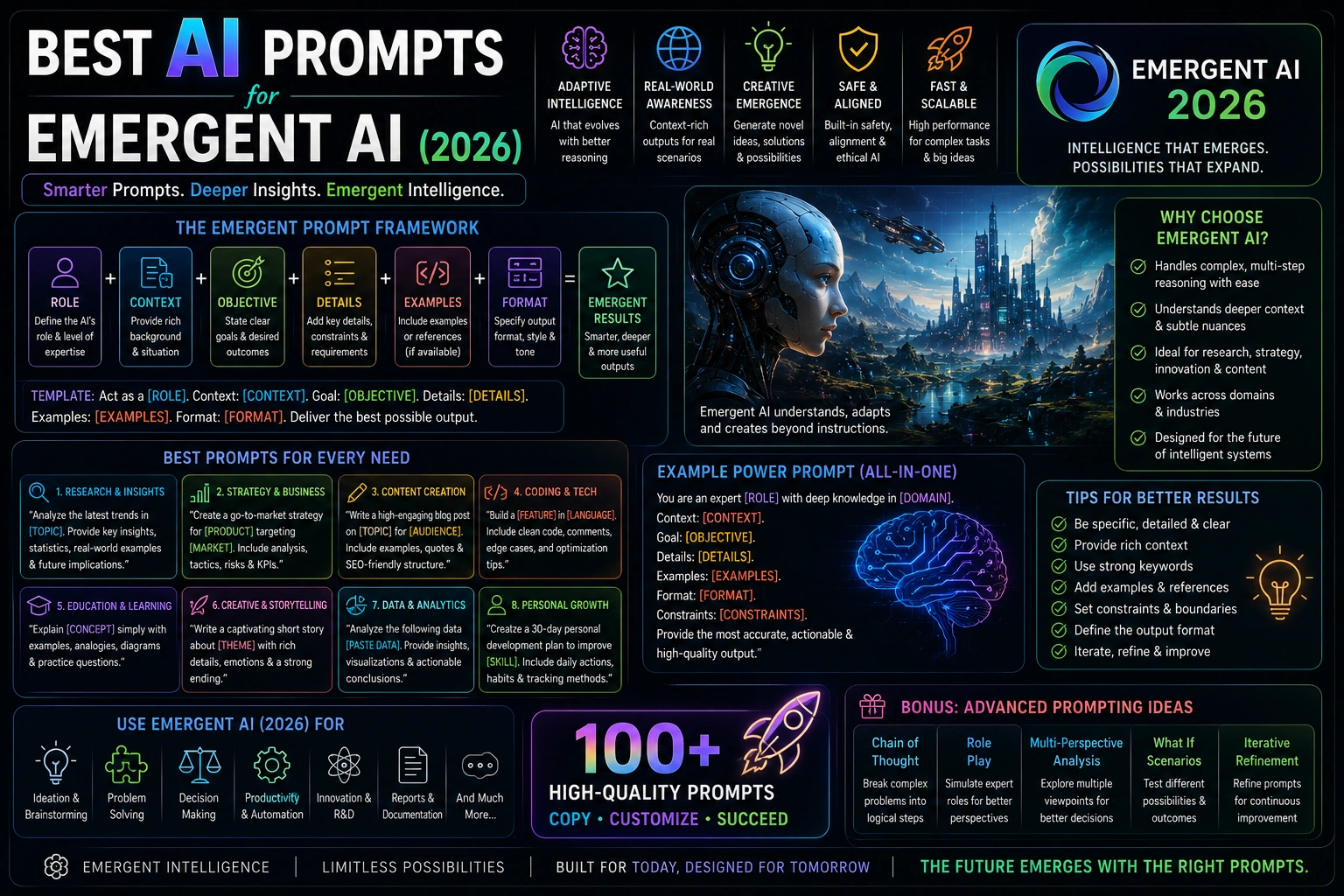
Copy 45 tested prompts for Emergent AI and agentic engineering workflows in 2026. These templates cover full-stack SaaS "vibe coding" (UI, backend APIs, MongoDB/PostgreSQL schemas, and automated E2E testing), Model Context Protocol (MCP) connectors, ReAct reflection loops, second-order causal cascades, and multi-agent research synthesis.
QUICK ANSWER: HOW TO PROMPT EMERGENT AI & AGENTIC BUILDERS IN 2026
What Makes an Effective Emergent AI & Vibe-Coding Prompt?
When prompting autonomous app builders and multi-agent systems (such as Emergent, Cursor/Windsurf agents, or LangGraph/AutoGen), structure your instruction in 4 stages: 1. Plan-Before-Build Gate (require an architecture blueprint and file/schema inventory before generating code), 2. Full-Stack Contract (explicitly define frontend states, API routes, DB indexes, and auth roles), 3. Bounded Autonomy & MCP Rules (cap retry loops and gate destructive or external actions behind human approval), and 4. Self-Verification (run automated E2E user-journey and boundary tests before marking the task complete).
Updated for Nov 2026 Agentic Builders 45 Full-Stack, Agent & Systems Templates MCP, MongoDB & ReAct Loop Ready Free 1-Click Copy
Turn a product concept into a complete full-stack SaaS app with auth, RBAC, database schema, and billing hooks.
Build a production-ready full-stack SaaS application for: [describe SaaS product idea, target user, and core workflow].
Execute in 3 verifiable phases:
1. Phase 1 (Architecture Blueprint First): Output the database schema (collections/tables, indexes, relations), REST/RPC API route contract, and component tree. Wait for my approval if any requirement is ambiguous.
2. Phase 2 (Full-Stack Implementation): Build the responsive frontend, JWT/session authentication, role-based user dashboard, admin panel, and subscription/webhook handlers with loading skeletons and empty/error states.
3. Phase 3 (End-to-End Verification): Run backend API and frontend user-journey checks to verify signup, core CRUD operations, and permission guards before presenting the build.
Pro Emergent Workflow Tip: Requiring Phase 1 (Architecture Blueprint) before full-stack code generation prevents agentic builders from hardcoding mock arrays instead of wiring real database persistence.
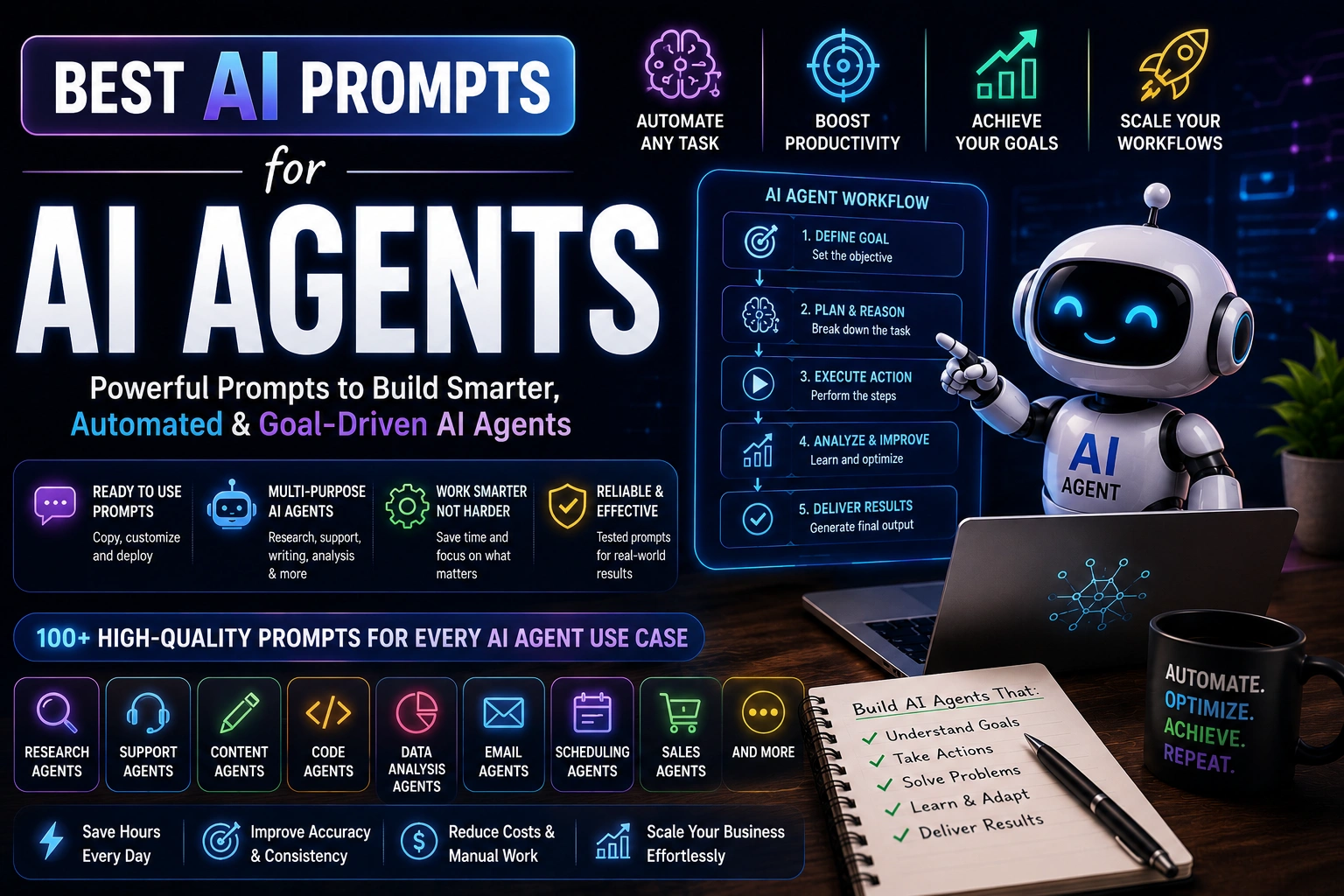
2. Autonomous Multi-Tool AI Agent Builder
AI AGENTS
Architect an autonomous agent with short/long-term memory, bounded retry loops, and human approval gates.
Build an autonomous AI agent designed to accomplish: [objective].
Equip the agent with:
1. State & Memory Schema: Short-term working scratchpad and persistent task state log.
2. Scoped Tool Layer: Define exact input/output JSON schemas, timeouts, and error-recovery fallbacks for each allowed tool: [list tools/APIs].
3. Bounded Execution Loop: Decompose complex requests into atomic sub-tasks (capped at max [5] iterations per step) and verify tool outputs before advancing.
4. Human-in-the-Loop Gate: Pause and require explicit user approval before executing any state-mutating, external messaging, or financial action.
Pro Emergent Workflow Tip: Always cap autonomous agent loops at 3–5 retries per step so a failing third-party API never triggers an infinite token-burning loop.
3. Idea-to-Production Vibe Coding Specification
VIBE CODING
Transform a natural-language product vision into a working, tested application with zero dead-end buttons.
Turn this product idea into a complete, working full-stack application: "[describe app idea and main user goal]".
Follow these strict Vibe-Coding quality rules:
1. No Dead UI: Every button, filter, modal, and form input rendered in the UI must be wired to working state and backend persistence (zero placeholder `alert()` or dead links).
2. Design System: Use a cohesive dark/light color palette, consistent 8px spacing grid, responsive mobile breakpoints, and clear toast notifications on user actions.
3. Seed Data & Smoke Test: Pre-populate realistic sample data so the dashboard looks alive on first load, and test the primary user flow end-to-end before finishing.
Pro Emergent Workflow Tip: Explicitly banning "dead UI buttons and un-wired modals" is the #1 rule for getting shippable apps from natural-language vibe coding.
4. Interactive Operations & KPI Business Dashboard
WEB APP
Build a real-time analytics and operations dashboard with date-range filtering, CSV export, and role views.
Build a responsive Business Operations Dashboard for [business type] connected to [data source / schema]:
1. Executive KPI Strip: 4 top-level metric cards showing current value, period-over-period `%` delta badge, and sparkline trend.
2. Interactive Visuals & Drill-Down: Time-series revenue/activity chart and category breakdown that dynamically re-render when the user changes the Date Range (`7d / 30d / 90d / Custom`) or Status filter.
3. Data Table: Searchable, sortable, paginated data table with inline status updates, CSV export, empty-search state, and loading skeletons.
Pro Emergent Workflow Tip: Ensure your chart components and data table share a single URL-synced filter state (`?range=30d&status=active`) so users can bookmark filtered views.
5. RAG Knowledge Base App with Citation & Stale-Doc Admin
AI APPS
Build a full-stack Retrieval-Augmented Generation (RAG) portal with chunk citations and admin document management.
Build an AI Knowledge Base & RAG application for [company / domain]:
1. Document Ingestion Pipeline: Admin upload interface supporting PDF/Markdown/text, semantic chunking with overlap, metadata tagging (`department`, `updated_at`), and vector indexing.
2. Grounded Chat Interface: Answer user questions strictly using retrieved chunks, displaying clickable inline source badges (`[Doc Title, Section]`) and a confidence indicator.
3. Hallucination & Freshness Guardrail: If retrieval similarity falls below threshold, reply `"Not found in current documentation"` and log the unanswered query in an Admin Gap-Analysis table for content updates.
Pro Emergent Workflow Tip: Logging unanswered low-confidence queries into an "Admin Gap-Analysis table" tells you exactly which missing help articles to write next.
6. Model Context Protocol (MCP) Tool-Connected Application
MCP
Build an AI application that connects to external services via standardized MCP server tool contracts.
Build an MCP-connected AI application for [use case] integrating with [external tools/services]:
1. MCP Tool Contract: Define strict JSON Schema input parameters, read-only vs. write-capable scopes, and timeout limits for each MCP tool.
2. Transparent Execution Log: Render a collapsible "Agent Tool Activity" drawer in the UI showing the exact tool called, arguments passed, and latency.
3. Security & Approval Gate: Keep API credentials strictly in server-side environment variables, sanitize untrusted tool outputs against prompt injection, and require a user confirmation modal before any destructive or external write call.
Pro Emergent Workflow Tip: Rendering a collapsible "Agent Tool Activity" drawer in the UI builds instant user trust and makes debugging failed MCP tool calls effortless.
Upgrade a specific screen's typography, spacing, and visual hierarchy without breaking existing API or state bindings.
Redesign the visual UI of [target screen / component] in [application] while keeping 100% of existing state hooks, event handlers, and API calls untouched:
1. Visual Hierarchy & Layout: Upgrade typography scale, card contrast, border radii, and responsive grid alignment for desktop (`1440px`) and mobile (`375px`).
2. Micro-Interactions & Accessibility: Add clear hover/focus-visible states, button loading spinners during async calls, and WCAG 2.2 AA color contrast.
3. Regression Check: Verify that all existing form submissions, props, and navigation routes continue to function identically after styling changes.
Pro Emergent Workflow Tip: Explicitly stating "keep 100% of existing state hooks, event handlers, and API calls untouched" prevents visual edits from accidentally wiping out working backend logic.
8. Production MongoDB Atlas & Relational Schema Architect
Design and implement the production database layer for [application] using [MongoDB Atlas / PostgreSQL / Supabase]:
1. Schema & Validation: Define all collections/tables with strict field types, required constraints, enum validations, and `createdAt`/`updatedAt` timestamps.
2. Query-Driven Indexing: Create compound indexes (following the ESR—Equality, Sort, Range—rule for MongoDB) matched to the app's top 5 read queries.
3. Multi-Tenant Access & Seeding: Enforce user/organization ownership checks on every query and write an idempotent seed script for development testing.
Pro Emergent Workflow Tip: Following MongoDB's **ESR (Equality, Sort, Range)** rule when defining compound indexes prevents slow collection scans as your app scales past 100k documents.
9. Autonomous E2E App Testing & Self-Repair Agent
TESTING
Systematically crawl user journeys, API endpoints, and edge cases to detect and patch bugs autonomously.
Run a comprehensive end-to-end QA audit and repair pass on [application]:
1. User Journey & API Test Matrix: Test authentication flows, protected routes, form validation (empty, malformed, duplicate submits), mobile viewport overflow, and HTTP 400/401/500 error handling.
2. Root-Cause Bug Fix: For every failing test or console/network error detected, trace the root cause and apply a minimal, non-breaking fix.
3. Verification Report: Re-run the test suite after patching and output a pass/fail table summarizing every issue found and resolved.
Pro Emergent Workflow Tip: Run this prompt right before deploying a vibe-coded app—testing rapid double-clicks and empty form submits catches 80% of production crashes.
Adapt a desktop web application into a touch-optimized mobile experience with bottom-sheet navigation.
Build or adapt [product] into a seamless mobile-first web and Progressive Web App (PWA) experience:
1. Mobile Navigation & Ergonomics: Replace wide desktop sidebars with a thumb-friendly bottom navigation bar, slide-up drawer modals, and minimum `44x44px` touch targets.
2. Responsive Tables & Forms: Convert wide multi-column desktop tables into stacked mobile summary cards on screens under `640px`, and use native mobile input types (`inputmode="numeric"`, `type="tel"`).
3. Offline & Network Resilience: Add optimistic UI updates, retry banners for flaky mobile connections, and a web app manifest.
Pro Emergent Workflow Tip: Converting horizontal data tables into stacked summary cards below `640px` eliminates horizontal scrollbars on mobile phones.
11. Event-Driven Business Workflow Automation Agent
AUTOMATION
Automate intake triage, data enrichment, and exception escalation with idempotent webhook handling.
Build an event-driven AI workflow automation system for [business process, e.g., service booking intake / invoice triage]:
1. Intake & Classification: Receive incoming webhook/form payloads, validate schema, and classify urgency and category using structured JSON output.
2. Idempotency & Retry Logic: Use unique event IDs so duplicate webhooks are never processed twice, and implement exponential backoff for transient downstream API errors.
3. Exception Escalation & Audit Trail: Log every state transition with timestamps, auto-execute low-risk actions, and route low-confidence or high-value exceptions to a human approval queue.
Pro Emergent Workflow Tip: Enforcing idempotency keys on webhook endpoints prevents duplicate emails or double database inserts when third-party services retry a slow request.
12. Pre-Launch Production Readiness & Security Hardening Audit
DEPLOYMENT
Run a 10-point security, environment variable, CORS, and performance audit before pushing live.
Prepare [application] for production deployment by auditing and fixing:
1. Secret & Env Hygiene: Verify zero API keys or DB credentials are hardcoded in client bundles; generate a complete `.env.example` template.
2. API Security & Rate Limiting: Check authentication middleware on all private routes, input sanitization, CORS allowlists, and rate limiting on login/public endpoints.
3. Build & SEO Readiness: Verify production build compiles with zero warnings, add `title`, Open Graph tags, `robots.txt`, and healthcheck endpoint (`/api/health`), and output a final Launch Checklist.
Pro Emergent Workflow Tip: Always check that client-side environment variables (`NEXT_PUBLIC_` or `VITE_`) never contain private database URIs or secret LLM keys before clicking deploy.
13. Proactive Always-On Operations Wingman Agent
AI ASSISTANT
Design a background operations assistant that monitors KPIs, flags stalled tasks, and drafts daily briefings.
Build a proactive Always-On Operations Assistant for [team / business]:
1. Scheduled Monitoring Loop: Poll approved data sources ([tasks, tickets, sales, or server logs]) on a defined schedule to detect overdue items, SLA risks, or metric anomalies.
2. Daily Morning Digest: Compile a concise 5-bullet briefing ranking the top 3 bottlenecks that need human attention today, along with 1-click recommended actions.
3. Permission & Approval Boundary: Respect role-based data visibility and require a 1-click `"Approve & Send"` confirmation before dispatching external messages or modifying records.
Pro Emergent Workflow Tip: Grouping notifications into a single prioritized morning digest prevents alert fatigue and keeps the assistant genuinely useful.
Map non-obvious downstream ripple effects, perverse incentives, and feedback loops from a strategic decision.
Decision / System Change to Analyze: "[describe decision, policy, or product change]".
Trace the nonlinear ripple effects across 3 horizons:
1. First-Order Effects (Immediate / Intended): Direct outcomes in Days 1–14.
2. Second-Order Cascades (Behavioral Adaptation): For each first-order effect, derive 2 downstream adaptations as users, competitors, or employees optimize around the new rule.
3. Third-Order Emergent Loops & Cobra Effects: Identify reinforcing or balancing feedback loops that could produce counterintuitive outcomes at 6–12 months, and design 2 early-warning tripwires.
Pro Emergent Workflow Tip: Modeling how participants "game the new metric" at the second order prevents Goodhart's Law failures in pricing and KPI design.
Evaluate a high-stakes AI, product, or policy dilemma across competing ethical and risk frameworks.
Dilemma / High-Stakes Trade-Off: "[describe scenario and competing stakeholder interests]".
1. Three-Lens Evaluation Table: Analyze the decision independently through **Consequentialist / Utilitarian** (net aggregate impact), **Deontological / Rights-Based** (hard rules, consent, and duty), and **Virtue / Trust Ethics** (long-term institutional integrity).
2. Blind-Spot Critique: State the primary failure mode of each framework if applied in isolation.
3.Pareto Meta-Solution: Propose a concrete operational design with guardrails that satisfies the core constraints of all three frameworks.
Pro Emergent Workflow Tip: Using a structured 3-lens table turns vague "AI ethics" discussions into concrete engineering constraints and consent gates.
Simulate a 5-round multi-party negotiation where each agent optimizes private utility constraints and BATNAs.
Simulate a 5-round strategic negotiation between 3 agents:
- **Agent A**: [Role, public goal, private walk-away BATNA, hidden agenda]
- **Agent B**: [Role, public goal, private walk-away BATNA, hidden agenda]
- **Agent C**: [Role, public goal, private walk-away BATNA, hidden agenda]
1. Run 5 rounds of explicit offers, counteroffers, and coalition-building moves.
2. Game-Theory Debrief: Reveal how the hidden agendas shaped the emergent equilibrium (Nash equilibrium vs. Pareto suboptimal stalemate) and tell me the optimal opening move for [my side].
Pro Emergent Workflow Tip: Assigning each simulated party a quantitative walk-away BATNA reveals which coalition will form before you enter a real negotiation.
17. System Dynamics Causal Loop Diagram (CLD) & Leverage Finder
SYSTEMS ANALYSIS
Convert a messy operational problem into a polarity-labeled Causal Loop Diagram and Donella Meadows leverage points.
System Problem Description: "[paste description of recurring business, engineering, or economic bottleneck]".
1. Variable & Link Polarity Table: Extract the core stocks, flows, and variables, mapping causal links with `+` (same direction) or `-` (opposite direction) polarity.
2. Reinforcing (`R`) vs. Balancing (`B`) Loops: Trace the closed feedback loops driving exponential growth, runaway burnout/debt, or stagnation, and output a valid `mermaid` flowchart.
3. Leverage Points: Rank the top 3 intervention points using Donella Meadows' hierarchy (information flows, rules, delays, feedback gain).
Pro Emergent Workflow Tip: Pasting the generated `mermaid` causal loop diagram into Notion or GitHub gives your team a shared visual map of why quick fixes keep failing.
Model a counterfactual historical or market divergence by propagating structural, economic, and technological constraints.
Point of Divergence (What-If): "What if [specific historical, technological, or market event] had occurred differently at [date]?"
1. Constraint-Grounded Timeline: Construct a stage-by-stage timeline from the divergence point to 2026, anchoring every shift in real supply-chain, demographic, physical, or economic constraints (no hand-waving).
2. Second-Order Tech & Market Winners: Identify which industries or architectures would have accelerated vs. stalled.
3. Plausibility Audit: Rate the probability of each branch and identify the strongest "attractor state" that would pull history back toward our actual timeline.
Pro Emergent Workflow Tip: Asking for "attractor states that pull the system back" separates rigorous structural forecasting from wishful sci-fi storytelling.
Generate resilient Python/Node.js service patterns with half-open circuit breakers, jittered backoff, and auto-rollback.
Design and implement a self-healing service layer in [Python FastAPI / Node.js TypeScript] for [critical workflow]:
1. Circuit Breaker State Machine: Implement `CLOSED -> OPEN -> HALF_OPEN` transitions with configurable failure thresholds and recovery probes so cascading downstream timeouts are isolated immediately.
2. Jittered Exponential Backoff & Dead-Letter Queue (DLQ): Handle transient network faults safely and route poisoned payloads to a DLQ for inspection.
3. Health & Auto-Recovery Hook: Include a liveness/readiness probe endpoint that triggers graceful connection-pool recycling when latency spikes.
Pro Emergent Workflow Tip: Adding randomized **full jitter** to exponential backoff retries stops all worker nodes from hammering a recovering database at the exact same millisecond (thundering herd).
Write a self-contained Python genetic algorithm with tournament selection, elitism, and convergence tracking.
Write a complete, runnable Python implementation (using `numpy`) of a Genetic Algorithm to optimize this multi-constraint problem:
[Describe optimization problem, decision variables, and hard/soft constraints, e.g., technician route scheduling or portfolio/resource allocation]
1. Chromosome Encoding & Penalty Fitness Function: Define how candidate solutions are encoded and how constraint violations are penalized.
2. Evolutionary Operators: Implement Elitism (preserving top $k\%$ solutions), Tournament Selection, Crossover, and Adaptive Mutation (increasing mutation rate if population diversity stagnates).
3. Output generation-by-generation fitness convergence logs and the final optimal parameter set.
Pro Emergent Workflow Tip: Including **Elitism** guarantees your best solution found so far is never destroyed by a random crossover step in later generations.
21. Emergent Game AI Behavior Tree & Utility System
CODING & GAME AI
Combine Utility AI scoring curves with Behavior Trees so NPCs exhibit unscripted, lifelike emergent behavior.
Design and code a modular Hybrid Behavior Tree + Utility AI system in [C# Unity / C++ Unreal / TypeScript / Python] for an autonomous NPC in [game genre]:
1. Utility Scoring Curves: Define normalized `(0.0 to 1.0)` response curves (linear, quadratic, logistic) for competing drives: Survival/Health, Resource Gathering, Threat Evasion, and Social Cooperation.
2. Behavior Tree Execution: Show Selector, Sequence, and Decorator nodes with blackboard state sharing and hysteresis (preventing rapid state-thrashing between two close utility scores).
3. Walk through 2 emergent gameplay scenarios that arise naturally from these rules without hardcoding them.
Pro Emergent Workflow Tip: Adding a **hysteresis commitment bonus** (+0.15 utility to the currently active action) stops NPCs from flickering back and forth when two needs have nearly equal scores.
Implement a Reasoning + Acting (ReAct) agent with a separate Evaluator node that grades and refines answers.
Write a clean Python implementation of a **ReAct + Reflexion (Self-Critique)** agent loop for answering complex queries over [data source / codebase]:
1. Generator Node (`Thought -> Action -> Observation`): Formulates a search query, retrieves evidence, and drafts a candidate response with inline citations.
2. Critic / Evaluator Node: Scores the candidate draft `(0–100)` on Faithfulness to retrieved evidence, Completeness, and Schema Compliance.
3. Bounded Reflection Loop: If score `< 90` and `iteration < 3`, pass the Critic's specific failure feedback back to the Generator to rewrite the query and answer.
Pro Emergent Workflow Tip: Separating the **Generator prompt** from the **Critic prompt** catches 3x more hallucinations than asking a single prompt to "check its own work."
23. Neural Network Backpropagation from Scratch (NumPy + LaTeX Math)
CODING & ML
Build a multi-layer perceptron in pure NumPy with line-by-line matrix-calculus gradient derivations.
Write a pure `NumPy` implementation (zero deep-learning frameworks) of a 2-layer neural network with [ReLU / SiLU] hidden activation and [Softmax / Sigmoid] output:
1. Matrix Calculus Derivation: Above each code block in `forward()` and `backward()`, write the exact chain-rule partial derivatives ($\frac{\partial \mathcal{L}}{\partial W_2}, \frac{\partial \mathcal{L}}{\partial b_2}, \frac{\partial \mathcal{L}}{\partial W_1}$) and explicit matrix dimensions `(B, D)`.
2. Numerical Gradient Check: Include a finite-difference gradient checker ($\frac{f(\theta + \epsilon) - f(\theta - \epsilon)}{2\epsilon}$) proving analytical gradients match within $10^{-7}$.
3. Explain how the hidden layer folds the input space to form a nonlinear decision boundary.
Pro Emergent Workflow Tip: Including a finite-difference numerical gradient check is the gold-standard way to prove your custom backpropagation math has zero sign or transpose bugs.
24. Principal Architect Concurrency & Load-Failure Code Review
CODING
Audit a pull request specifically for emergent failures under 100x concurrent traffic, lock contention, and memory leaks.
Act as a Principal Systems Architect reviewing this code under a simulated 100x traffic spike:
[Paste code / PR diff]
1. Emergent Load Failures: Hunt for race conditions (TOCTOU), database connection-pool exhaustion, N+1 query amplification, unbounded in-memory caches/arrays, and missing timeouts.
2. Categorized Review Table: Group findings into **[Blocker — Will Page On-Call]**, **[Major — Degrades Performance]**, and **[Minor — Maintainability]**.
3. Provide the exact refactored code diff that resolves all Blocker and Major findings.
Pro Emergent Workflow Tip: Code that passes unit tests with 1 user often deadlocks at 500 concurrent requests—asking the model to "simulate a 100x traffic spike" surfaces race conditions immediately.
25. Ambiguous Business Question to Defensive SQL & Metric Spec
CODING & DATA
Translate a vague stakeholder question into explicit metric definitions, schema assumptions, and CTE SQL.
A stakeholder asked this ambiguous data question: "[e.g., How are our active users trending this quarter and which channel is best?]"
Database Dialect: [PostgreSQL / BigQuery / Snowflake]. Known tables: [list tables or ask to infer standard SaaS/e-commerce schema].
1. Disambiguation Contract: Define the exact mathematical formula for each ambiguous term (e.g., what counts as "Active", attribution window, timezone, churned/refunded exclusions).
2. Defensive CTE SQL: Write the production query handling duplicate events, `NULL` join keys, and division-by-zero safely.
3. Recommend the composite index needed to keep this query fast.
Pro Emergent Workflow Tip: Defining the "Disambiguation Contract" at the top of your analytics report prevents two departments from reporting conflicting numbers for the same KPI.
26. Equivalence Partitioning & Property-Based Test Generator
CODING & QA
Generate unit and property-based tests (Hypothesis / fast-check) that uncover hidden boundary bugs.
Generate a rigorous test suite in [Vitest / Jest + fast-check / Pytest + Hypothesis] for this function:
[Paste function code]
1. Equivalence Partitioning & Boundary Table: Map the input domain into valid partitions, exact boundary edges (`min`, `min-1`, `max`, `max+1`, `0`, empty, Unicode), and invalid partitions.
2. Standard Unit Tests: Cover all boundary edges and error/exception branches.
3. Property-Based Invariant Tests: Write 2 fuzz/property-based tests (`fc.property` or `@given`) asserting invariants that must hold true for *any* generated input.
Pro Emergent Workflow Tip: Property-based tests (`fast-check` in TypeScript or `Hypothesis` in Python) automatically generate hundreds of randomized inputs to find the exact minimal edge case that crashes your function.
27. Zero-Dependency TypeScript SDK Builder from OpenAPI Spec
CODING
Generate a strongly typed, retry-enabled TypeScript API client from an OpenAPI / Swagger specification.
Given this OpenAPI 3.x specification (or endpoint list):
[Paste OpenAPI JSON/YAML]
Generate a clean, fully typed TypeScript SDK client using native `fetch` (or `axios`):
1. Strict Types: Export request parameter, request body, and response interfaces for every endpoint (including discriminated unions for `2xx` vs. `4xx/5xx` error payloads).
2. Resilience Built-In: Include configurable base URL, bearer-token auth injection, `AbortSignal` request timeouts, and automatic exponential backoff on `429 / 503` responses.
3. Provide a concise copy-paste usage example for each method.
Pro Emergent Workflow Tip: Using native `fetch` with `AbortSignal.timeout()` keeps your generated SDK lightweight and compatible across Node.js 22+, Cloudflare Workers, and browser runtimes.
28. Explainable AI (XAI) SHAP/Counterfactual Feature Attribution
CODING & ML
Generate Python SHAP/LIME interpretability code and minimum-change counterfactual explanations for ML models.
We have a trained [XGBoost / LightGBM / PyTorch / scikit-learn] model predicting `[target outcome]` from these features: `[list features and types]`.
For a specific instance where the model predicted `[prediction]` with features `[feature values]`:
1. Write the Python code using `shap` (`TreeExplainer` / `KernelExplainer`) to compute local and global feature attributions and render a waterfall plot.
2. Actionable Counterfactual Recourse: Calculate and explain the **minimum feasible feature change** (respecting immutable features like age/history) required to flip the model's prediction across the decision threshold.
Pro Emergent Workflow Tip: Marking immutable features in step 2 ensures counterfactual explanations suggest actionable steps ("lower utilization by 8%") rather than impossible ones.
Mine conflicting empirical results across multiple research papers to formulate novel resolving hypotheses.
Analyze these [number] research abstracts/papers on [topic]:
[Paste abstracts or excerpts]
1. Empirical Conflict Matrix: Quote every pair of papers that report opposing effects, conflicting directional trends, or incompatible theoretical conclusions (`Paper A Claim | Paper B Claim | Hidden Moderator Variable`).
2. Resolving Hypotheses: For each conflict, formulate a testable hypothesis explaining *why* both findings occurred (e.g., non-linear U-shaped curve, sample regime boundary, measurement artifact).
3. Design 1 crucial experiment that tests your resolving hypothesis directly.
Pro Emergent Workflow Tip: The fastest way to find a publishable thesis or R&D breakthrough is to look for hidden moderator variables where Paper A says $X \to Y$ is positive and Paper B says it is negative.
30. Abductive Theory Synthesizer & Popperian Falsification Test
RESEARCH
Synthesize scattered empirical observations into a unified explanatory model with strict falsification criteria.
Here are [5–10] disparate empirical observations or anomalies from [domain]:
[List observations/data points]
1. Unified Explanatory Model: Use abductive reasoning (inference to the best explanation) to formulate a single underlying mechanism that accounts for all listed observations simultaneously.
2. Parsimony Check (Occam's Razor): List the minimum assumptions required by your model.
3. Popperian Falsification Test: Specify 2 novel, observable predictions that *must* be true if your theory is right—and state the exact experimental outcome that would prove your theory 100% false.
Pro Emergent Workflow Tip: Requiring a strict **Popperian Falsification Test** stops LLMs from generating unfalsifiable "just-so stories" that sound smart but can't be tested.
Integrate statistical effect sizes with qualitative interview themes to explain the "why" behind the numbers.
Synthesize these quantitative metrics/effect sizes and qualitative interview findings on [study topic]:
[Paste quantitative data + qualitative excerpts]
1. Mixed-Methods Joint Display Table: `Domain / Construct | Quantitative Result (N, Effect Size, p-value) | Qualitative Theme & Verbatim Quote | Meta-Inference (Convergence / Divergence / Expansion)`.
2. Divergence Analysis: Highlight any area where what participants *said* in interviews contradicts what the behavioral metrics show, and explain the gap.
Pro Emergent Workflow Tip: A **Joint Display Table** with `Convergence / Divergence / Expansion` labels is the exact format required by top mixed-methods journals and UX research reports.
Evaluate an invention disclosure against prior-art references across independent claim elements.
Invention Disclosure: "[describe technical mechanism and components]".
Known Prior-Art References: "[paste prior-art summaries or enable search]".
1. Element-by-Element Claim Chart: Break the invention into independent claim elements (`Element A, B, C, D`) and map which elements are disclosed in Prior Art 1 vs. Prior Art 2.
2. Non-Obviousness / Inventive Step Analysis: Evaluate whether combining Prior Art 1 + Prior Art 2 yields an unexpected synergistic result or teaches away from the combination.
3. Draft 1 broad Independent Method/System Claim and 3 narrowing Dependent Claims focusing on the novel technical delta.
Pro Emergent Workflow Tip: Mapping invention features into an **Element-by-Element Claim Chart** isolates the exact novel sub-component your patent attorney should emphasize.
Reconcile database screening counts and generate a PRISMA 2020 flow diagram in Mermaid.js.
Using our systematic review screening numbers:
- Records identified per database: [e.g., PubMed = X, IEEE = Y, Scopus = Z]
- Duplicates removed: [N]
- Title/Abstract exclusions: [N]
- Full-text articles assessed & excluded by reason: [list reasons and counts]
1. Arithmetic Reconciliation Check: Verify that all stage additions and subtractions balance to the exact final included study count (`n = ...`), flagging any math discrepancy.
2. PRISMA 2020 Mermaid Diagram: Output a copy-ready `mermaid` flowchart following official PRISMA 2020 boxes.
3. Write the formal Results narrative paragraph reporting the selection process.
Pro Emergent Workflow Tip: Running an **Arithmetic Reconciliation Check** first catches the #1 reason systematic review manuscripts get sent back by journal editors (mismatched exclusion counts).
Build an emergent theoretical model from raw field notes or transcripts using Strauss & Corbin grounded theory.
Analyze this raw qualitative dataset / transcript using Grounded Theory:
[Paste transcript or field notes]
1. Stage 1 (Open Coding): Extract line-by-line in-vivo and descriptive codes grounded strictly in participant actions and language.
2. Stage 2 (Axial Coding Paradigm): Connect open codes into categories across: **Causal Conditions**, **Core Phenomenon**, **Context / Intervening Conditions**, **Action/Interaction Strategies**, and **Consequences**.
3. Stage 3 (Selective Coding): Synthesize the single overarching Core Category and output a hierarchical Code Tree.
Pro Emergent Workflow Tip: Structuring Stage 2 around the 5-part **Axial Coding Paradigm** turns flat tag lists into a dynamic process model explaining *how* and *why* behaviors happen.
Cross two uncorrelated macro uncertainties to map four distinct future worlds and leading indicator signposts.
Focal Trend / Industry: "[describe technology or market]". Time Horizon: [2030 / 2035].
1. Critical Axes Selection: Identify the 2 highest-impact, highest-uncertainty drivers that are independent of each other, and cross them into a **2x2 Scenario Matrix** (4 named future worlds—avoid a simplistic "Good vs. Bad" axis).
2. World Profiles: For each of the 4 quadrants, detail Market Structure, Winner Business Models, and Regulatory Reality.
3. Leading Signpost Radar: List 2 concrete observable events in the next 12–18 months that signal we are shifting toward each quadrant.
Pro Emergent Workflow Tip: Crossing two independent uncertainties (e.g., *Compute Centralization* vs. *Regulatory Liability*) creates 4 genuinely strategic futures rather than lazy optimism vs. pessimism.
Design an adaptive trial or product experiment with interim stopping rules and alpha-spending controls.
Design an Adaptive Experimental Protocol for testing [hypotheses / variants] on [target metric]:
1. Interim Checkpoints & Stopping Rules: Define exact sample-size checkpoints ($25\%, 50\%, 75\%$ of $N$) with pre-specified rules for **Early Efficacy Stopping** and **Futility Dropping** of underperforming arms.
2. Type-I Error Control: Specify the alpha-spending function (O'Brien-Fleming or Pocock boundaries) or Thompson Sampling allocation rules so peeking at interim data does not inflate false-positive rates.
3. Output a decision-rule table for the engineering/research team.
Pro Emergent Workflow Tip: Using **O'Brien-Fleming boundaries** lets you drop losing experiment variants early without invalidating your $p$-value through mid-test peeking.
Grade a scientific or technical claim by study tier (Meta-Analysis vs. RCT vs. Observational vs. Preprint).
Evaluate the evidentiary strength behind this claim:
"[Insert scientific, health, economic, or technical claim]"
1. Evidence Pyramid Breakdown: Separate supporting and refuting evidence by methodological tier: (Level 1) Systematic Reviews / Meta-Analyses, (Level 2) Randomized Controlled Trials / Controlled Benchmarks, (Level 3) Observational Cohort Studies, and (Level 4) Animal/In-Vitro, Unreviewed Preprints, or Expert Anecdote.
2. Effect Size vs. Hype: State the actual magnitude of the effect (absolute vs. relative risk/gain), not just whether $p < 0.05$.
3. Final GRADE Confidence Score (`High / Moderate / Low / Very Low`).
Pro Emergent Workflow Tip: Separating Level 1/2 human RCTs from Level 4 rodent/in-vitro studies immediately exposes overhyped headlines.
38. Cross-Lingual Literature & Non-English Blind-Spot Synthesizer
RESEARCH
Compare research abstracts across English, Chinese, Spanish, German, or Hindi/Japanese to uncover regional findings.
Synthesize these multilingual research excerpts/abstracts on [topic]:
[Paste abstracts across multiple languages]
1. Cross-Lingual Concept Alignment: Map equivalent technical terms across languages where direct translations differ.
2. Blind-Spot Discovery: Identify empirical findings, datasets, or engineering approaches reported in the non-English papers that are overlooked in English-only reviews.
3. Output a unified English synthesis table citing the original language and methodology of each source.
Pro Emergent Workflow Tip: In hardware, battery chemistry, agriculture, and regional economics, cross-lingual synthesis uncovers years of empirical data missed by English-only keyword searches.
Extract tacit perceptual cues, heuristics, and diagnostic rules from a senior domain expert.
We want to codify the tacit diagnostic expertise of a senior [role, e.g., HVAC/appliance master technician, ICU clinician, staff SRE, or structural engineer] troubleshooting [complex scenario]:
1. Task Diagram & Perceptual Cues: Identify the subtle visual, auditory, or telemetry signals an expert notices in the first 60 seconds that a novice misses.
2. Cognitive Demands Table: `Diagnostic Step | Why It Is Difficult | Common Novice Mistake | Expert Heuristic / Rule-of-Thumb | Verification Check`.
3. Convert the expert's mental model into a deterministic troubleshooting decision tree.
Pro Emergent Workflow Tip: Contrasting "Common Novice Mistake" against "Expert Perceptual Cue" is the fastest way to turn a senior technician's intuition into a training SOP or AI agent prompt.
40. Prospective Hindsight Pre-Mortem ("Why Did Our Project Fail?")
SYSTEMS ANALYSIS
Assume your launch failed 12 months from now and work backward to engineer preventive tripwires today.
Project / Launch Plan: "[describe architecture, GTM plan, timeline, and team setup]".
Imagine it is November 2027 and this project has failed catastrophically.
1. Forensic Post-Mortem Narrative: Write a blunt, realistic engineering and business post-mortem explaining the exact sequence of ignored warning signs, technical debt, and market miscalculations that killed it.
2. Top 5 Root Causes Table: `Failure Cause | Early Warning Sign in Month 1 | Preventive Tripwire to Add This Week`.
3. Identify the single "Polite Lie" the team is currently telling itself.
Pro Emergent Workflow Tip: Asking for "the single Polite Lie the team is telling itself" surfaces unspoken timeline or distribution risks immediately.
Use Fritz Zwicky's Morphological Analysis to explore non-obvious product architectures under hard constraints.
Design Objective: "[describe product, hardware, or software system]".
Hard Constraints: "[cost ceiling, weight/latency limit, material/stack rules, environment]".
1. Zwicky Morphological Box: Break the system into 4–5 independent functional sub-dimensions and list 4 distinct physical/technical mechanisms for each row.
2. Cross-Combination Generation: Synthesize 3 non-obvious, high-scoring combinations across the matrix that satisfy all hard constraints.
3. Evolutionary Mutation Step: Take the winning concept, apply 1 extreme constraint mutation (e.g., cut part count by 50%), and evaluate if the simplified design is superior.
Pro Emergent Workflow Tip: Building a Zwicky Morphological Box first forces the AI to explore the entire design space systematically instead of anchor-biasing on the most cliché solution.
42. Complex System Bifurcation & Tipping-Point Detector
SYSTEMS ANALYSIS
Scan operational, infrastructure, or market time-series behavior for Critical Slowing Down (CSD) and phase transitions.
System & Time-Series Behavior: "[describe system metrics, queue depths, churn, or ecological/market telemetry]".
Evaluate whether this system is approaching a nonlinear tipping point (bifurcation):
1. Early Warning Indicators (Critical Slowing Down): Check for rising lag-1 autocorrelation, increasing variance/flickering between states, and slower recovery time after minor perturbations.
2. Buffer Depletion Audit: Identify which hidden capacity buffer (retry queues, cash reserves, on-call bandwidth, trust) is silently absorbing stress right now.
3. State what the post-transition regime looks like and how to restore negative (stabilizing) feedback damping.
Pro Emergent Workflow Tip: Distributed servers and support teams often look "stable" right until their retry queue or buffer hits 100%—tracking **recovery time after minor spikes** catches the cliff before it happens.
43. AI & Autonomous Agent FMEA (Failure Mode and Effects Analysis)
SYSTEMS ANALYSIS
Build a quantitative FMEA table scored by Risk Priority Number ($S \times O \times D$) for production AI systems.
Conduct a formal **FMEA (Failure Mode and Effects Analysis)** for an AI system that performs: "[describe AI agent or ML pipeline and its production permissions]".
1. FMEA Matrix Table: Across Data Drift, Prompt Injection, Hallucinated Tool Arguments, Rate-Limit Cascade, Schema Failure, and PII Leakage, score:
- **Severity ($S$, 1–10)**
- **Occurrence ($O$, 1–10)**
- **Detection Difficulty ($D$, 1–10, where 10 = silent/undetected)**
- **RPN ($S \times O \times D$)**.
2. Sort by highest RPN and design automated deterministic guardrails that cut $O$ or $D$ in half for the top 3 failure modes.
Pro Emergent Workflow Tip: In AI systems, silent failures (`Detection Difficulty = 10`) are far more dangerous than loud crashes—always add automated schema and range assertions to lower $D$.
Forecast uncertain events by anchoring on an Outside-View reference class before applying Inside-View adjustments.
Forecasting Question: "Will [specific resolvable event] occur on or before [exact date]?"
Resolution Criteria: [define exact pass/fail condition].
Apply Philip Tetlock's Superforecasting methodology:
1. Outside View (Base Rate First): Define the broadest relevant historical reference class and calculate the historical base-rate probability ($P_{\text{base}}\%$) before looking at case-specific details.
2. Inside View Adjustments: List specific causal factors pushing the probability UP (`+X%`) and DOWN (`-Y%`) relative to the base rate.
3. Pre-Commit Signposts: State your final point probability ($0\text{–}100\%$), $80\%$ confidence interval, and 2 specific future news events that would cause you to update your forecast by $\ge 15\%$.
Pro Emergent Workflow Tip: Anchoring on the **Outside View (historical base rate)** first stops you and the AI from falling for narrative bias on ambitious project deadlines or market launches.
Generate a 5-source critical annotated bibliography evaluating internal validity, sample bias, and synthesis utility.
Create a critical Annotated Bibliography for these sources on [research question]:
[Paste citations and abstracts/excerpts]
For each source, structure the entry into 4 distinct blocks:
1. Verified Citation Header (mark any missing volume/DOI field as `[MISSING]`—never invent numbers).
2. Core Thesis & Empirical Method (2 sentences).
3. Methodological & Bias Critique (2 sentences evaluating sample size, confounders, measurement proxies, or funding bias).
4. Synthesis Link: Explain how this paper's findings connect to or challenge the other sources in this bibliography.
Pro Emergent Workflow Tip: Adding the **Synthesis Link** block at the end of each entry turns a disconnected list of summaries into a ready-to-draft literature review chapter.
EMERGENT AI & AGENTIC SYSTEMS GUIDE
1. Optimizing Your Emergent AI, Vibe-Coding, and Complex Systems Workflow
Start with a bounded objective, an explicit system contract, known constraints, and measurable acceptance criteria. Separate **Architecture Planning**, **Implementation**, **Automated Testing**, and **Human Approval** into explicit stages. For full-stack vibe coding and multi-agent tasks, define each module's data schema, permitted MCP tools, and handoff rules before generating code.
Require a **Phase 1 Architecture & Schema Blueprint** before full-stack code generation.
Ensure every rendered UI button, modal, and filter is wired to real state and backend persistence.
Set strict iteration, token, and timeout limits on autonomous reflection loops.
Compare multi-agent outputs against a single-prompt baseline to verify that added orchestration improves accuracy.
Specify the environment & schema: Define database collections/tables, API contracts, available observations, and termination conditions.
Scope MCP & tool permissions: Grant read-only access by default and gate destructive, financial, or external messaging actions behind a human `"CONFIRM"` checkpoint.
Separate Generator and Critic roles: Use an independent Evaluator/Critic prompt (Prompt #22) to score outputs against a rubric before returning the final result.
Run automated E2E verification: Test happy paths, empty states, malformed inputs, and concurrent load before deployment.
3. The Science Behind Emergent Behavior, Feedback Loops, and Nonlinear System Dynamics
Emergent system behavior arises when multiple components or agents interact under local incentives. Reinforcing feedback loops (`R`) amplify small initial advantages or errors into exponential runaways, while balancing loops (`B`) resist change and create plateaus. Mapping systems via Causal Loop Diagrams (Prompt #17) and FMEA Risk Priority Numbers (Prompt #43) exposes hidden single points of failure before they cascade in production.
AI Prompt Templates for Unlocking Emergent Capabilities
These 45 prompt templates are engineered for full-stack vibe coding, autonomous AI agents, MCP tool integrations, resilient software architecture, and complex systems analysis. Copy any template above, replace the bracketed placeholders with your specific constraints, and verify the output against your test suite.
About the Author
Adnan Khan
Founder of I Love AI Prompt • AI Prompt Researcher • Prompt Engineering Specialist
Hi, I'm Adnan Khan, the founder of I Love AI Prompt. I research, test, and publish AI prompts for creators, developers, marketers, designers, students, and businesses. Every prompt on this website is reviewed and refined to improve output quality, consistency, and usability across today's leading AI tools.
This guide was created by testing full-stack agentic app builders, MCP tool workflows, ReAct reflection loops, and complex systems analysis prompts across modern reasoning models.
Frequently Asked Questions
What was updated on this page for November 2026?
This page was updated on November 10, 2026 with a 2026 Emergent AI & Agentic Architecture Matrix, expanded multi-step specifications across all 45 prompts, unique implementation tips for full-stack vibe coding, MCP connectors, and ReAct loops, fixed category filter buttons, and synchronized JSON-LD schema.
What are the best AI prompts for Emergent AI and vibe coding in 2026?
The best prompts for Emergent AI and agentic app builders require a Phase 1 architecture and database schema plan before coding, mandate that every UI button and modal is wired to real backend persistence, and include an automated end-to-end verification pass before completion.
Do these Emergent AI prompts work with Cursor, Windsurf, Claude, and ChatGPT?
Yes. Prompts #1–#13 and #19–#28 work directly in Emergent, Cursor, Windsurf, Roo Code, and Claude Code, while the systems analysis and research templates (#14–#18, #29–#45) excel on OpenAI o-series, Claude Opus/Sonnet, DeepSeek-R1, and Gemini Pro.
How do I prevent autonomous AI agents from getting stuck in infinite loops?
Always set an explicit maximum iteration cap (such as max 3–5 retries per step), define a fallback error state when a tool returns empty or 429/500 responses, and require human-in-the-loop approval before irreversible actions (see Prompts #2, #6, and #22).
Are these prompts suitable for beginners building their first full-stack app?
Yes. Prompts #1, #3, #4, #8, and #12 guide the AI to make sensible full-stack architecture decisions, generate seed data, and audit security settings automatically—simply replace the bracketed placeholders with your app idea.
Should I verify code and forecasts generated by Emergent AI workflows?
Always. Run generated applications and database migrations in a staging environment first, verify that no API secrets are exposed in client-side bundles (Prompt #12), and validate research or forecasting claims against primary data.
Related Guides
You May Also Like
Explore related prompt guides selected for this topic.