Explore This Guide
Jump directly to any section of this article.
AI Prompts for Blog Content, Keyword Strategy & SEO Growth
Select a category or browse all blogging and SEO prompts below
1. Query Fan-Out & Conversational Keyword Clustering
SEOCluster topics the way AI Mode breaks one long question into many sub-searches.
Act as an SEO strategist. Build a keyword and query cluster for the topic [topic] and audience [audience].
Include:
1\) Primary keyword
2\) 10 long, conversational questions a person might type or speak into an AI search box
3\) For each question, the 3-4 sub-questions an AI system would likely search to answer it (query fan-out)
4\) Search intent for each (informational/commercial/transactional/local)
5\) A flag for queries likely to be answered fully in an AI response versus queries that still need a
click-through
6\) The page type best suited to each cluster (guide, comparison, tool, service page)
7\) Estimated difficulty (low/medium/high)
Group by subtopic for a content hub.
Act as an SEO strategist. Build a keyword and query cluster for the topic [topic] and audience [audience].
Include:
1\) Primary keyword
2\) 10 long, conversational questions a person might type or speak into an AI search box
3\) For each question, the 3-4 sub-questions an AI system would likely search to answer it (query fan-out)
4\) Search intent for each (informational/commercial/transactional/local)
5\) A flag for queries likely to be answered fully in an AI response versus queries that still need a
click-through
6\) The page type best suited to each cluster (guide, comparison, tool, service page)
7\) Estimated difficulty (low/medium/high)
Group by subtopic for a content hub.
Recommended Tech Stack
ChatGPT (GPT-4o), Claude 3.5 Sonnet, Surfer SEO, SEMrush, WordPress, Google Search Console.
Quick Implementation Guide
- Input the prompt specifying target keywords, search intent, word count, and structured headings (H2/H3).
- Review the generated draft for keyword relevance, E-E-A-T (Experience, Expertise, Authoritativeness, and Trustworthiness) alignment, factual accuracy, originality, and engaging formatting.
- Optimize the post with relevant internal links, an accurate meta description, and structured data only where appropriate and consistent with visible content; publish it in your CMS and monitor indexing and performance.
Real-World Use Case Example
Use these workflows to structure programmatic SEO content outlines, draft compelling and accurate meta tags, or expand niche topical-authority clusters around distinct search intents to attract relevant organic traffic.
2. AI Mode-Ready Blog Outline Generator
CONTENTOutline that covers the main question and its likely follow-ups with original value.
Create a detailed SEO blog outline for [primary keyword].
Include:
\- SEO title (under 60 characters) and meta description (under 155 characters)
\- H2/H3 structure that answers the main question first, then the likely follow-up questions an AI system would
ask
\- A direct answer in the first sentence of every section
\- For each section, one piece of original value the writer must add (first-hand experience, own data, example,
photo, or expert quote)
\- Short paragraphs (under 3 lines) and one table or list where it helps
\- Internal linking opportunities with descriptive anchor text
\- A list of facts to verify before publishing
Do not recommend special AI-only markup or files; focus on useful, crawlable, indexable content.
Create a detailed SEO blog outline for [primary keyword].
Include:
\- SEO title (under 60 characters) and meta description (under 155 characters)
\- H2/H3 structure that answers the main question first, then the likely follow-up questions an AI system would
ask
\- A direct answer in the first sentence of every section
\- For each section, one piece of original value the writer must add (first-hand experience, own data, example,
photo, or expert quote)
\- Short paragraphs (under 3 lines) and one table or list where it helps
\- Internal linking opportunities with descriptive anchor text
\- A list of facts to verify before publishing
Do not recommend special AI-only markup or files; focus on useful, crawlable, indexable content.
Recommended Tech Stack
ChatGPT (GPT-4o), Claude 3.5 Sonnet, Surfer SEO, SEMrush, WordPress, Google Search Console.
Quick Implementation Guide
- Input the prompt specifying target keywords, search intent, word count, and structured headings (H2/H3).
- Review the generated draft for keyword relevance, E-E-A-T (Experience, Expertise, Authoritativeness, and Trustworthiness) alignment, factual accuracy, originality, and engaging formatting.
- Optimize the post with relevant internal links, an accurate meta description, and structured data only where appropriate and consistent with visible content; publish it in your CMS and monitor indexing and performance.
Real-World Use Case Example
Use these workflows to structure programmatic SEO content outlines, draft compelling and accurate meta tags, or expand niche topical-authority clusters around distinct search intents to attract relevant organic traffic.
3. Information-Gain Long-Form Blog Post
CONTENTWrite a full article that adds something competitors' pages do not.
Write a 1500-2000 word SEO blog post on [topic] targeting [primary keyword].
Before writing, list 5 things the current top results already say and 3 things they miss.
Then include a strong intro that gives the core answer in the first two sentences, H2/H3 structure, short
scannable paragraphs,
at least one original insight, example, or first-hand observation per major section (use placeholders like [add
my own data or experience here] where I must supply it),
a comparison table or numbered list where relevant, an FAQ section, internal links, and a CTA.
Write in clear, natural language for a human reader first, avoid filler and repeated phrasing, and do not invent
statistics or quotes.
Write a 1500-2000 word SEO blog post on [topic] targeting [primary keyword].
Before writing, list 5 things the current top results already say and 3 things they miss.
Then include a strong intro that gives the core answer in the first two sentences, H2/H3 structure, short
scannable paragraphs,
at least one original insight, example, or first-hand observation per major section (use placeholders like [add
my own data or experience here] where I must supply it),
a comparison table or numbered list where relevant, an FAQ section, internal links, and a CTA.
Write in clear, natural language for a human reader first, avoid filler and repeated phrasing, and do not invent
statistics or quotes.
Recommended Tech Stack
ChatGPT (GPT-4o), Claude 3.5 Sonnet, Surfer SEO, SEMrush, WordPress, Google Search Console.
Quick Implementation Guide
- Input the prompt specifying target keywords, search intent, word count, and structured headings (H2/H3).
- Review the generated draft for keyword relevance, E-E-A-T (Experience, Expertise, Authoritativeness, and Trustworthiness) alignment, factual accuracy, originality, and engaging formatting.
- Optimize the post with relevant internal links, an accurate meta description, and structured data only where appropriate and consistent with visible content; publish it in your CMS and monitor indexing and performance.
Real-World Use Case Example
Use these workflows to structure programmatic SEO content outlines, draft compelling and accurate meta tags, or expand niche topical-authority clusters around distinct search intents to attract relevant organic traffic.
4. Blog Introduction Hook Generator (Direct-Answer First)
CONTENTHooks that keep readers on the page and give AI summaries a clean answer to quote.
Write 5 different blog introduction hooks for [topic].
Include a curiosity hook, a stat-based hook (use a placeholder if a verified stat is needed), a pain-point hook,
a story-based hook, and a direct-answer hook that states the core takeaway in the very first sentence before
elaborating.
Keep each under 60 words and lead naturally into the article.
After each hook add one line explaining why a reader would keep reading instead of leaving.
Write 5 different blog introduction hooks for [topic].
Include a curiosity hook, a stat-based hook (use a placeholder if a verified stat is needed), a pain-point hook,
a story-based hook, and a direct-answer hook that states the core takeaway in the very first sentence before
elaborating.
Keep each under 60 words and lead naturally into the article.
After each hook add one line explaining why a reader would keep reading instead of leaving.
Recommended Tech Stack
ChatGPT (GPT-4o), Claude 3.5 Sonnet, Surfer SEO, SEMrush, WordPress, Google Search Console.
Quick Implementation Guide
- Input the prompt specifying target keywords, search intent, word count, and structured headings (H2/H3).
- Review the generated draft for keyword relevance, E-E-A-T (Experience, Expertise, Authoritativeness, and Trustworthiness) alignment, factual accuracy, originality, and engaging formatting.
- Optimize the post with relevant internal links, an accurate meta description, and structured data only where appropriate and consistent with visible content; publish it in your CMS and monitor indexing and performance.
Real-World Use Case Example
Use these workflows to structure programmatic SEO content outlines, draft compelling and accurate meta tags, or expand niche topical-authority clusters around distinct search intents to attract relevant organic traffic.
5. Title, Meta Description & Standalone Summary Optimizer
SEOTitles and descriptions that earn clicks and still read well if a search engine rewrites them.
Write 5 SEO title tag options (under 60 characters) and 5 meta description options (under 155 characters) for a
page about [topic] targeting [primary keyword].
Make them accurate to the page and click-worthy.
Also write a 2-sentence standalone summary placed at the top of the page that works well if a search engine uses
it instead of the meta description,
and a one-line brand-plus-benefit statement that makes sense even without the surrounding page.
Avoid clickbait, vague wording, and keyword stuffing.
Write 5 SEO title tag options (under 60 characters) and 5 meta description options (under 155 characters) for a
page about [topic] targeting [primary keyword].
Make them accurate to the page and click-worthy.
Also write a 2-sentence standalone summary placed at the top of the page that works well if a search engine uses
it instead of the meta description,
and a one-line brand-plus-benefit statement that makes sense even without the surrounding page.
Avoid clickbait, vague wording, and keyword stuffing.
Recommended Tech Stack
ChatGPT (GPT-4o), Claude 3.5 Sonnet, Surfer SEO, SEMrush, WordPress, Google Search Console.
Quick Implementation Guide
- Input the prompt specifying target keywords, search intent, word count, and structured headings (H2/H3).
- Review the generated draft for keyword relevance, E-E-A-T (Experience, Expertise, Authoritativeness, and Trustworthiness) alignment, factual accuracy, originality, and engaging formatting.
- Optimize the post with relevant internal links, an accurate meta description, and structured data only where appropriate and consistent with visible content; publish it in your CMS and monitor indexing and performance.
Real-World Use Case Example
Use these workflows to structure programmatic SEO content outlines, draft compelling and accurate meta tags, or expand niche topical-authority clusters around distinct search intents to attract relevant organic traffic.
6. Entity & Brand Authority Topic Cluster Planner
STRATEGYBuild topical authority and brand recognition together, not just keyword coverage.
Create a topic cluster plan for the pillar topic [topic] for the brand [brand].
Include:
1\) One pillar page idea
2\) 8-10 supporting cluster post ideas
3\) The key entities in this topic and how they relate (people, places, products, concepts, organizations)
4\) The signals that show the brand and author are real and trustworthy (author pages, about page, reviews,
citations, consistent profiles)
5\) Internal linking between pillar and clusters with descriptive anchor text
6\) Target keyword for each piece
7\) Three off-site mentions or partnerships that would strengthen brand recognition
Explain how this helps classic rankings and AI search citations.
Create a topic cluster plan for the pillar topic [topic] for the brand [brand].
Include:
1\) One pillar page idea
2\) 8-10 supporting cluster post ideas
3\) The key entities in this topic and how they relate (people, places, products, concepts, organizations)
4\) The signals that show the brand and author are real and trustworthy (author pages, about page, reviews,
citations, consistent profiles)
5\) Internal linking between pillar and clusters with descriptive anchor text
6\) Target keyword for each piece
7\) Three off-site mentions or partnerships that would strengthen brand recognition
Explain how this helps classic rankings and AI search citations.
Recommended Tech Stack
ChatGPT (GPT-4o), Claude 3.5 Sonnet, Surfer SEO, SEMrush, WordPress, Google Search Console.
Quick Implementation Guide
- Input the prompt specifying target keywords, search intent, word count, and structured headings (H2/H3).
- Review the generated draft for keyword relevance, E-E-A-T (Experience, Expertise, Authoritativeness, and Trustworthiness) alignment, factual accuracy, originality, and engaging formatting.
- Optimize the post with relevant internal links, an accurate meta description, and structured data only where appropriate and consistent with visible content; publish it in your CMS and monitor indexing and performance.
Real-World Use Case Example
Use these workflows to structure programmatic SEO content outlines, draft compelling and accurate meta tags, or expand niche topical-authority clusters around distinct search intents to attract relevant organic traffic.
7. Core & Spam Update Content Audit & Recovery Plan
STRATEGYAudit a site after a traffic drop without overreacting to rumors.
Act as an SEO analyst. Create a content audit and recovery plan for [website] after a traffic drop starting
around [date].
Include:
1\) How to check whether the drop lines up with a confirmed Google update (dates, affected sections, query
types)
2\) How to separate ranking loss from AI-answer click loss using impressions, clicks, and position data
3\) A page-level scorecard: helpfulness, original value, accuracy, experience signals, thin or repetitive
content, ad and layout experience
4\) Which pages to improve, merge, redirect, or remove, with criteria for each decision
5\) Site reputation and spam-policy checks (scaled content, expired domain use, third-party content)
6\) A 90-day action plan and what not to change while waiting for the next update
Do not promise recovery timelines.
Act as an SEO analyst. Create a content audit and recovery plan for [website] after a traffic drop starting
around [date].
Include:
1\) How to check whether the drop lines up with a confirmed Google update (dates, affected sections, query
types)
2\) How to separate ranking loss from AI-answer click loss using impressions, clicks, and position data
3\) A page-level scorecard: helpfulness, original value, accuracy, experience signals, thin or repetitive
content, ad and layout experience
4\) Which pages to improve, merge, redirect, or remove, with criteria for each decision
5\) Site reputation and spam-policy checks (scaled content, expired domain use, third-party content)
6\) A 90-day action plan and what not to change while waiting for the next update
Do not promise recovery timelines.
Recommended Tech Stack
ChatGPT (GPT-4o), Claude 3.5 Sonnet, Surfer SEO, SEMrush, WordPress, Google Search Console.
Quick Implementation Guide
- Input the prompt specifying target keywords, search intent, word count, and structured headings (H2/H3).
- Review the generated draft for keyword relevance, E-E-A-T (Experience, Expertise, Authoritativeness, and Trustworthiness) alignment, factual accuracy, originality, and engaging formatting.
- Optimize the post with relevant internal links, an accurate meta description, and structured data only where appropriate and consistent with visible content; publish it in your CMS and monitor indexing and performance.
Real-World Use Case Example
Use these workflows to structure programmatic SEO content outlines, draft compelling and accurate meta tags, or expand niche topical-authority clusters around distinct search intents to attract relevant organic traffic.
8. AI Search Visibility & Citation Tracking Plan
STRATEGYMeasure impressions, citations, and brand mentions across Google AI features and AI assistants.
Create a tracking plan for [website] to measure visibility in Google AI Overviews, AI Mode, and AI assistants
such as ChatGPT, Gemini, Claude, and Perplexity.
Include:
1\) A list of 30 target questions grouped by intent
2\) A monthly manual testing routine (what to record: cited or not, position, competitor citations, answer
accuracy)
3\) Search Console reports and filters to review for AI feature impressions and clicks
4\) Analytics setup for AI referral traffic and branded search growth
5\) A simple spreadsheet layout for results
6\) How to interpret changes without over-reading small samples
7\) Content actions to take when a competitor is cited and we are not
Create a tracking plan for [website] to measure visibility in Google AI Overviews, AI Mode, and AI assistants
such as ChatGPT, Gemini, Claude, and Perplexity.
Include:
1\) A list of 30 target questions grouped by intent
2\) A monthly manual testing routine (what to record: cited or not, position, competitor citations, answer
accuracy)
3\) Search Console reports and filters to review for AI feature impressions and clicks
4\) Analytics setup for AI referral traffic and branded search growth
5\) A simple spreadsheet layout for results
6\) How to interpret changes without over-reading small samples
7\) Content actions to take when a competitor is cited and we are not
Recommended Tech Stack
ChatGPT (GPT-4o), Claude 3.5 Sonnet, Surfer SEO, SEMrush, WordPress, Google Search Console.
Quick Implementation Guide
- Input the prompt specifying target keywords, search intent, word count, and structured headings (H2/H3).
- Review the generated draft for keyword relevance, E-E-A-T (Experience, Expertise, Authoritativeness, and Trustworthiness) alignment, factual accuracy, originality, and engaging formatting.
- Optimize the post with relevant internal links, an accurate meta description, and structured data only where appropriate and consistent with visible content; publish it in your CMS and monitor indexing and performance.
Real-World Use Case Example
Use these workflows to structure programmatic SEO content outlines, draft compelling and accurate meta tags, or expand niche topical-authority clusters around distinct search intents to attract relevant organic traffic.
9. Search Agent Readiness Checklist
STRATEGYForward-looking checklist for when AI agents research, compare, and book on behalf of users.
Create a checklist to prepare [website/business] for AI agents that research and complete tasks for users
(compare prices, check availability, book services).
Include:
1\) Clear, crawlable pages for pricing, services, policies, locations, and contact options
2\) Structured data and feeds that match visible page content (products, services, availability, reviews)
3\) Simple booking, quote, or enquiry flows that work without confusing pop-ups
4\) Consistent business information across the site and profiles
5\) Page speed and accessibility checks
6\) Ways to monitor and control which bots can access which content
7\) Risks to review: wrong information being quoted, price or policy mismatches, spam or fake enquiries
Prioritize the top 5 actions by impact.
Create a checklist to prepare [website/business] for AI agents that research and complete tasks for users
(compare prices, check availability, book services).
Include:
1\) Clear, crawlable pages for pricing, services, policies, locations, and contact options
2\) Structured data and feeds that match visible page content (products, services, availability, reviews)
3\) Simple booking, quote, or enquiry flows that work without confusing pop-ups
4\) Consistent business information across the site and profiles
5\) Page speed and accessibility checks
6\) Ways to monitor and control which bots can access which content
7\) Risks to review: wrong information being quoted, price or policy mismatches, spam or fake enquiries
Prioritize the top 5 actions by impact.
Recommended Tech Stack
ChatGPT (GPT-4o), Claude 3.5 Sonnet, Surfer SEO, SEMrush, WordPress, Google Search Console.
Quick Implementation Guide
- Input the prompt specifying target keywords, search intent, word count, and structured headings (H2/H3).
- Review the generated draft for keyword relevance, E-E-A-T (Experience, Expertise, Authoritativeness, and Trustworthiness) alignment, factual accuracy, originality, and engaging formatting.
- Optimize the post with relevant internal links, an accurate meta description, and structured data only where appropriate and consistent with visible content; publish it in your CMS and monitor indexing and performance.
Real-World Use Case Example
Use these workflows to structure programmatic SEO content outlines, draft compelling and accurate meta tags, or expand niche topical-authority clusters around distinct search intents to attract relevant organic traffic.
10. On-Page SEO + GEO Readiness Audit
SEOThe classic on-page checklist, plus the specific structural signals that determine whether AI systems can cite the page.
Review this blog post for on-page SEO and AI-citation readiness: [paste content or URL].
Check for:
\- Keyword usage and header structure (H1/H2/H3)
\- Meta title and description
\- Internal/external links and image alt text
\- Readability, and specifically: paragraph length (flag anything over 3-4 lines), whether conclusions are
stated explicitly rather than implied, and whether jargon terms are defined inline
\- Presence of structured data/schema markup
\- Whether the site has an llms.txt file, and if not, whether one would be worth adding
Provide a prioritized list of fixes.
Review this blog post for on-page SEO and AI-citation readiness: [paste content or URL].
Check for:
\- Keyword usage and header structure (H1/H2/H3)
\- Meta title and description
\- Internal/external links and image alt text
\- Readability, and specifically: paragraph length (flag anything over 3-4 lines), whether conclusions are
stated explicitly rather than implied, and whether jargon terms are defined inline
\- Presence of structured data/schema markup
\- Whether the site has an llms.txt file, and if not, whether one would be worth adding
Provide a prioritized list of fixes.
Recommended Tech Stack
ChatGPT (GPT-4o), Claude 3.5 Sonnet, Surfer SEO, SEMrush, WordPress, Google Search Console.
Quick Implementation Guide
- Input the prompt specifying target keywords, search intent, word count, and structured headings (H2/H3).
- Review the generated draft for keyword relevance, E-E-A-T (Experience, Expertise, Authoritativeness, and Trustworthiness) alignment, factual accuracy, originality, and engaging formatting.
- Optimize the post with relevant internal links, an accurate meta description, and structured data only where appropriate and consistent with visible content; publish it in your CMS and monitor indexing and performance.
Real-World Use Case Example
Use these workflows to structure programmatic SEO content outlines, draft compelling and accurate meta tags, or expand niche topical-authority clusters around distinct search intents to attract relevant organic traffic.
11. FAQ Section Generator (PAA + AI-Extraction Ready)
CONTENTFAQ answers written as fully self-contained chunks, since that's exactly the format both Google's PAA and AI answer engines pull from.
Generate 8 FAQ questions and concise answers for a blog post about
[topic]. Base questions on real search queries and "People Also Ask"
patterns. Keep answers under 50 words each, fully self-contained (the
answer should make sense even with no surrounding context, since AI
engines often extract just the Q&A pair on its own), and schema-ready.
Generate 8 FAQ questions and concise answers for a blog post about
[topic]. Base questions on real search queries and "People Also Ask"
patterns. Keep answers under 50 words each, fully self-contained (the
answer should make sense even with no surrounding context, since AI
engines often extract just the Q&A pair on its own), and schema-ready.
Recommended Tech Stack
ChatGPT (GPT-4o), Claude 3.5 Sonnet, Surfer SEO, SEMrush, WordPress, Google Search Console.
Quick Implementation Guide
- Input the prompt specifying target keywords, search intent, word count, and structured headings (H2/H3).
- Review the generated draft for keyword relevance, E-E-A-T (Experience, Expertise, Authoritativeness, and Trustworthiness) alignment, factual accuracy, originality, and engaging formatting.
- Optimize the post with relevant internal links, an accurate meta description, and structured data only where appropriate and consistent with visible content; publish it in your CMS and monitor indexing and performance.
Real-World Use Case Example
Use these workflows to structure programmatic SEO content outlines, draft compelling and accurate meta tags, or expand niche topical-authority clusters around distinct search intents to attract relevant organic traffic.
12. Content Refresh & AI-Citation Recovery Plan
STRATEGYRevive an old post's rankings, and diagnose whether it's also stopped getting cited in AI answers.
Create a content refresh plan for this outdated blog post: [paste content or URL].
Include:
1\) Outdated info to update
2\) New sections to add
3\) Updated keyword opportunities
4\) Improved title/meta suggestions
5\) Internal linking updates
6\) At least one new original stat, example, or first-hand data point to add, since fresh original data is one
of the strongest levers for regaining an AI citation on a topic that's since been covered more thoroughly
elsewhere
Create a content refresh plan for this outdated blog post: [paste content or URL].
Include:
1\) Outdated info to update
2\) New sections to add
3\) Updated keyword opportunities
4\) Improved title/meta suggestions
5\) Internal linking updates
6\) At least one new original stat, example, or first-hand data point to add, since fresh original data is one
of the strongest levers for regaining an AI citation on a topic that's since been covered more thoroughly
elsewhere
Recommended Tech Stack
ChatGPT (GPT-4o), Claude 3.5 Sonnet, Surfer SEO, SEMrush, WordPress, Google Search Console.
Quick Implementation Guide
- Input the prompt specifying target keywords, search intent, word count, and structured headings (H2/H3).
- Review the generated draft for keyword relevance, E-E-A-T (Experience, Expertise, Authoritativeness, and Trustworthiness) alignment, factual accuracy, originality, and engaging formatting.
- Optimize the post with relevant internal links, an accurate meta description, and structured data only where appropriate and consistent with visible content; publish it in your CMS and monitor indexing and performance.
Real-World Use Case Example
Use these workflows to structure programmatic SEO content outlines, draft compelling and accurate meta tags, or expand niche topical-authority clusters around distinct search intents to attract relevant organic traffic.
13. Blog-to-Social Repurposing
CONTENTTurn one blog post into multiple content pieces across the platforms readers actually spend time on.
Repurpose this blog post into multiple formats: [paste content].
Create:
1\) A Twitter/X thread (5-7 tweets)
2\) A LinkedIn post
3\) An Instagram carousel outline
4\) A short YouTube/Reels video script
Keep the core message and key stat/claim consistent across formats, since a claim that's repeated and cited
across multiple platforms builds the kind of consistent brand signal AI systems weigh when deciding what to
trust.
Repurpose this blog post into multiple formats: [paste content].
Create:
1\) A Twitter/X thread (5-7 tweets)
2\) A LinkedIn post
3\) An Instagram carousel outline
4\) A short YouTube/Reels video script
Keep the core message and key stat/claim consistent across formats, since a claim that's repeated and cited
across multiple platforms builds the kind of consistent brand signal AI systems weigh when deciding what to
trust.
Recommended Tech Stack
ChatGPT (GPT-4o), Claude 3.5 Sonnet, Surfer SEO, SEMrush, WordPress, Google Search Console.
Quick Implementation Guide
- Input the prompt specifying target keywords, search intent, word count, and structured headings (H2/H3).
- Review the generated draft for keyword relevance, E-E-A-T (Experience, Expertise, Authoritativeness, and Trustworthiness) alignment, factual accuracy, originality, and engaging formatting.
- Optimize the post with relevant internal links, an accurate meta description, and structured data only where appropriate and consistent with visible content; publish it in your CMS and monitor indexing and performance.
Real-World Use Case Example
Use these workflows to structure programmatic SEO content outlines, draft compelling and accurate meta tags, or expand niche topical-authority clusters around distinct search intents to attract relevant organic traffic.
14. Guest Post & Brand-Mention Pitch Email
STRATEGYBacklink outreach that also targets the unlinked brand mentions AI systems now use as a trust signal.
Write a guest post pitch email to [website/blog name] for a post about
[topic]. Include a personalized opening, 3 tailored topic ideas,
credibility points, and a simple CTA. Frame the ask as building
credibility and brand recognition (a linked or even unlinked mention on
a trusted site both help), not just a backlink for ranking purposes.
Tone: professional and non-spammy.
Write a guest post pitch email to [website/blog name] for a post about
[topic]. Include a personalized opening, 3 tailored topic ideas,
credibility points, and a simple CTA. Frame the ask as building
credibility and brand recognition (a linked or even unlinked mention on
a trusted site both help), not just a backlink for ranking purposes.
Tone: professional and non-spammy.
Recommended Tech Stack
ChatGPT (GPT-4o), Claude 3.5 Sonnet, Surfer SEO, SEMrush, WordPress, Google Search Console.
Quick Implementation Guide
- Input the prompt specifying target keywords, search intent, word count, and structured headings (H2/H3).
- Review the generated draft for keyword relevance, E-E-A-T (Experience, Expertise, Authoritativeness, and Trustworthiness) alignment, factual accuracy, originality, and engaging formatting.
- Optimize the post with relevant internal links, an accurate meta description, and structured data only where appropriate and consistent with visible content; publish it in your CMS and monitor indexing and performance.
Real-World Use Case Example
Use these workflows to structure programmatic SEO content outlines, draft compelling and accurate meta tags, or expand niche topical-authority clusters around distinct search intents to attract relevant organic traffic.
15. Author Bio & E-E-A-T Booster
CONTENTA credible author bio, now doing double duty as a trust signal AI systems use to decide whether to cite the page.
Write a short author bio (50-80 words) for a blog on [niche] that
establishes experience, expertise, authority, and trust (E-E-A-T).
Include relevant credentials, specific first-hand experience (not just
job titles), and a personal touch, since E-E-A-T signals are now one of
the main filters AI answer engines use to decide which sources are
credible enough to cite.
Write a short author bio (50-80 words) for a blog on [niche] that
establishes experience, expertise, authority, and trust (E-E-A-T).
Include relevant credentials, specific first-hand experience (not just
job titles), and a personal touch, since E-E-A-T signals are now one of
the main filters AI answer engines use to decide which sources are
credible enough to cite.
Recommended Tech Stack
ChatGPT (GPT-4o), Claude 3.5 Sonnet, Surfer SEO, SEMrush, WordPress, Google Search Console.
Quick Implementation Guide
- Input the prompt specifying target keywords, search intent, word count, and structured headings (H2/H3).
- Review the generated draft for keyword relevance, E-E-A-T (Experience, Expertise, Authoritativeness, and Trustworthiness) alignment, factual accuracy, originality, and engaging formatting.
- Optimize the post with relevant internal links, an accurate meta description, and structured data only where appropriate and consistent with visible content; publish it in your CMS and monitor indexing and performance.
Real-World Use Case Example
Use these workflows to structure programmatic SEO content outlines, draft compelling and accurate meta tags, or expand niche topical-authority clusters around distinct search intents to attract relevant organic traffic.
16. Entity-Based Internal Linking Strategy
STRATEGYInternal links that reinforce entity relationships for LLM understanding, not just anchor-text keyword optimization.
Suggest an internal linking strategy for a blog post about [topic]
on a site with these existing pages: [list URLs/topics].
Recommend anchor text, link placement, and which pages should
link to and from this post, prioritizing links that reinforce a clear
entity relationship (e.g. linking a product mention to its dedicated
page, or a term to its definition page) over generic keyword-stuffed
anchors, since this is what helps both search crawlers and LLMs map
how the topics on the site relate to each other.
Suggest an internal linking strategy for a blog post about [topic]
on a site with these existing pages: [list URLs/topics].
Recommend anchor text, link placement, and which pages should
link to and from this post, prioritizing links that reinforce a clear
entity relationship (e.g. linking a product mention to its dedicated
page, or a term to its definition page) over generic keyword-stuffed
anchors, since this is what helps both search crawlers and LLMs map
how the topics on the site relate to each other.
Recommended Tech Stack
ChatGPT (GPT-4o), Claude 3.5 Sonnet, Surfer SEO, SEMrush, WordPress, Google Search Console.
Quick Implementation Guide
- Input the prompt specifying target keywords, search intent, word count, and structured headings (H2/H3).
- Review the generated draft for keyword relevance, E-E-A-T (Experience, Expertise, Authoritativeness, and Trustworthiness) alignment, factual accuracy, originality, and engaging formatting.
- Optimize the post with relevant internal links, an accurate meta description, and structured data only where appropriate and consistent with visible content; publish it in your CMS and monitor indexing and performance.
Real-World Use Case Example
Use these workflows to structure programmatic SEO content outlines, draft compelling and accurate meta tags, or expand niche topical-authority clusters around distinct search intents to attract relevant organic traffic.
17. Listicle Blog Post Generator
CONTENTA scannable listicle format - one of the formats AI systems extract most reliably, which is exactly why it still works.
Write a "[number] Best [topic]" listicle blog post.
Include an SEO intro that states the top recommendation or key takeaway
up front, numbered items with short descriptions, a comparison table
(if relevant), an FAQ section, and a CTA.
Target keyword: [primary keyword].
Keep each list item self-contained enough to be understood if extracted
on its own, since numbered lists are pulled into AI summaries more
reliably than dense paragraph text.
Write a "[number] Best [topic]" listicle blog post.
Include an SEO intro that states the top recommendation or key takeaway
up front, numbered items with short descriptions, a comparison table
(if relevant), an FAQ section, and a CTA.
Target keyword: [primary keyword].
Keep each list item self-contained enough to be understood if extracted
on its own, since numbered lists are pulled into AI summaries more
reliably than dense paragraph text.
Recommended Tech Stack
ChatGPT (GPT-4o), Claude 3.5 Sonnet, Surfer SEO, SEMrush, WordPress, Google Search Console.
Quick Implementation Guide
- Input the prompt specifying target keywords, search intent, word count, and structured headings (H2/H3).
- Review the generated draft for keyword relevance, E-E-A-T (Experience, Expertise, Authoritativeness, and Trustworthiness) alignment, factual accuracy, originality, and engaging formatting.
- Optimize the post with relevant internal links, an accurate meta description, and structured data only where appropriate and consistent with visible content; publish it in your CMS and monitor indexing and performance.
Real-World Use Case Example
Use these workflows to structure programmatic SEO content outlines, draft compelling and accurate meta tags, or expand niche topical-authority clusters around distinct search intents to attract relevant organic traffic.
18. SEO + Original-Research Content Calendar
STRATEGYA monthly plan mixing keyword-targeted posts with original-data pieces, since keyword-volume-only content is losing ground to genuine expertise content.
Create a 30-day SEO content calendar for a blog in the [niche] industry.
Include blog topics, target keywords, content type
(guide/listicle/comparison/original-research), and publishing frequency.
Deliberately include at least 2-3 pieces built around original data,
a first-hand case study, or a proprietary survey/analysis rather than
purely synthesized keyword-target content, since AI answer engines
increasingly favor citing sources with genuine original information.
Goal: [traffic growth/lead generation/authority building].
Create a 30-day SEO content calendar for a blog in the [niche] industry.
Include blog topics, target keywords, content type
(guide/listicle/comparison/original-research), and publishing frequency.
Deliberately include at least 2-3 pieces built around original data,
a first-hand case study, or a proprietary survey/analysis rather than
purely synthesized keyword-target content, since AI answer engines
increasingly favor citing sources with genuine original information.
Goal: [traffic growth/lead generation/authority building].
Recommended Tech Stack
ChatGPT (GPT-4o), Claude 3.5 Sonnet, Surfer SEO, SEMrush, WordPress, Google Search Console.
Quick Implementation Guide
- Input the prompt specifying target keywords, search intent, word count, and structured headings (H2/H3).
- Review the generated draft for keyword relevance, E-E-A-T (Experience, Expertise, Authoritativeness, and Trustworthiness) alignment, factual accuracy, originality, and engaging formatting.
- Optimize the post with relevant internal links, an accurate meta description, and structured data only where appropriate and consistent with visible content; publish it in your CMS and monitor indexing and performance.
Real-World Use Case Example
Use these workflows to structure programmatic SEO content outlines, draft compelling and accurate meta tags, or expand niche topical-authority clusters around distinct search intents to attract relevant organic traffic.
19. Blog CTA Optimizer
CONTENTConvert the readers who do click through, since a growing share of your remaining traffic is higher-intent than before.
Write 5 CTA variations for the end of a blog post about [topic],
aimed at converting readers into [subscribers/leads/customers].
Include a soft CTA, a direct CTA, and a curiosity-based CTA. Assume
this reader clicked through past an AI summary that could have answered
their basic question already, so they're likely further along and worth
a slightly more direct ask than a typical top-of-funnel visitor.
Write 5 CTA variations for the end of a blog post about [topic],
aimed at converting readers into [subscribers/leads/customers].
Include a soft CTA, a direct CTA, and a curiosity-based CTA. Assume
this reader clicked through past an AI summary that could have answered
their basic question already, so they're likely further along and worth
a slightly more direct ask than a typical top-of-funnel visitor.
Recommended Tech Stack
ChatGPT (GPT-4o), Claude 3.5 Sonnet, Surfer SEO, SEMrush, WordPress, Google Search Console.
Quick Implementation Guide
- Input the prompt specifying target keywords, search intent, word count, and structured headings (H2/H3).
- Review the generated draft for keyword relevance, E-E-A-T (Experience, Expertise, Authoritativeness, and Trustworthiness) alignment, factual accuracy, originality, and engaging formatting.
- Optimize the post with relevant internal links, an accurate meta description, and structured data only where appropriate and consistent with visible content; publish it in your CMS and monitor indexing and performance.
Real-World Use Case Example
Use these workflows to structure programmatic SEO content outlines, draft compelling and accurate meta tags, or expand niche topical-authority clusters around distinct search intents to attract relevant organic traffic.
20. Image & Video Alt Text / Transcript Optimizer
SEOAccessibility and multimodal AI-search optimization overlap almost completely - this covers both in one pass.
Write SEO-friendly alt text and file names for [number] images used
in a blog post about [topic]. Keep alt text descriptive, under 125
characters, and naturally including relevant keywords where possible.
If the post includes any video, also draft a short transcript/caption
outline for it, since multimodal AI systems now parse video transcripts
directly, and accessible, well-captioned content consistently sees
stronger organic visibility as a byproduct.
Write SEO-friendly alt text and file names for [number] images used
in a blog post about [topic]. Keep alt text descriptive, under 125
characters, and naturally including relevant keywords where possible.
If the post includes any video, also draft a short transcript/caption
outline for it, since multimodal AI systems now parse video transcripts
directly, and accessible, well-captioned content consistently sees
stronger organic visibility as a byproduct.
Recommended Tech Stack
ChatGPT (GPT-4o), Claude 3.5 Sonnet, Surfer SEO, SEMrush, WordPress, Google Search Console.
Quick Implementation Guide
- Input the prompt specifying target keywords, search intent, word count, and structured headings (H2/H3).
- Review the generated draft for keyword relevance, E-E-A-T (Experience, Expertise, Authoritativeness, and Trustworthiness) alignment, factual accuracy, originality, and engaging formatting.
- Optimize the post with relevant internal links, an accurate meta description, and structured data only where appropriate and consistent with visible content; publish it in your CMS and monitor indexing and performance.
Real-World Use Case Example
Use these workflows to structure programmatic SEO content outlines, draft compelling and accurate meta tags, or expand niche topical-authority clusters around distinct search intents to attract relevant organic traffic.
Optimizing Your Blogging and SEO Workflow with AI
Use AI to accelerate research, outlining, drafting, and optimization without outsourcing editorial judgment. Start with verified audience questions and search intent, then use a human review to add first-hand experience, examples, and trustworthy sources.
- Map the reader’s task and search intent before choosing a keyword.
- Use AI to group related queries and propose an outline; validate demand and competition with SEO research tools.
- Draft section by section, adding real examples, original insight, citations, and clear answers.
- Review accuracy, originality, accessibility, internal links, and conversion goals before publishing.
- Track impressions, clicks, engagement, and conversions in Search Console and analytics; refresh based on evidence.
Step-by-Step Guide: Generating Rank-Ready Articles from Prompts
A useful prompt gives the model a clear audience, primary topic, search intent, content boundaries, and output structure. No prompt can guarantee rankings; the finished page must satisfy readers better than competing results and be technically accessible to search engines.
- Provide the primary keyword, audience, intent, region if relevant, and the reader’s main question.
- Request a title, concise direct answer, H2/H3 outline, related questions, evidence needs, and internal-link ideas.
- Generate a draft with placeholders for first-hand experience and facts requiring verification.
- Fact-check claims against primary or authoritative sources; remove invented statistics and unsupported expertise claims.
- Edit for usefulness and natural language, then add accurate metadata, descriptive links, image alt text, and relevant structured data that matches visible content.
- Publish, inspect the URL and indexing status, and measure results over time rather than expecting immediate ranking changes.
The Science Behind High-Ranking AI SEO and Content Prompts
Effective prompts reduce ambiguity by defining the task, context, constraints, and acceptance criteria. Search performance still depends on many factors—including relevance, usefulness, competition, technical accessibility, and reputation—so AI output should be treated as a draft, not a ranking shortcut.
- Specific context helps the model produce a more relevant outline than a vague request.
- Explicit search intent keeps the article aligned with the question the visitor wants answered.
- Evidence requirements and fact-checking reduce fabricated claims and unsupported detail.
- Original examples, experience, and data make a page more distinctive than generic summaries.
- Clear headings and self-contained answers improve usability; they do not guarantee inclusion in AI answers or featured results.
Best Practices for Optimizing and Humanizing AI-Generated Blog Posts
Humanizing a draft means making it accurate, specific, readable, and genuinely useful—not disguising authorship or trying to evade detection. Keep editorial responsibility with the publisher and disclose AI use when required by your policies, clients, or applicable rules.
- Replace generic introductions with a direct answer and a clear reason the article matters.
- Add real examples, original screenshots/data, practical limitations, or first-hand observations you can substantiate.
- Vary sentence structure naturally; remove repetition, empty transitions, and exaggerated claims.
- Verify names, dates, quotations, numbers, product details, and outbound references.
- Check tone, accessibility, grammar, internal links, and whether each section advances the reader’s goal.
- Do a final human edit and ensure the byline and credentials accurately represent the people responsible for the content.
Unlocking Advanced Keyword Clustering and Topical Authority with Expert Prompts
Topical authority is best approached as a useful, well-connected collection of pages that covers a subject in depth—not as a target score or a reason to publish large volumes of repetitive pages. Build clusters around distinct user needs and maintain a clear internal-link structure.
- Choose a pillar topic that matches your audience and business goals.
- Cluster keywords by shared intent and the page that can best satisfy each group; avoid creating near-duplicate pages for close variants.
- Map each supporting article to a unique purpose, primary query, evidence needs, and next-step links.
- Link related pages with descriptive anchor text and make the hierarchy understandable to visitors and crawlers.
- Prioritize gaps where you can add expertise or original value; merge overlapping pages where appropriate.
- Review Search Console query/page data periodically and update the cluster based on demonstrated needs.
AI Prompt Templates for High-Ranking Blogs & SEO Content
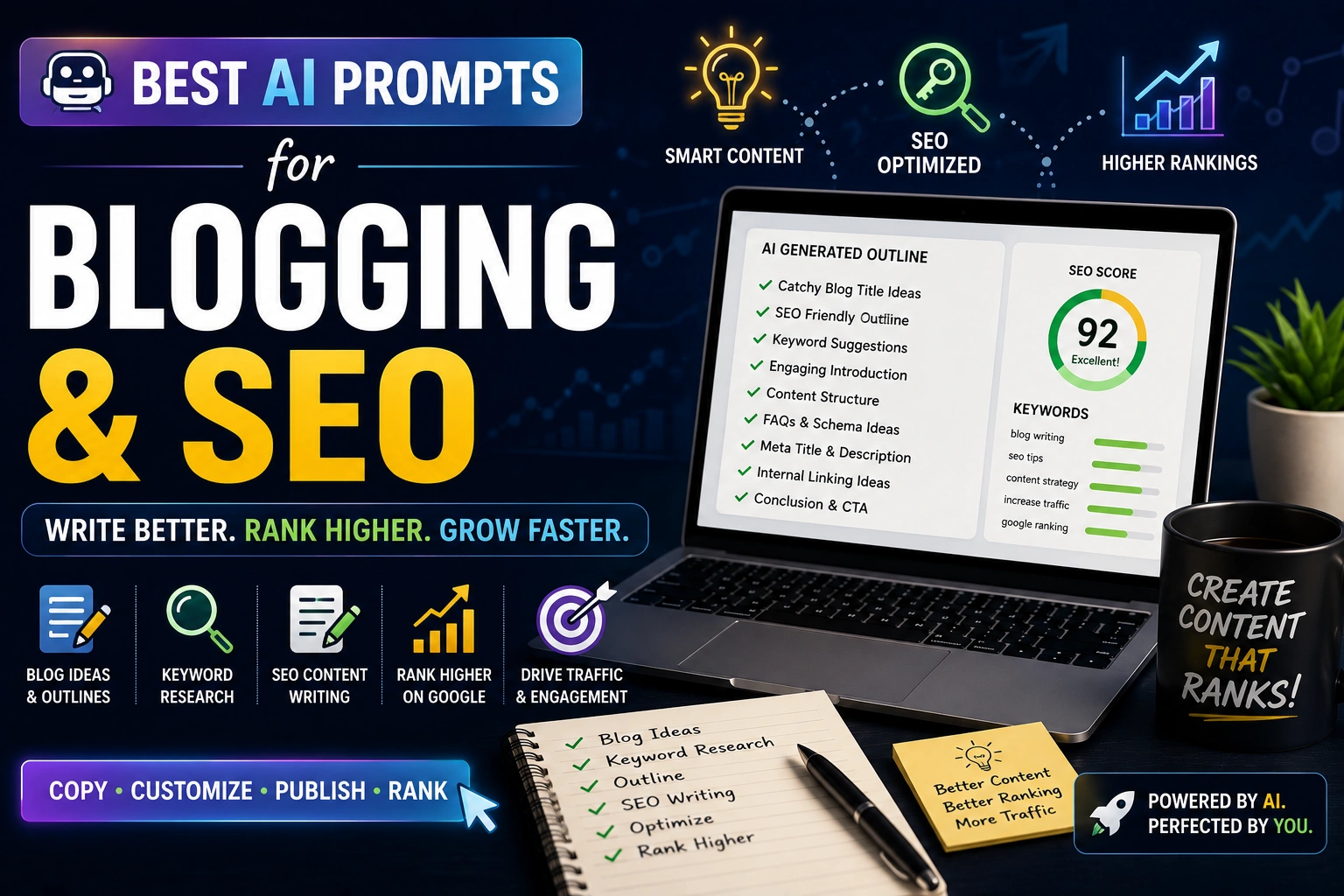
Use these AI prompt templates to create keyword-optimized blog outlines, SEO articles, meta descriptions, topic clusters, and content strategies. These prompts are designed to help bloggers and SEOs improve organic visibility, attract targeted traffic, increase reader engagement, and drive higher search rankings with the power of AI.
How Can AI Prompts Improve Blogging and SEO?
AI prompts improve blogging and SEO by helping writers create keyword-rich outlines, optimized meta titles, structured articles, and content clusters faster. They automate research and idea generation, improve on-page SEO, and enable bloggers to scale publishing while maintaining search intent and E-E-A-T standards.

Frequently Asked Questions
What was updated on this page for Oct 2026?
This page was refreshed on Oct 14, 2026 with updated prompt wording, cleaner formatting, and improved guidance so readers can quickly find the most useful AI prompt templates.
What are AI prompts for blogging and SEO?
AI prompts for blogging and SEO are text instructions that help AI create keyword-optimized outlines, blog posts, meta descriptions, and content strategies for better rankings.
Can AI prompts help with keyword research?
Yes. AI prompts can generate keyword clusters, search intent breakdowns, and topic ideas to guide your content strategy.
Are AI blogging prompts beginner-friendly?
Yes. Beginners can use AI prompts to plan blog posts, write SEO content, and structure articles without prior SEO experience.
Which AI tools work best for blogging and SEO prompts?
These prompts work well with tools like ChatGPT, Jasper, Copy.ai, Claude, and other AI writing platforms.
Can these AI prompts help improve Google rankings?
Yes. Bloggers and SEOs use these prompts to build topic clusters, optimize on-page SEO, and produce content that satisfies search intent.