Explore This Guide
Jump directly to any section of this article.
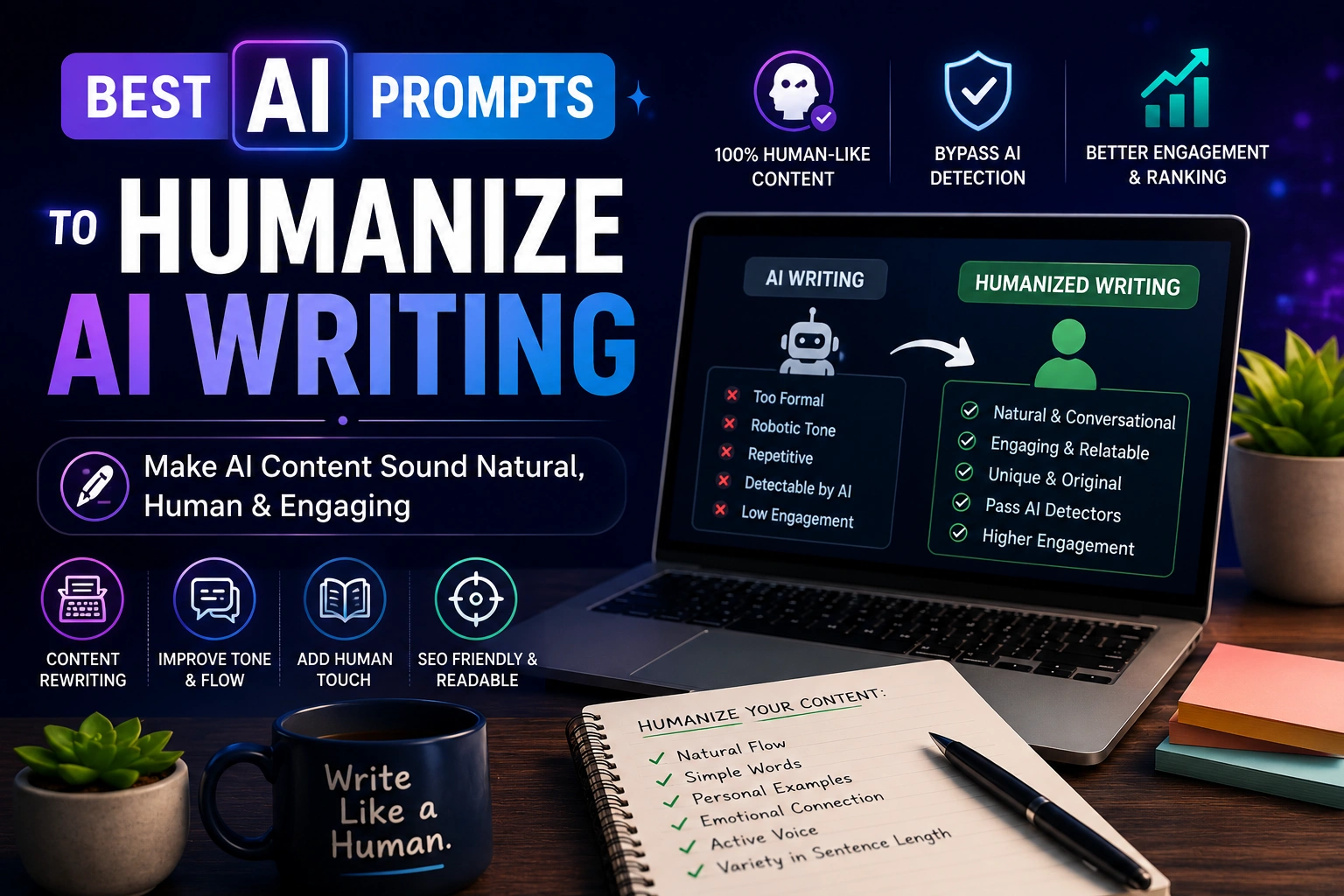
Improve AI-Assisted Writing with Natural, Authentic Editing
Choose a category or browse all 40 writing-quality prompts below
1. Natural Writing Rewrite
HUMANIZERewrite polished AI text into clear, natural everyday writing.
Rewrite this draft in a natural, conversational voice. Use clear everyday language, varied sentence
lengths, and natural transitions. Cut stock openers, repeated contrasts like "it's not just X, it's Y,"
automatic lists of three, and unnecessary summaries. Preserve the original meaning and facts, and do not
add new claims. [paste text]
Rewrite this draft in a natural, conversational voice. Use clear everyday language,
varied sentence lengths, and natural transitions. Cut stock openers, repeated contrasts like "it's not
just X, it's Y," automatic lists of three, and unnecessary summaries. Preserve the original meaning and
facts, and do not add new claims. [paste text]
Recommended Tech Stack
ChatGPT (GPT-4o), Claude 3.5 Sonnet, Originality.ai (as one imperfect signal only), Grammarly. Undetectable AI may be used for editing experiments, but do not rely on detector scores as proof of authorship or as a guarantee.
Quick Implementation Guide
- Specify the target audience, vocabulary level, sentence-length variety, and emotional tone while preserving the draft's meaning and facts.
- Apply the prompt to the draft to improve predictable phrasing, transitions, and rhythm. Add idioms or personal details only when they are authentic and appropriate.
- Review readability, verify claims and citations, and confirm the text meets the relevant academic, workplace, and publishing standards. Detector results are not guarantees.
Real-World Use Case Example
Refine a high-volume programmatic article for clearer structure and a more natural reading rhythm, or polish automated marketing copy so it sounds conversational while retaining verified facts and the brand voice.
2. Personal Voice Matcher
VOICEMake a draft match your own writing style and personality.
Study my writing samples and describe my style in 6 short points: sentence length, vocabulary,
formality, humor, how I open and close, and words I use or avoid. Then rewrite the draft in my voice
without copying sentences from the samples. Keep the facts and meaning unchanged, and list 3 places
where the draft still doesn't sound like me. Writing samples: [2-3 samples] Draft: [text]
Study my writing samples and describe my style in 6 short points: sentence length,
vocabulary, formality, humor, how I open and close, and words I use or avoid. Then rewrite the draft in
my voice without copying sentences from the samples. Keep the facts and meaning unchanged, and list 3
places where the draft still doesn't sound like me. Writing samples: [2-3 samples] Draft: [text]
Recommended Tech Stack
ChatGPT (GPT-4o), Claude 3.5 Sonnet, Originality.ai (as one imperfect signal only), Grammarly. Undetectable AI may be used for editing experiments, but do not rely on detector scores as proof of authorship or as a guarantee.
Quick Implementation Guide
- Specify the target audience, vocabulary level, sentence-length variety, and emotional tone while preserving the draft's meaning and facts.
- Apply the prompt to the draft to improve predictable phrasing, transitions, and rhythm. Add idioms or personal details only when they are authentic and appropriate.
- Review readability, verify claims and citations, and confirm the text meets the relevant academic, workplace, and publishing standards. Detector results are not guarantees.
Real-World Use Case Example
Refine a high-volume programmatic article for clearer structure and a more natural reading rhythm, or polish automated marketing copy so it sounds conversational while retaining verified facts and the brand voice.
3. Remove AI-Like Phrasing
EDITINGReplace stock words, patterns, and formatting habits with simple, specific language.
Edit this text to remove stock AI-sounding writing. Replace overused words (delve, tapestry, leverage,
testament, robust, navigate, landscape, pivotal, unlock, elevate) with plain ones, remove generic
introductions and closing summaries, cut extra em dashes and bold phrases, and replace vague claims with
specific wording from the original. Keep the meaning and facts, add nothing new, and list anything that
still sounds generic at the end. [paste text]
Edit this text to remove stock AI-sounding writing. Replace overused words (delve,
tapestry, leverage, testament, robust, navigate, landscape, pivotal, unlock, elevate) with plain ones,
remove generic introductions and closing summaries, cut extra em dashes and bold phrases, and replace
vague claims with specific wording from the original. Keep the meaning and facts, add nothing new, and
list anything that still sounds generic at the end. [paste text]
Recommended Tech Stack
ChatGPT (GPT-4o), Claude 3.5 Sonnet, Originality.ai (as one imperfect signal only), Grammarly. Undetectable AI may be used for editing experiments, but do not rely on detector scores as proof of authorship or as a guarantee.
Quick Implementation Guide
- Specify the target audience, vocabulary level, sentence-length variety, and emotional tone while preserving the draft's meaning and facts.
- Apply the prompt to the draft to improve predictable phrasing, transitions, and rhythm. Add idioms or personal details only when they are authentic and appropriate.
- Review readability, verify claims and citations, and confirm the text meets the relevant academic, workplace, and publishing standards. Detector results are not guarantees.
Real-World Use Case Example
Refine a high-volume programmatic article for clearer structure and a more natural reading rhythm, or polish automated marketing copy so it sounds conversational while retaining verified facts and the brand voice.
4. Sentence Rhythm Editor
STYLEFix flat, repetitive rhythm so the text flows the way people actually write and speak.
Rewrite this text with natural sentence rhythm. Mix short, medium, and longer sentences, vary how
sentences and paragraphs begin, replace the most predictable phrasing with natural but less obvious
wording, and read it as if spoken aloud to fix anything stiff. Keep it easy to read, do not add
unnecessary words, and do not change the meaning. [paste text]
Rewrite this text with natural sentence rhythm. Mix short, medium, and longer
sentences, vary how sentences and paragraphs begin, replace the most predictable phrasing with natural
but less obvious wording, and read it as if spoken aloud to fix anything stiff. Keep it easy to read, do
not add unnecessary words, and do not change the meaning. [paste text]
Recommended Tech Stack
ChatGPT (GPT-4o), Claude 3.5 Sonnet, Originality.ai (as one imperfect signal only), Grammarly. Undetectable AI may be used for editing experiments, but do not rely on detector scores as proof of authorship or as a guarantee.
Quick Implementation Guide
- Specify the target audience, vocabulary level, sentence-length variety, and emotional tone while preserving the draft's meaning and facts.
- Apply the prompt to the draft to improve predictable phrasing, transitions, and rhythm. Add idioms or personal details only when they are authentic and appropriate.
- Review readability, verify claims and citations, and confirm the text meets the relevant academic, workplace, and publishing standards. Detector results are not guarantees.
Real-World Use Case Example
Refine a high-volume programmatic article for clearer structure and a more natural reading rhythm, or polish automated marketing copy so it sounds conversational while retaining verified facts and the brand voice.
5. Specificity Upgrade
HUMANIZETurn vague statements into useful writing by adding the real details only you can supply.
Review this draft and find every vague or generic statement. For each one, ask me one specific question
that only someone with real experience could answer (a real number, a named situation, what happened,
what I would do differently). After I answer, rewrite the draft using only my answers. Do not invent
personal experiences, statistics, quotes, or facts. If I skip a question, leave an [add detail here]
placeholder. [paste text]
Review this draft and find every vague or generic statement. For each one, ask me one
specific question that only someone with real experience could answer (a real number, a named situation,
what happened, what I would do differently). After I answer, rewrite the draft using only my answers. Do
not invent personal experiences, statistics, quotes, or facts. If I skip a question, leave an [add
detail here] placeholder. [paste text]
Recommended Tech Stack
ChatGPT (GPT-4o), Claude 3.5 Sonnet, Originality.ai (as one imperfect signal only), Grammarly. Undetectable AI may be used for editing experiments, but do not rely on detector scores as proof of authorship or as a guarantee.
Quick Implementation Guide
- Specify the target audience, vocabulary level, sentence-length variety, and emotional tone while preserving the draft's meaning and facts.
- Apply the prompt to the draft to improve predictable phrasing, transitions, and rhythm. Add idioms or personal details only when they are authentic and appropriate.
- Review readability, verify claims and citations, and confirm the text meets the relevant academic, workplace, and publishing standards. Detector results are not guarantees.
Real-World Use Case Example
Refine a high-volume programmatic article for clearer structure and a more natural reading rhythm, or polish automated marketing copy so it sounds conversational while retaining verified facts and the brand voice.
6. Voice Note to Polished Post
VOICETurn a rambling voice-note transcript into a clean post that still sounds like you.
Turn this voice-note transcript into a polished [blog post / LinkedIn post / newsletter]. Keep my own
phrases, examples, and opinions. Remove filler words, repetition, and false starts, put the ideas in a
clear order with a strong first line, and keep the spoken, natural feel instead of making it formal. Do
not add facts or claims I didn't say, and list any statements I should fact-check before publishing.
[paste transcript]
Turn this voice-note transcript into a polished [blog post / LinkedIn post /
newsletter]. Keep my own phrases, examples, and opinions. Remove filler words, repetition, and false
starts, put the ideas in a clear order with a strong first line, and keep the spoken, natural feel
instead of making it formal. Do not add facts or claims I didn't say, and list any statements I should
fact-check before publishing. [paste transcript]
Recommended Tech Stack
ChatGPT (GPT-4o), Claude 3.5 Sonnet, Originality.ai (as one imperfect signal only), Grammarly. Undetectable AI may be used for editing experiments, but do not rely on detector scores as proof of authorship or as a guarantee.
Quick Implementation Guide
- Specify the target audience, vocabulary level, sentence-length variety, and emotional tone while preserving the draft's meaning and facts.
- Apply the prompt to the draft to improve predictable phrasing, transitions, and rhythm. Add idioms or personal details only when they are authentic and appropriate.
- Review readability, verify claims and citations, and confirm the text meets the relevant academic, workplace, and publishing standards. Detector results are not guarantees.
Real-World Use Case Example
Refine a high-volume programmatic article for clearer structure and a more natural reading rhythm, or polish automated marketing copy so it sounds conversational while retaining verified facts and the brand voice.
7. Human Edit Review Checklist
EDITINGGet a reviewer's checklist of what still needs a human touch, without rewriting the draft.
Act as a strict editor and review this draft without rewriting it. List the exact sentences that are
generic, repeated, unsupported, or unclear, and for each one say what real detail, example, or opinion
the author should add. Also flag claims that need fact-checking, places that hedge without taking a
position, and sections that could be cut. End with the 5 changes that would most improve the draft.
[paste text]
Act as a strict editor and review this draft without rewriting it. List the exact
sentences that are generic, repeated, unsupported, or unclear, and for each one say what real detail,
example, or opinion the author should add. Also flag claims that need fact-checking, places that hedge
without taking a position, and sections that could be cut. End with the 5 changes that would most
improve the draft. [paste text]
Recommended Tech Stack
ChatGPT (GPT-4o), Claude 3.5 Sonnet, Originality.ai (as one imperfect signal only), Grammarly. Undetectable AI may be used for editing experiments, but do not rely on detector scores as proof of authorship or as a guarantee.
Quick Implementation Guide
- Specify the target audience, vocabulary level, sentence-length variety, and emotional tone while preserving the draft's meaning and facts.
- Apply the prompt to the draft to improve predictable phrasing, transitions, and rhythm. Add idioms or personal details only when they are authentic and appropriate.
- Review readability, verify claims and citations, and confirm the text meets the relevant academic, workplace, and publishing standards. Detector results are not guarantees.
Real-World Use Case Example
Refine a high-volume programmatic article for clearer structure and a more natural reading rhythm, or polish automated marketing copy so it sounds conversational while retaining verified facts and the brand voice.
8. Add Genuine Perspective
VOICEGive informational writing a clearer point of view.
Review this draft and identify places where a clear point of view would improve it. Add perspective only
where it can be supported by the information provided. Include reasonable trade-offs, observations, or
conclusions without inventing personal experiences. [paste text]
Review this draft and identify places where a clear point of view would improve it. Add
perspective only where it can be supported by the information provided. Include reasonable trade-offs,
observations, or conclusions without inventing personal experiences. [paste text]
Recommended Tech Stack
ChatGPT (GPT-4o), Claude 3.5 Sonnet, Originality.ai (as one imperfect signal only), Grammarly. Undetectable AI may be used for editing experiments, but do not rely on detector scores as proof of authorship or as a guarantee.
Quick Implementation Guide
- Specify the target audience, vocabulary level, sentence-length variety, and emotional tone while preserving the draft's meaning and facts.
- Apply the prompt to the draft to improve predictable phrasing, transitions, and rhythm. Add idioms or personal details only when they are authentic and appropriate.
- Review readability, verify claims and citations, and confirm the text meets the relevant academic, workplace, and publishing standards. Detector results are not guarantees.
Real-World Use Case Example
Refine a high-volume programmatic article for clearer structure and a more natural reading rhythm, or polish automated marketing copy so it sounds conversational while retaining verified facts and the brand voice.
9. Improve Paragraph Flow
STYLEMake paragraphs connect naturally instead of following a rigid structure.
Rewrite this article so each paragraph naturally leads into the next. Remove repetitive topic sentences
and predictable transitions. Combine or split paragraphs when necessary and preserve the original
information, structure, and meaning. [paste text]
Rewrite this article so each paragraph naturally leads into the next. Remove repetitive
topic sentences and predictable transitions. Combine or split paragraphs when necessary and preserve the
original information, structure, and meaning. [paste text]
Recommended Tech Stack
ChatGPT (GPT-4o), Claude 3.5 Sonnet, Originality.ai (as one imperfect signal only), Grammarly. Undetectable AI may be used for editing experiments, but do not rely on detector scores as proof of authorship or as a guarantee.
Quick Implementation Guide
- Specify the target audience, vocabulary level, sentence-length variety, and emotional tone while preserving the draft's meaning and facts.
- Apply the prompt to the draft to improve predictable phrasing, transitions, and rhythm. Add idioms or personal details only when they are authentic and appropriate.
- Review readability, verify claims and citations, and confirm the text meets the relevant academic, workplace, and publishing standards. Detector results are not guarantees.
Real-World Use Case Example
Refine a high-volume programmatic article for clearer structure and a more natural reading rhythm, or polish automated marketing copy so it sounds conversational while retaining verified facts and the brand voice.
10. Natural Word Choice
HUMANIZEReplace unnecessarily complex vocabulary with natural wording.
Review the vocabulary in this text. Replace unnecessarily complicated, academic, or unnatural words with
simpler words that a knowledgeable person would normally use. Keep important technical terms when they
are necessary. Preserve the meaning. [paste text]
Review the vocabulary in this text. Replace unnecessarily complicated, academic, or
unnatural words with simpler words that a knowledgeable person would normally use. Keep important
technical terms when they are necessary. Preserve the meaning. [paste text]
Recommended Tech Stack
ChatGPT (GPT-4o), Claude 3.5 Sonnet, Originality.ai (as one imperfect signal only), Grammarly. Undetectable AI may be used for editing experiments, but do not rely on detector scores as proof of authorship or as a guarantee.
Quick Implementation Guide
- Specify the target audience, vocabulary level, sentence-length variety, and emotional tone while preserving the draft's meaning and facts.
- Apply the prompt to the draft to improve predictable phrasing, transitions, and rhythm. Add idioms or personal details only when they are authentic and appropriate.
- Review readability, verify claims and citations, and confirm the text meets the relevant academic, workplace, and publishing standards. Detector results are not guarantees.
Real-World Use Case Example
Refine a high-volume programmatic article for clearer structure and a more natural reading rhythm, or polish automated marketing copy so it sounds conversational while retaining verified facts and the brand voice.
11. Personal Context Editor
VOICEMake writing more personal using real information supplied by the writer.
Revise this draft using the genuine personal context I provide. Integrate relevant experiences,
preferences, observations, or examples naturally instead of adding generic personal language. Do not
invent anything. Draft: [TEXT] Personal context: [REAL DETAILS]
Revise this draft using the genuine personal context I provide. Integrate relevant
experiences, preferences, observations, or examples naturally instead of adding generic personal
language. Do not invent anything. Draft: [TEXT] Personal context: [REAL DETAILS]
Recommended Tech Stack
ChatGPT (GPT-4o), Claude 3.5 Sonnet, Originality.ai (as one imperfect signal only), Grammarly. Undetectable AI may be used for editing experiments, but do not rely on detector scores as proof of authorship or as a guarantee.
Quick Implementation Guide
- Specify the target audience, vocabulary level, sentence-length variety, and emotional tone while preserving the draft's meaning and facts.
- Apply the prompt to the draft to improve predictable phrasing, transitions, and rhythm. Add idioms or personal details only when they are authentic and appropriate.
- Review readability, verify claims and citations, and confirm the text meets the relevant academic, workplace, and publishing standards. Detector results are not guarantees.
Real-World Use Case Example
Refine a high-volume programmatic article for clearer structure and a more natural reading rhythm, or polish automated marketing copy so it sounds conversational while retaining verified facts and the brand voice.
12. Anti-Repetition Editor
STYLERemove repeated words, ideas, and sentence patterns.
Analyze this text for repeated words, phrases, sentence structures, and ideas. Rewrite the repetitive
sections using natural alternatives while keeping the original meaning and important keywords. Do not
replace necessary terminology just for the sake of variation. [paste text]
Analyze this text for repeated words, phrases, sentence structures, and ideas. Rewrite
the repetitive sections using natural alternatives while keeping the original meaning and important
keywords. Do not replace necessary terminology just for the sake of variation. [paste text]
Recommended Tech Stack
ChatGPT (GPT-4o), Claude 3.5 Sonnet, Originality.ai (as one imperfect signal only), Grammarly. Undetectable AI may be used for editing experiments, but do not rely on detector scores as proof of authorship or as a guarantee.
Quick Implementation Guide
- Specify the target audience, vocabulary level, sentence-length variety, and emotional tone while preserving the draft's meaning and facts.
- Apply the prompt to the draft to improve predictable phrasing, transitions, and rhythm. Add idioms or personal details only when they are authentic and appropriate.
- Review readability, verify claims and citations, and confirm the text meets the relevant academic, workplace, and publishing standards. Detector results are not guarantees.
Real-World Use Case Example
Refine a high-volume programmatic article for clearer structure and a more natural reading rhythm, or polish automated marketing copy so it sounds conversational while retaining verified facts and the brand voice.
13. Authentic Storytelling
HUMANIZETurn dry explanations into engaging writing without inventing experiences.
Rewrite this section using stronger storytelling techniques. Use only the facts and experiences
provided. Add concrete context, natural pacing, relevant observations, and clear cause-and-effect. Do
not invent events, emotions, quotations, or personal experiences. [paste text]
Rewrite this section using stronger storytelling techniques. Use only the facts and
experiences provided. Add concrete context, natural pacing, relevant observations, and clear
cause-and-effect. Do not invent events, emotions, quotations, or personal experiences. [paste
text]
Recommended Tech Stack
ChatGPT (GPT-4o), Claude 3.5 Sonnet, Originality.ai (as one imperfect signal only), Grammarly. Undetectable AI may be used for editing experiments, but do not rely on detector scores as proof of authorship or as a guarantee.
Quick Implementation Guide
- Specify the target audience, vocabulary level, sentence-length variety, and emotional tone while preserving the draft's meaning and facts.
- Apply the prompt to the draft to improve predictable phrasing, transitions, and rhythm. Add idioms or personal details only when they are authentic and appropriate.
- Review readability, verify claims and citations, and confirm the text meets the relevant academic, workplace, and publishing standards. Detector results are not guarantees.
Real-World Use Case Example
Refine a high-volume programmatic article for clearer structure and a more natural reading rhythm, or polish automated marketing copy so it sounds conversational while retaining verified facts and the brand voice.
14. Final Human Editorial Pass
EDITINGGive an AI-assisted draft a final natural editorial review.
Act as a careful human editor. Review this AI-assisted draft for unnatural wording, repetitive
structure, generic claims, unnecessary filler, awkward transitions, and missing context. Rewrite only
where needed. Preserve accurate facts and the writer's intended voice. Flag anything that requires human
verification. [paste text]
Act as a careful human editor. Review this AI-assisted draft for unnatural wording,
repetitive structure, generic claims, unnecessary filler, awkward transitions, and missing context.
Rewrite only where needed. Preserve accurate facts and the writer's intended voice. Flag anything that
requires human verification. [paste text]
Recommended Tech Stack
ChatGPT (GPT-4o), Claude 3.5 Sonnet, Originality.ai (as one imperfect signal only), Grammarly. Undetectable AI may be used for editing experiments, but do not rely on detector scores as proof of authorship or as a guarantee.
Quick Implementation Guide
- Specify the target audience, vocabulary level, sentence-length variety, and emotional tone while preserving the draft's meaning and facts.
- Apply the prompt to the draft to improve predictable phrasing, transitions, and rhythm. Add idioms or personal details only when they are authentic and appropriate.
- Review readability, verify claims and citations, and confirm the text meets the relevant academic, workplace, and publishing standards. Detector results are not guarantees.
Real-World Use Case Example
Refine a high-volume programmatic article for clearer structure and a more natural reading rhythm, or polish automated marketing copy so it sounds conversational while retaining verified facts and the brand voice.
15. Natural Rewrite & Voice Preservation
HUMANIZEPolish AI-assisted text while preserving the writer's authentic voice.
Rewrite this AI-assisted draft so it feels natural and specific to the intended writer. Preserve the
writer's personality, vocabulary preferences, opinions, and level of formality. Vary sentence rhythm,
remove generic filler, improve transitions, and keep all facts accurate. Do not add fake experiences or
deliberately introduce mistakes. [paste text]
Rewrite this AI-assisted draft so it feels natural and specific to the intended writer.
Preserve the writer's personality, vocabulary preferences, opinions, and level of formality. Vary
sentence rhythm, remove generic filler, improve transitions, and keep all facts accurate. Do not add
fake experiences or deliberately introduce mistakes. [paste text]
Recommended Tech Stack
ChatGPT (GPT-4o), Claude 3.5 Sonnet, Originality.ai (as one imperfect signal only), Grammarly. Undetectable AI may be used for editing experiments, but do not rely on detector scores as proof of authorship or as a guarantee.
Quick Implementation Guide
- Specify the target audience, vocabulary level, sentence-length variety, and emotional tone while preserving the draft's meaning and facts.
- Apply the prompt to the draft to improve predictable phrasing, transitions, and rhythm. Add idioms or personal details only when they are authentic and appropriate.
- Review readability, verify claims and citations, and confirm the text meets the relevant academic, workplace, and publishing standards. Detector results are not guarantees.
Real-World Use Case Example
Refine a high-volume programmatic article for clearer structure and a more natural reading rhythm, or polish automated marketing copy so it sounds conversational while retaining verified facts and the brand voice.
16. Add Tangential Thoughts
BYPASSInclude off-topic but interesting asides to mimic human thinking.
Add 2-3 tangential thoughts or footnotes-style asides to this text. These can be interesting facts,
personal memories, or related observations that aren't strictly necessary but add a human touch. Keep
them brief. [paste text]
Add 2-3 tangential thoughts or footnotes-style asides to this text. These can be
interesting facts, personal memories, or related observations that aren't strictly necessary but add a
human touch. Keep them brief. [paste text]
Recommended Tech Stack
ChatGPT (GPT-4o), Claude 3.5 Sonnet, Originality.ai (as one imperfect signal only), Grammarly. Undetectable AI may be used for editing experiments, but do not rely on detector scores as proof of authorship or as a guarantee.
Quick Implementation Guide
- Specify the target audience, vocabulary level, sentence-length variety, and emotional tone while preserving the draft's meaning and facts.
- Apply the prompt to the draft to improve predictable phrasing, transitions, and rhythm. Add idioms or personal details only when they are authentic and appropriate.
- Review readability, verify claims and citations, and confirm the text meets the relevant academic, workplace, and publishing standards. Detector results are not guarantees.
Real-World Use Case Example
Refine a high-volume programmatic article for clearer structure and a more natural reading rhythm, or polish automated marketing copy so it sounds conversational while retaining verified facts and the brand voice.
17. Change Perspective
HUMANIZERewrite from a first-person or second-person point of view.
Rewrite this text from the first-person ("I" or "we") or second-person ("you") perspective. Use personal
pronouns and direct address to make it more intimate and human. Adjust the tone accordingly. [paste
text]
Rewrite this text from the first-person ("I" or "we") or second-person ("you")
perspective. Use personal pronouns and direct address to make it more intimate and human. Adjust the
tone accordingly. [paste text]
Recommended Tech Stack
ChatGPT (GPT-4o), Claude 3.5 Sonnet, Originality.ai (as one imperfect signal only), Grammarly. Undetectable AI may be used for editing experiments, but do not rely on detector scores as proof of authorship or as a guarantee.
Quick Implementation Guide
- Specify the target audience, vocabulary level, sentence-length variety, and emotional tone while preserving the draft's meaning and facts.
- Apply the prompt to the draft to improve predictable phrasing, transitions, and rhythm. Add idioms or personal details only when they are authentic and appropriate.
- Review readability, verify claims and citations, and confirm the text meets the relevant academic, workplace, and publishing standards. Detector results are not guarantees.
Real-World Use Case Example
Refine a high-volume programmatic article for clearer structure and a more natural reading rhythm, or polish automated marketing copy so it sounds conversational while retaining verified facts and the brand voice.
18. Add Pacing Variety
STYLEVary the rhythm with short and long paragraphs.
Reorganize this text to include a mix of very short paragraphs (1-2 sentences) and longer paragraphs.
This creates a more dynamic reading experience, similar to human-written blog posts or essays. [paste
text]
Reorganize this text to include a mix of very short paragraphs (1-2 sentences) and
longer paragraphs. This creates a more dynamic reading experience, similar to human-written blog posts
or essays. [paste text]
Recommended Tech Stack
ChatGPT (GPT-4o), Claude 3.5 Sonnet, Originality.ai (as one imperfect signal only), Grammarly. Undetectable AI may be used for editing experiments, but do not rely on detector scores as proof of authorship or as a guarantee.
Quick Implementation Guide
- Specify the target audience, vocabulary level, sentence-length variety, and emotional tone while preserving the draft's meaning and facts.
- Apply the prompt to the draft to improve predictable phrasing, transitions, and rhythm. Add idioms or personal details only when they are authentic and appropriate.
- Review readability, verify claims and citations, and confirm the text meets the relevant academic, workplace, and publishing standards. Detector results are not guarantees.
Real-World Use Case Example
Refine a high-volume programmatic article for clearer structure and a more natural reading rhythm, or polish automated marketing copy so it sounds conversational while retaining verified facts and the brand voice.
19. Use Passive Voice Sparingly
BYPASSMix active and passive voice to avoid robotic patterns.
Rewrite this text to use a mix of active and passive voice. AI tends to overuse one or the other, so a
natural mix (about 70% active, 30% passive) will help bypass detection. Also, vary the subject of each
sentence. [paste text]
Rewrite this text to use a mix of active and passive voice. AI tends to overuse one or
the other, so a natural mix (about 70% active, 30% passive) will help bypass detection. Also, vary the
subject of each sentence. [paste text]
Recommended Tech Stack
ChatGPT (GPT-4o), Claude 3.5 Sonnet, Originality.ai (as one imperfect signal only), Grammarly. Undetectable AI may be used for editing experiments, but do not rely on detector scores as proof of authorship or as a guarantee.
Quick Implementation Guide
- Specify the target audience, vocabulary level, sentence-length variety, and emotional tone while preserving the draft's meaning and facts.
- Apply the prompt to the draft to improve predictable phrasing, transitions, and rhythm. Add idioms or personal details only when they are authentic and appropriate.
- Review readability, verify claims and citations, and confirm the text meets the relevant academic, workplace, and publishing standards. Detector results are not guarantees.
Real-World Use Case Example
Refine a high-volume programmatic article for clearer structure and a more natural reading rhythm, or polish automated marketing copy so it sounds conversational while retaining verified facts and the brand voice.
20. Final Humanization Polish
HUMANIZEApply a comprehensive humanization checklist.
Apply a final humanization polish to this text: ensure sentence variety, add 2 personal reflections,
insert a rhetorical question, include one tangential thought, and add a conversational closing. Also,
check for overused AI phrases like "delve," "unlock," or "not only... but also." Replace them with
simpler alternatives. [paste text]
Apply a final humanization polish to this text: ensure sentence variety, add 2 personal
reflections, insert a rhetorical question, include one tangential thought, and add a conversational
closing. Also, check for overused AI phrases like "delve," "unlock," or "not only... but also." Replace
them with simpler alternatives. [paste text]
Recommended Tech Stack
ChatGPT (GPT-4o), Claude 3.5 Sonnet, Originality.ai (as one imperfect signal only), Grammarly. Undetectable AI may be used for editing experiments, but do not rely on detector scores as proof of authorship or as a guarantee.
Quick Implementation Guide
- Specify the target audience, vocabulary level, sentence-length variety, and emotional tone while preserving the draft's meaning and facts.
- Apply the prompt to the draft to improve predictable phrasing, transitions, and rhythm. Add idioms or personal details only when they are authentic and appropriate.
- Review readability, verify claims and citations, and confirm the text meets the relevant academic, workplace, and publishing standards. Detector results are not guarantees.
Real-World Use Case Example
Refine a high-volume programmatic article for clearer structure and a more natural reading rhythm, or polish automated marketing copy so it sounds conversational while retaining verified facts and the brand voice.
21. Rewrite with Personal Voice
BYPASSInfuse the text with your unique personality and quirks.
Rewrite this text in your own distinct voice. Use your characteristic humor, favorite phrases, and
typical sentence rhythms. Make it sound like you're speaking directly to a friend. Add a few inside
jokes or references that feel personal to you. [paste text]
Rewrite this text in your own distinct voice. Use your characteristic humor, favorite
phrases, and typical sentence rhythms. Make it sound like you're speaking directly to a friend. Add a
few inside jokes or references that feel personal to you. [paste text]
Recommended Tech Stack
ChatGPT (GPT-4o), Claude 3.5 Sonnet, Originality.ai (as one imperfect signal only), Grammarly. Undetectable AI may be used for editing experiments, but do not rely on detector scores as proof of authorship or as a guarantee.
Quick Implementation Guide
- Specify the target audience, vocabulary level, sentence-length variety, and emotional tone while preserving the draft's meaning and facts.
- Apply the prompt to the draft to improve predictable phrasing, transitions, and rhythm. Add idioms or personal details only when they are authentic and appropriate.
- Review readability, verify claims and citations, and confirm the text meets the relevant academic, workplace, and publishing standards. Detector results are not guarantees.
Real-World Use Case Example
Refine a high-volume programmatic article for clearer structure and a more natural reading rhythm, or polish automated marketing copy so it sounds conversational while retaining verified facts and the brand voice.
22. Add Sensory Details
HUMANIZEEngage the senses to make writing more vivid and human.
Enhance this text by adding sensory details: what would you see, hear, smell, taste, or feel in this
situation? Weave in at least 3 sensory descriptions to make the writing more immersive and less
abstract. [paste text]
Enhance this text by adding sensory details: what would you see, hear, smell, taste, or
feel in this situation? Weave in at least 3 sensory descriptions to make the writing more immersive and
less abstract. [paste text]
Recommended Tech Stack
ChatGPT (GPT-4o), Claude 3.5 Sonnet, Originality.ai (as one imperfect signal only), Grammarly. Undetectable AI may be used for editing experiments, but do not rely on detector scores as proof of authorship or as a guarantee.
Quick Implementation Guide
- Specify the target audience, vocabulary level, sentence-length variety, and emotional tone while preserving the draft's meaning and facts.
- Apply the prompt to the draft to improve predictable phrasing, transitions, and rhythm. Add idioms or personal details only when they are authentic and appropriate.
- Review readability, verify claims and citations, and confirm the text meets the relevant academic, workplace, and publishing standards. Detector results are not guarantees.
Real-World Use Case Example
Refine a high-volume programmatic article for clearer structure and a more natural reading rhythm, or polish automated marketing copy so it sounds conversational while retaining verified facts and the brand voice.
23. Vary Vocabulary Level
STYLEMix simple and complex words for a natural rhythm.
Rewrite this text with a varied vocabulary level: use some very simple, everyday words alongside a few
more sophisticated terms. Avoid consistently high-level or low-level language. This mimics how humans
naturally write. [paste text]
Rewrite this text with a varied vocabulary level: use some very simple, everyday words
alongside a few more sophisticated terms. Avoid consistently high-level or low-level language. This
mimics how humans naturally write. [paste text]
Recommended Tech Stack
ChatGPT (GPT-4o), Claude 3.5 Sonnet, Originality.ai (as one imperfect signal only), Grammarly. Undetectable AI may be used for editing experiments, but do not rely on detector scores as proof of authorship or as a guarantee.
Quick Implementation Guide
- Specify the target audience, vocabulary level, sentence-length variety, and emotional tone while preserving the draft's meaning and facts.
- Apply the prompt to the draft to improve predictable phrasing, transitions, and rhythm. Add idioms or personal details only when they are authentic and appropriate.
- Review readability, verify claims and citations, and confirm the text meets the relevant academic, workplace, and publishing standards. Detector results are not guarantees.
Real-World Use Case Example
Refine a high-volume programmatic article for clearer structure and a more natural reading rhythm, or polish automated marketing copy so it sounds conversational while retaining verified facts and the brand voice.
24. Add Self-Corrections
BYPASSInclude moments where the writer corrects themselves.
Insert 2-3 self-corrections into this text, like "wait, that's not quite right," "actually, let me
rephrase that," or "scratch that what I really mean is..." This mimics real-time thinking and human
imperfection. [paste text]
Insert 2-3 self-corrections into this text, like "wait, that's not quite right,"
"actually, let me rephrase that," or "scratch that what I really mean is..." This mimics real-time
thinking and human imperfection. [paste text]
Recommended Tech Stack
ChatGPT (GPT-4o), Claude 3.5 Sonnet, Originality.ai (as one imperfect signal only), Grammarly. Undetectable AI may be used for editing experiments, but do not rely on detector scores as proof of authorship or as a guarantee.
Quick Implementation Guide
- Specify the target audience, vocabulary level, sentence-length variety, and emotional tone while preserving the draft's meaning and facts.
- Apply the prompt to the draft to improve predictable phrasing, transitions, and rhythm. Add idioms or personal details only when they are authentic and appropriate.
- Review readability, verify claims and citations, and confirm the text meets the relevant academic, workplace, and publishing standards. Detector results are not guarantees.
Real-World Use Case Example
Refine a high-volume programmatic article for clearer structure and a more natural reading rhythm, or polish automated marketing copy so it sounds conversational while retaining verified facts and the brand voice.
25. Add Cultural References
HUMANIZEGround the text in specific cultural touchpoints.
Incorporate 3-4 cultural references relevant to [year/decade/region] into this text. These could be
movies, songs, memes, historical events, or viral moments. This makes the text feel anchored in a
specific time and place. [paste text]
Incorporate 3-4 cultural references relevant to [year/decade/region] into this text.
These could be movies, songs, memes, historical events, or viral moments. This makes the text feel
anchored in a specific time and place. [paste text]
Recommended Tech Stack
ChatGPT (GPT-4o), Claude 3.5 Sonnet, Originality.ai (as one imperfect signal only), Grammarly. Undetectable AI may be used for editing experiments, but do not rely on detector scores as proof of authorship or as a guarantee.
Quick Implementation Guide
- Specify the target audience, vocabulary level, sentence-length variety, and emotional tone while preserving the draft's meaning and facts.
- Apply the prompt to the draft to improve predictable phrasing, transitions, and rhythm. Add idioms or personal details only when they are authentic and appropriate.
- Review readability, verify claims and citations, and confirm the text meets the relevant academic, workplace, and publishing standards. Detector results are not guarantees.
Real-World Use Case Example
Refine a high-volume programmatic article for clearer structure and a more natural reading rhythm, or polish automated marketing copy so it sounds conversational while retaining verified facts and the brand voice.
26. Use Varied Transitional Phrases
STYLEAvoid repetitive transitions that AI often uses.
Replace all transitional phrases in this text with more varied alternatives. Instead of "furthermore,"
"moreover," and "in addition," use "plus," "on top of that," "what's more," "not to mention," and
"besides." Create a natural flow. [paste text]
Replace all transitional phrases in this text with more varied alternatives. Instead of
"furthermore," "moreover," and "in addition," use "plus," "on top of that," "what's more," "not to
mention," and "besides." Create a natural flow. [paste text]
Recommended Tech Stack
ChatGPT (GPT-4o), Claude 3.5 Sonnet, Originality.ai (as one imperfect signal only), Grammarly. Undetectable AI may be used for editing experiments, but do not rely on detector scores as proof of authorship or as a guarantee.
Quick Implementation Guide
- Specify the target audience, vocabulary level, sentence-length variety, and emotional tone while preserving the draft's meaning and facts.
- Apply the prompt to the draft to improve predictable phrasing, transitions, and rhythm. Add idioms or personal details only when they are authentic and appropriate.
- Review readability, verify claims and citations, and confirm the text meets the relevant academic, workplace, and publishing standards. Detector results are not guarantees.
Real-World Use Case Example
Refine a high-volume programmatic article for clearer structure and a more natural reading rhythm, or polish automated marketing copy so it sounds conversational while retaining verified facts and the brand voice.
27. Add Informal List Structures
BYPASSUse casual list formats that don't feel overly structured.
Rewrite this section as a casual list using dashes or bullet points with informal language. For example:
"- First off, there's this thing... - Then you've got... - And honestly, the best part is..." Make it
feel like a quick brainstorm. [paste text]
Rewrite this section as a casual list using dashes or bullet points with informal
language. For example: "- First off, there's this thing... - Then you've got... - And honestly, the best
part is..." Make it feel like a quick brainstorm. [paste text]
Recommended Tech Stack
ChatGPT (GPT-4o), Claude 3.5 Sonnet, Originality.ai (as one imperfect signal only), Grammarly. Undetectable AI may be used for editing experiments, but do not rely on detector scores as proof of authorship or as a guarantee.
Quick Implementation Guide
- Specify the target audience, vocabulary level, sentence-length variety, and emotional tone while preserving the draft's meaning and facts.
- Apply the prompt to the draft to improve predictable phrasing, transitions, and rhythm. Add idioms or personal details only when they are authentic and appropriate.
- Review readability, verify claims and citations, and confirm the text meets the relevant academic, workplace, and publishing standards. Detector results are not guarantees.
Real-World Use Case Example
Refine a high-volume programmatic article for clearer structure and a more natural reading rhythm, or polish automated marketing copy so it sounds conversational while retaining verified facts and the brand voice.
28. Add Parenthetical Thoughts
HUMANIZEInsert asides that show inner thinking.
Add 3-4 parenthetical asides to this text that reveal the writer's inner thoughts, doubts, or additional
context. For example: "(and honestly, I'm still not sure about this part)" or "(though I could be wrong
about that)". [paste text]
Add 3-4 parenthetical asides to this text that reveal the writer's inner thoughts,
doubts, or additional context. For example: "(and honestly, I'm still not sure about this part)" or
"(though I could be wrong about that)". [paste text]
Recommended Tech Stack
ChatGPT (GPT-4o), Claude 3.5 Sonnet, Originality.ai (as one imperfect signal only), Grammarly. Undetectable AI may be used for editing experiments, but do not rely on detector scores as proof of authorship or as a guarantee.
Quick Implementation Guide
- Specify the target audience, vocabulary level, sentence-length variety, and emotional tone while preserving the draft's meaning and facts.
- Apply the prompt to the draft to improve predictable phrasing, transitions, and rhythm. Add idioms or personal details only when they are authentic and appropriate.
- Review readability, verify claims and citations, and confirm the text meets the relevant academic, workplace, and publishing standards. Detector results are not guarantees.
Real-World Use Case Example
Refine a high-volume programmatic article for clearer structure and a more natural reading rhythm, or polish automated marketing copy so it sounds conversational while retaining verified facts and the brand voice.
29. Use Varied Opening Styles
STYLEDiversify how sentences and paragraphs begin.
Revise this text to vary how sentences start. Don't always begin with the subject. Use introductory
phrases, adverbs, clauses, and questions to open sentences. Aim for at least 6 different opening
structures. [paste text]
Revise this text to vary how sentences start. Don't always begin with the subject. Use
introductory phrases, adverbs, clauses, and questions to open sentences. Aim for at least 6 different
opening structures. [paste text]
Recommended Tech Stack
ChatGPT (GPT-4o), Claude 3.5 Sonnet, Originality.ai (as one imperfect signal only), Grammarly. Undetectable AI may be used for editing experiments, but do not rely on detector scores as proof of authorship or as a guarantee.
Quick Implementation Guide
- Specify the target audience, vocabulary level, sentence-length variety, and emotional tone while preserving the draft's meaning and facts.
- Apply the prompt to the draft to improve predictable phrasing, transitions, and rhythm. Add idioms or personal details only when they are authentic and appropriate.
- Review readability, verify claims and citations, and confirm the text meets the relevant academic, workplace, and publishing standards. Detector results are not guarantees.
Real-World Use Case Example
Refine a high-volume programmatic article for clearer structure and a more natural reading rhythm, or polish automated marketing copy so it sounds conversational while retaining verified facts and the brand voice.
30. Add Personal Opinions
BYPASSInject subjective viewpoints into objective content.
Add 3-4 personal opinions to this text, even if it's meant to be objective. Use phrases like "in my
view," "I think," "it seems to me," or "I'd argue that." This adds a human layer of subjectivity. [paste
text]
Add 3-4 personal opinions to this text, even if it's meant to be objective. Use phrases
like "in my view," "I think," "it seems to me," or "I'd argue that." This adds a human layer of
subjectivity. [paste text]
Recommended Tech Stack
ChatGPT (GPT-4o), Claude 3.5 Sonnet, Originality.ai (as one imperfect signal only), Grammarly. Undetectable AI may be used for editing experiments, but do not rely on detector scores as proof of authorship or as a guarantee.
Quick Implementation Guide
- Specify the target audience, vocabulary level, sentence-length variety, and emotional tone while preserving the draft's meaning and facts.
- Apply the prompt to the draft to improve predictable phrasing, transitions, and rhythm. Add idioms or personal details only when they are authentic and appropriate.
- Review readability, verify claims and citations, and confirm the text meets the relevant academic, workplace, and publishing standards. Detector results are not guarantees.
Real-World Use Case Example
Refine a high-volume programmatic article for clearer structure and a more natural reading rhythm, or polish automated marketing copy so it sounds conversational while retaining verified facts and the brand voice.
31. Add Concrete Examples
HUMANIZEGround abstract ideas with real-world examples.
Replace abstract statements in this text with concrete, specific examples. For instance, instead of
"many people struggle," say "my friend Sarah struggled with this for months." Use real or realistic
scenarios. [paste text]
Replace abstract statements in this text with concrete, specific examples. For
instance, instead of "many people struggle," say "my friend Sarah struggled with this for months." Use
real or realistic scenarios. [paste text]
Recommended Tech Stack
ChatGPT (GPT-4o), Claude 3.5 Sonnet, Originality.ai (as one imperfect signal only), Grammarly. Undetectable AI may be used for editing experiments, but do not rely on detector scores as proof of authorship or as a guarantee.
Quick Implementation Guide
- Specify the target audience, vocabulary level, sentence-length variety, and emotional tone while preserving the draft's meaning and facts.
- Apply the prompt to the draft to improve predictable phrasing, transitions, and rhythm. Add idioms or personal details only when they are authentic and appropriate.
- Review readability, verify claims and citations, and confirm the text meets the relevant academic, workplace, and publishing standards. Detector results are not guarantees.
Real-World Use Case Example
Refine a high-volume programmatic article for clearer structure and a more natural reading rhythm, or polish automated marketing copy so it sounds conversational while retaining verified facts and the brand voice.
32. Use Varied Punctuation
STYLEIncorporate dashes, ellipses, and other punctuation for rhythm.
Rewrite this text with varied punctuation: use em dashes for emphasis, ellipses for hesitation,
semicolons for connections, and parentheses for asides. This creates a more dynamic reading experience.
[paste text]
Rewrite this text with varied punctuation: use em dashes for emphasis, ellipses for
hesitation, semicolons for connections, and parentheses for asides. This creates a more dynamic reading
experience. [paste text]
Recommended Tech Stack
ChatGPT (GPT-4o), Claude 3.5 Sonnet, Originality.ai (as one imperfect signal only), Grammarly. Undetectable AI may be used for editing experiments, but do not rely on detector scores as proof of authorship or as a guarantee.
Quick Implementation Guide
- Specify the target audience, vocabulary level, sentence-length variety, and emotional tone while preserving the draft's meaning and facts.
- Apply the prompt to the draft to improve predictable phrasing, transitions, and rhythm. Add idioms or personal details only when they are authentic and appropriate.
- Review readability, verify claims and citations, and confirm the text meets the relevant academic, workplace, and publishing standards. Detector results are not guarantees.
Real-World Use Case Example
Refine a high-volume programmatic article for clearer structure and a more natural reading rhythm, or polish automated marketing copy so it sounds conversational while retaining verified facts and the brand voice.
33. Mimic a Specific Occupation
BYPASSAdopt the jargon and perspective of a particular profession.
Rewrite this text as if it were written by a [profession, e.g., teacher, nurse, engineer]. Use
appropriate jargon, real-world references, and a perspective that reflects that profession's values and
experiences. [paste text]
Rewrite this text as if it were written by a [profession, e.g., teacher, nurse,
engineer]. Use appropriate jargon, real-world references, and a perspective that reflects that
profession's values and experiences. [paste text]
Recommended Tech Stack
ChatGPT (GPT-4o), Claude 3.5 Sonnet, Originality.ai (as one imperfect signal only), Grammarly. Undetectable AI may be used for editing experiments, but do not rely on detector scores as proof of authorship or as a guarantee.
Quick Implementation Guide
- Specify the target audience, vocabulary level, sentence-length variety, and emotional tone while preserving the draft's meaning and facts.
- Apply the prompt to the draft to improve predictable phrasing, transitions, and rhythm. Add idioms or personal details only when they are authentic and appropriate.
- Review readability, verify claims and citations, and confirm the text meets the relevant academic, workplace, and publishing standards. Detector results are not guarantees.
Real-World Use Case Example
Refine a high-volume programmatic article for clearer structure and a more natural reading rhythm, or polish automated marketing copy so it sounds conversational while retaining verified facts and the brand voice.
34. Add Lighthearted Digressions
HUMANIZEInclude brief, amusing tangents that feel human.
Add 2 lighthearted, slightly off-topic digressions to this text. These should be brief (1-2 sentences)
and add a touch of personality. For example: "This reminds me of that time I tried to build a
bookshelf..." [paste text]
Add 2 lighthearted, slightly off-topic digressions to this text. These should be brief
(1-2 sentences) and add a touch of personality. For example: "This reminds me of that time I tried to
build a bookshelf..." [paste text]
Recommended Tech Stack
ChatGPT (GPT-4o), Claude 3.5 Sonnet, Originality.ai (as one imperfect signal only), Grammarly. Undetectable AI may be used for editing experiments, but do not rely on detector scores as proof of authorship or as a guarantee.
Quick Implementation Guide
- Specify the target audience, vocabulary level, sentence-length variety, and emotional tone while preserving the draft's meaning and facts.
- Apply the prompt to the draft to improve predictable phrasing, transitions, and rhythm. Add idioms or personal details only when they are authentic and appropriate.
- Review readability, verify claims and citations, and confirm the text meets the relevant academic, workplace, and publishing standards. Detector results are not guarantees.
Real-World Use Case Example
Refine a high-volume programmatic article for clearer structure and a more natural reading rhythm, or polish automated marketing copy so it sounds conversational while retaining verified facts and the brand voice.
35. Use Varied Paragraph Lengths
STYLECreate a visual rhythm with paragraphs of different lengths.
Restructure this text into paragraphs of varied lengths: a one-sentence paragraph, a three-sentence
paragraph, a long 6-8 sentence paragraph, and then repeat. This mimics the natural flow of human
writing. [paste text]
Restructure this text into paragraphs of varied lengths: a one-sentence paragraph, a
three-sentence paragraph, a long 6-8 sentence paragraph, and then repeat. This mimics the natural flow
of human writing. [paste text]
Recommended Tech Stack
ChatGPT (GPT-4o), Claude 3.5 Sonnet, Originality.ai (as one imperfect signal only), Grammarly. Undetectable AI may be used for editing experiments, but do not rely on detector scores as proof of authorship or as a guarantee.
Quick Implementation Guide
- Specify the target audience, vocabulary level, sentence-length variety, and emotional tone while preserving the draft's meaning and facts.
- Apply the prompt to the draft to improve predictable phrasing, transitions, and rhythm. Add idioms or personal details only when they are authentic and appropriate.
- Review readability, verify claims and citations, and confirm the text meets the relevant academic, workplace, and publishing standards. Detector results are not guarantees.
Real-World Use Case Example
Refine a high-volume programmatic article for clearer structure and a more natural reading rhythm, or polish automated marketing copy so it sounds conversational while retaining verified facts and the brand voice.
36. Add Emotional Amplifiers
BYPASSUse intensifiers to convey genuine human emotion.
Add emotional amplifiers to this text: "absolutely," "completely," "totally," "honestly," "genuinely,"
and "unbelievably." Also include expressions of excitement, frustration, or surprise to make it feel
alive. [paste text]
Add emotional amplifiers to this text: "absolutely," "completely," "totally,"
"honestly," "genuinely," and "unbelievably." Also include expressions of excitement, frustration, or
surprise to make it feel alive. [paste text]
Recommended Tech Stack
ChatGPT (GPT-4o), Claude 3.5 Sonnet, Originality.ai (as one imperfect signal only), Grammarly. Undetectable AI may be used for editing experiments, but do not rely on detector scores as proof of authorship or as a guarantee.
Quick Implementation Guide
- Specify the target audience, vocabulary level, sentence-length variety, and emotional tone while preserving the draft's meaning and facts.
- Apply the prompt to the draft to improve predictable phrasing, transitions, and rhythm. Add idioms or personal details only when they are authentic and appropriate.
- Review readability, verify claims and citations, and confirm the text meets the relevant academic, workplace, and publishing standards. Detector results are not guarantees.
Real-World Use Case Example
Refine a high-volume programmatic article for clearer structure and a more natural reading rhythm, or polish automated marketing copy so it sounds conversational while retaining verified facts and the brand voice.
37. Use Real-World Scenarios
HUMANIZEAnchor content in relatable everyday situations.
Translate this text into a real-world scenario that readers can easily imagine. For example, if the text
is about productivity, describe a busy morning routine. Use specific details to make it tangible. [paste
text]
Translate this text into a real-world scenario that readers can easily imagine. For
example, if the text is about productivity, describe a busy morning routine. Use specific details to
make it tangible. [paste text]
Recommended Tech Stack
ChatGPT (GPT-4o), Claude 3.5 Sonnet, Originality.ai (as one imperfect signal only), Grammarly. Undetectable AI may be used for editing experiments, but do not rely on detector scores as proof of authorship or as a guarantee.
Quick Implementation Guide
- Specify the target audience, vocabulary level, sentence-length variety, and emotional tone while preserving the draft's meaning and facts.
- Apply the prompt to the draft to improve predictable phrasing, transitions, and rhythm. Add idioms or personal details only when they are authentic and appropriate.
- Review readability, verify claims and citations, and confirm the text meets the relevant academic, workplace, and publishing standards. Detector results are not guarantees.
Real-World Use Case Example
Refine a high-volume programmatic article for clearer structure and a more natural reading rhythm, or polish automated marketing copy so it sounds conversational while retaining verified facts and the brand voice.
38. Add Contrasting Ideas
STYLEShow nuance by presenting contrasting perspectives.
Incorporate 3-4 contrasting ideas or "on the other hand" moments into this text. This shows that the
writer is considering multiple angles, which is a hallmark of human thinking. [paste text]
Incorporate 3-4 contrasting ideas or "on the other hand" moments into this text. This
shows that the writer is considering multiple angles, which is a hallmark of human thinking. [paste
text]
Recommended Tech Stack
ChatGPT (GPT-4o), Claude 3.5 Sonnet, Originality.ai (as one imperfect signal only), Grammarly. Undetectable AI may be used for editing experiments, but do not rely on detector scores as proof of authorship or as a guarantee.
Quick Implementation Guide
- Specify the target audience, vocabulary level, sentence-length variety, and emotional tone while preserving the draft's meaning and facts.
- Apply the prompt to the draft to improve predictable phrasing, transitions, and rhythm. Add idioms or personal details only when they are authentic and appropriate.
- Review readability, verify claims and citations, and confirm the text meets the relevant academic, workplace, and publishing standards. Detector results are not guarantees.
Real-World Use Case Example
Refine a high-volume programmatic article for clearer structure and a more natural reading rhythm, or polish automated marketing copy so it sounds conversational while retaining verified facts and the brand voice.
39. Mimic a Specific Age Group
BYPASSAdopt the language and concerns of a particular generation.
Rewrite this text as if it were written by someone in their [age group, e.g., teens, 30s, 60s]. Use
appropriate slang, cultural references, and perspectives that reflect that age group's worldview. [paste
text]
Rewrite this text as if it were written by someone in their [age group, e.g., teens,
30s, 60s]. Use appropriate slang, cultural references, and perspectives that reflect that age group's
worldview. [paste text]
Recommended Tech Stack
ChatGPT (GPT-4o), Claude 3.5 Sonnet, Originality.ai (as one imperfect signal only), Grammarly. Undetectable AI may be used for editing experiments, but do not rely on detector scores as proof of authorship or as a guarantee.
Quick Implementation Guide
- Specify the target audience, vocabulary level, sentence-length variety, and emotional tone while preserving the draft's meaning and facts.
- Apply the prompt to the draft to improve predictable phrasing, transitions, and rhythm. Add idioms or personal details only when they are authentic and appropriate.
- Review readability, verify claims and citations, and confirm the text meets the relevant academic, workplace, and publishing standards. Detector results are not guarantees.
Real-World Use Case Example
Refine a high-volume programmatic article for clearer structure and a more natural reading rhythm, or polish automated marketing copy so it sounds conversational while retaining verified facts and the brand voice.
40. Full Humanization Overhaul
HUMANIZEApply all humanization techniques in one comprehensive pass.
Perform a complete humanization overhaul of this text. Apply all techniques: varied sentence structure,
personal anecdotes, emotional nuance, rhetorical questions, informal language, sensory details,
self-corrections, cultural references, and a conversational tone. The result should feel like a
thoughtful human wrote it over several drafts. [paste text]
Perform a complete humanization overhaul of this text. Apply all techniques: varied
sentence structure, personal anecdotes, emotional nuance, rhetorical questions, informal language,
sensory details, self-corrections, cultural references, and a conversational tone. The result should
feel like a thoughtful human wrote it over several drafts. [paste text]
Recommended Tech Stack
ChatGPT (GPT-4o), Claude 3.5 Sonnet, Originality.ai (as one imperfect signal only), Grammarly. Undetectable AI may be used for editing experiments, but do not rely on detector scores as proof of authorship or as a guarantee.
Quick Implementation Guide
- Specify the target audience, vocabulary level, sentence-length variety, and emotional tone while preserving the draft's meaning and facts.
- Apply the prompt to the draft to improve predictable phrasing, transitions, and rhythm. Add idioms or personal details only when they are authentic and appropriate.
- Review readability, verify claims and citations, and confirm the text meets the relevant academic, workplace, and publishing standards. Detector results are not guarantees.
Real-World Use Case Example
Refine a high-volume programmatic article for clearer structure and a more natural reading rhythm, or polish automated marketing copy so it sounds conversational while retaining verified facts and the brand voice.
Optimizing Your Content Refinement and Authenticity Workflow with AI
Treat AI as an editor, not a substitute for your judgment. Start with a clear purpose, audience, source material, and your own point of view. Use prompts to improve clarity and rhythm, then compare the revision with the original to ensure it still says what you mean.
- Define the audience, purpose, format, and constraints before asking for a rewrite.
- Provide trustworthy source material and genuine notes or examples; never ask the model to invent lived experience.
- Review changes, verify factual claims and citations, and disclose AI assistance where required.
Step-by-Step Guide: Overcoming AI Detector Patterns Using Advanced Prompts
Use prompts to address weak writing rather than to promise detector evasion. AI-detection systems can produce false positives and false negatives, and their scores are not proof of authorship. If a school, employer, or publisher has rules about AI assistance, follow them and keep drafts or notes that document your process.
- Ask for an editorial diagnosis of generic phrasing, repetition, unclear claims, and unsupported statements.
- Revise only the passages that need work; preserve technical meaning, citations, and your authentic perspective.
- Check the final text against the assignment or publication policy. Do not treat a detector score as a guarantee or as a substitute for evidence.
The Science Behind Perplexity, Burstiness, and Natural Linguistic Flow
Perplexity is a model-dependent measure related to how predictable a sequence of text is to a language model; burstiness is used informally for variation in patterns such as sentence length. Neither metric reliably separates human writing from AI writing on its own. Strong writing is not a game of maximizing randomness: it is clear, purposeful, accurate, and appropriate to its audience.
- Vary sentence length when it serves emphasis or comprehension, not to hit an arbitrary ratio.
- Use transitions that reflect the real relationship between ideas instead of swapping words mechanically.
- Read the passage aloud and remove awkward repetition while keeping necessary terminology and a coherent argument.
Best Practices for Balancing Detector Bypass Techniques with Content Quality and E-E-A-T
Prioritize helpfulness, evidence, and editorial accountability over detector scores. For experience, include only real firsthand details the author can substantiate. For expertise and trust, cite reliable sources, distinguish facts from opinions, and correct errors. No prompt can manufacture genuine experience or guarantee that content will be considered trustworthy.
- Add original analysis, accurate sourcing, and verifiable examples relevant to the reader's question.
- Attribute quotations and data, check dates and figures, and avoid fabricated credentials or personal anecdotes.
- Review the content for usefulness, transparency, originality, and compliance with relevant AI-use rules.
Unlocking Advanced Stylistic Diversity and Human-Like Variance with Expert Prompts
Stylistic variation works best when it follows the writer's purpose and voice. Avoid adding fake hesitations, random digressions, unsupported opinions, or invented sensory details merely to make prose seem human. Instead, ask for controlled alternatives and choose the one that communicates the idea most clearly.
- Specify the intended tone, reading level, audience, and any words or stylistic habits to retain or avoid.
- Ask for two or three distinct revisions and compare them for accuracy, clarity, rhythm, and voice.
- Keep only changes that improve the text; remove artificial quirks and verify all factual additions.
Why Use AI Detection Bypass Prompts?
These prompts can help writers improve clarity, specificity, flow, and voice. They are editing aids, not a reliable way to determine authorship or guarantee detector outcomes. Review all output, verify facts, and follow applicable academic, workplace, and publisher rules.
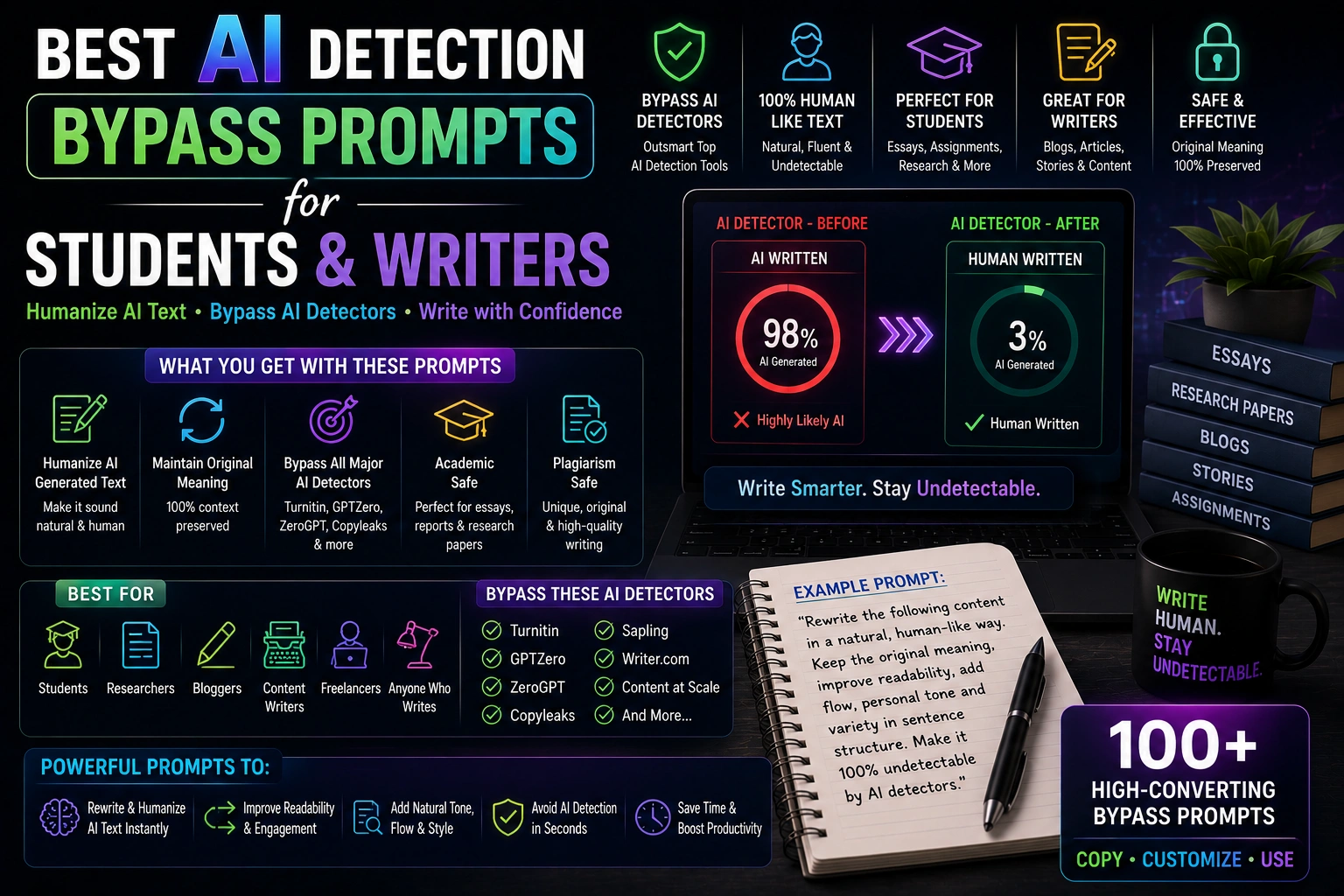
AI Detection Bypass Prompts for Students & Writers
Use these AI prompt templates to revise AI-assisted drafts for clarity, voice, and readability. Keep the work grounded in your own ideas and evidence, disclose AI assistance when required, and follow academic integrity and professional publishing standards.
How Can AI Prompts Help Bypass AI Detection?
Writing prompts can guide revisions to sentence structure, tone, transitions, and specificity. These changes may improve readability, but they do not reliably establish authorship or guarantee a result from Turnitin, GPTZero, Originality.ai, or another detector. Detector outputs can be mistaken, so use them cautiously and follow the relevant policy.
Who Can Benefit from These Prompts?
Students can use these prompts to draft essays and research papers that sound more natural and less robotic. Professional writers and bloggers can generate first drafts that require less editing and feel more organic. Content creators can scale their output while maintaining a human touch. These prompts are suitable for writers who want to improve quality, readability, and authentic expression in AI-assisted drafts.

Frequently Asked Questions
What was updated on this page for Oct 2026?
The page was refreshed on Oct 14, 2026 with revised guidance, improved prompt templates, and clearer notes about verification and responsible AI use.
Can prompts guarantee that AI detectors will not flag writing?
No. AI detectors can make mistakes, and no prompt guarantees a particular result. Use prompts to improve clarity and voice, preserve your own ideas, and follow the relevant AI-use policy.
Do these prompts work for Turnitin and GPTZero?
There is no reliable guarantee that these prompts will affect Turnitin, GPTZero, or Originality.ai in a particular way. Detector outputs are imperfect signals, not definitive proof of authorship.
Are these prompts suitable for students?
Students can use these prompts for editing and learning when permitted by their course rules. Follow disclosure requirements, keep your own analysis central, and never submit fabricated experiences or sources.
Which AI tools work best with these prompts?
These prompts can be adapted for ChatGPT, Claude, Gemini, Jasper, and other language models. Review and verify each output before using it.
Can I use these prompts for professional writing?
Absolutely. Professional writers use these prompts to generate first drafts, blog posts, and reports that feel more organic and less AI-generated.