Explore This Guide
Jump directly to any section of this article.
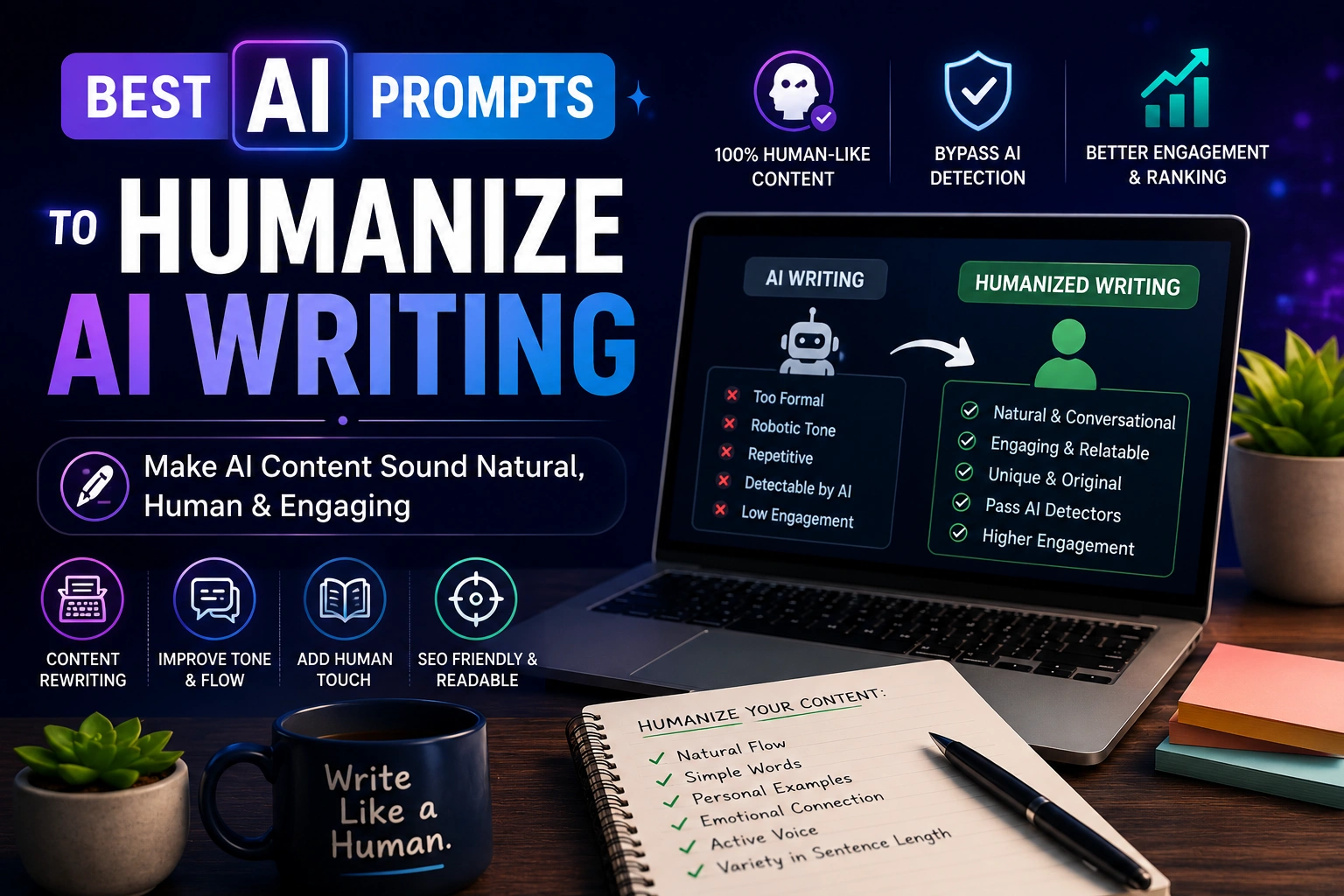
AI Prompts for Natural Tone, Voice & Readability
Select a category or browse all humanizing prompts below
1. AI-Pattern & Stock Phrase Remover
EDITINGRemove the stock words, sentence patterns, and formatting habits that make drafts sound machine-written.
Edit this text to remove stock AI-sounding writing: [paste text].
Fix these patterns:
1\) Overused words (delve, tapestry, leverage, testament, robust,
navigate, landscape, pivotal, unlock, elevate) - replace with plain words
2\) Stock openers and closers ("In today's fast-paced world," "In
conclusion," "I hope this helps!")
3\) Repeated "it's not just X, it's Y" contrasts and automatic lists of
three
4\) Too many em dashes, colons, and bold phrases
5\) Vague claims with no detail behind them
Keep the meaning and facts exactly the same. Do not add new facts. At
the end, list the patterns you removed and anything that still sounds
generic.
Recommended Tech Stack
ChatGPT (GPT-4o), Claude 3.5 Sonnet, Grammarly, Hemingway Editor, and detector tools such as Undetectable AI / Originality.ai for optional, cautious testing.
Quick Implementation Guide
- Specify the target audience persona, desired emotional resonance, varied sentence cadence, and appropriate colloquial nuance.
- Paste your AI-generated draft alongside the humanization prompt. Ask for predictable phrasing and robotic transitions to be revised while preserving meaning, facts, and your own voice.
- Review the result for factual accuracy, natural flow, readability, and compliance with the relevant editorial or disclosure requirements before publishing.
Real-World Use Case Example
Refine a blog introduction with a stronger narrative opening, make corporate email copy more conversational, or edit a thought-leadership article for clearer voice and less repetitive phrasing. Do not invent personal experiences or use detector scores as proof of authorship.
2. Personal Writing Style Matcher
VOICERewrite a draft in your own voice by learning from samples of your real writing.
First, study these samples of my own writing: [paste 2-3 samples].
Describe my style in 6 bullet points: sentence length, vocabulary,
humor, how I open and close, punctuation habits, and words I use or
avoid.
Then rewrite this draft in my voice: [paste draft].
Keep the facts and structure the same, copy my natural rhythm and
word choices, and do not add phrases I would never use. After the
rewrite, list 3 places where the draft still doesn't sound like me so I
can fix them.
Recommended Tech Stack
ChatGPT (GPT-4o), Claude 3.5 Sonnet, Grammarly, Hemingway Editor, and detector tools such as Undetectable AI / Originality.ai for optional, cautious testing.
Quick Implementation Guide
- Specify the target audience persona, desired emotional resonance, varied sentence cadence, and appropriate colloquial nuance.
- Paste your AI-generated draft alongside the humanization prompt. Ask for predictable phrasing and robotic transitions to be revised while preserving meaning, facts, and your own voice.
- Review the result for factual accuracy, natural flow, readability, and compliance with the relevant editorial or disclosure requirements before publishing.
Real-World Use Case Example
Refine a blog introduction with a stronger narrative opening, make corporate email copy more conversational, or edit a thought-leadership article for clearer voice and less repetitive phrasing. Do not invent personal experiences or use detector scores as proof of authorship.
3. Conversational Tone Rewrite
TONEA warm, natural rewrite that sounds like someone talking, not a press release.
Rewrite this paragraph in a warm, conversational tone as if explaining
it to a friend: [paste text].
Use contractions, shorter sentences, and a natural rhythm while
keeping the original meaning intact. Allow an occasional informal
aside or a sentence fragment where it feels natural, and avoid making
every sentence equally polished. Do not use slang the reader may not
understand.
Recommended Tech Stack
ChatGPT (GPT-4o), Claude 3.5 Sonnet, Grammarly, Hemingway Editor, and detector tools such as Undetectable AI / Originality.ai for optional, cautious testing.
Quick Implementation Guide
- Specify the target audience persona, desired emotional resonance, varied sentence cadence, and appropriate colloquial nuance.
- Paste your AI-generated draft alongside the humanization prompt. Ask for predictable phrasing and robotic transitions to be revised while preserving meaning, facts, and your own voice.
- Review the result for factual accuracy, natural flow, readability, and compliance with the relevant editorial or disclosure requirements before publishing.
Real-World Use Case Example
Refine a blog introduction with a stronger narrative opening, make corporate email copy more conversational, or edit a thought-leadership article for clearer voice and less repetitive phrasing. Do not invent personal experiences or use detector scores as proof of authorship.
4. Sentence Rhythm & Word Choice Variator
EDITINGFix flat, repetitive rhythm and predictable phrasing so the text reads like a real person wrote it.
Revise this text for rhythm and word choice: [paste text].
Mix short and long sentences so the pace isn't uniform, vary how
sentences begin, replace the most predictable phrasing with natural
but less obvious wording, and cut filler words. Read it as if spoken
aloud and fix any line that sounds stiff. Keep meaning and facts
unchanged, and keep the language clear rather than fancy.
Recommended Tech Stack
ChatGPT (GPT-4o), Claude 3.5 Sonnet, Grammarly, Hemingway Editor, and detector tools such as Undetectable AI / Originality.ai for optional, cautious testing.
Quick Implementation Guide
- Specify the target audience persona, desired emotional resonance, varied sentence cadence, and appropriate colloquial nuance.
- Paste your AI-generated draft alongside the humanization prompt. Ask for predictable phrasing and robotic transitions to be revised while preserving meaning, facts, and your own voice.
- Review the result for factual accuracy, natural flow, readability, and compliance with the relevant editorial or disclosure requirements before publishing.
Real-World Use Case Example
Refine a blog introduction with a stronger narrative opening, make corporate email copy more conversational, or edit a thought-leadership article for clearer voice and less repetitive phrasing. Do not invent personal experiences or use detector scores as proof of authorship.
5. Add Real Experience, Specifics & Examples
VOICETurn generic writing into useful writing by asking for the real details only you can supply.
Review this text and find every place that is vague or generic:
[paste text].
For each place, ask me one specific question that only someone with
real experience could answer (a real number, a named situation, what
happened, what I would do differently).
After I answer, rewrite the text using only my answers. Do not invent
facts, quotes, names, or statistics. If I skip a question, leave a
[add detail here] placeholder instead of making something up.
Recommended Tech Stack
ChatGPT (GPT-4o), Claude 3.5 Sonnet, Grammarly, Hemingway Editor, and detector tools such as Undetectable AI / Originality.ai for optional, cautious testing.
Quick Implementation Guide
- Specify the target audience persona, desired emotional resonance, varied sentence cadence, and appropriate colloquial nuance.
- Paste your AI-generated draft alongside the humanization prompt. Ask for predictable phrasing and robotic transitions to be revised while preserving meaning, facts, and your own voice.
- Review the result for factual accuracy, natural flow, readability, and compliance with the relevant editorial or disclosure requirements before publishing.
Real-World Use Case Example
Refine a blog introduction with a stronger narrative opening, make corporate email copy more conversational, or edit a thought-leadership article for clearer voice and less repetitive phrasing. Do not invent personal experiences or use detector scores as proof of authorship.
6. Add a Clear Point of View
TONEReplace "on one hand, on the other hand" writing with a clear stance the reader can agree or disagree with.
Rewrite this text so it has a clear point of view: [paste text].
My opinion on the topic is: [state your opinion].
Find places where the text hedges or lists both sides without
committing, and rewrite them to state my position directly, with the
reason behind it. Keep the other side fairly represented in one
sentence. Do not change the facts or claim anything I haven't said.
Recommended Tech Stack
ChatGPT (GPT-4o), Claude 3.5 Sonnet, Grammarly, Hemingway Editor, and detector tools such as Undetectable AI / Originality.ai for optional, cautious testing.
Quick Implementation Guide
- Specify the target audience persona, desired emotional resonance, varied sentence cadence, and appropriate colloquial nuance.
- Paste your AI-generated draft alongside the humanization prompt. Ask for predictable phrasing and robotic transitions to be revised while preserving meaning, facts, and your own voice.
- Review the result for factual accuracy, natural flow, readability, and compliance with the relevant editorial or disclosure requirements before publishing.
Real-World Use Case Example
Refine a blog introduction with a stronger narrative opening, make corporate email copy more conversational, or edit a thought-leadership article for clearer voice and less repetitive phrasing. Do not invent personal experiences or use detector scores as proof of authorship.
7. Plain-Language & Reading-Level Simplifier
EDITINGCut corporate wording and long sentences so anyone can read the text on a phone.
Simplify this text to a [8th-grade / general audience] reading level:
[paste text].
Replace formal or corporate words with everyday ones, split sentences
longer than 25 words, turn passive sentences into active ones, and
remove hedging and boilerplate disclaimers. Keep it professional,
keep all facts, and format it for easy mobile reading with short
paragraphs.
Recommended Tech Stack
ChatGPT (GPT-4o), Claude 3.5 Sonnet, Grammarly, Hemingway Editor, and detector tools such as Undetectable AI / Originality.ai for optional, cautious testing.
Quick Implementation Guide
- Specify the target audience persona, desired emotional resonance, varied sentence cadence, and appropriate colloquial nuance.
- Paste your AI-generated draft alongside the humanization prompt. Ask for predictable phrasing and robotic transitions to be revised while preserving meaning, facts, and your own voice.
- Review the result for factual accuracy, natural flow, readability, and compliance with the relevant editorial or disclosure requirements before publishing.
Real-World Use Case Example
Refine a blog introduction with a stronger narrative opening, make corporate email copy more conversational, or edit a thought-leadership article for clearer voice and less repetitive phrasing. Do not invent personal experiences or use detector scores as proof of authorship.
8. Hinglish & Regional Voice Adapter
VOICERewrite English content in natural Hinglish or simple Hindi the way people actually speak and message.
Rewrite this text in natural [Hinglish / simple Hindi] for [target
audience, e.g. students, small business owners, social media
followers]: [paste text].
Use everyday spoken words, keep common English terms that people
normally use as they are (like app, link, online), avoid stiff
textbook Hindi, and keep the meaning and facts the same. Write Hindi
words in [Roman script / Devanagari]. Keep the tone [friendly /
professional] and give a second shorter version for social media
captions.
Recommended Tech Stack
ChatGPT (GPT-4o), Claude 3.5 Sonnet, Grammarly, Hemingway Editor, and detector tools such as Undetectable AI / Originality.ai for optional, cautious testing.
Quick Implementation Guide
- Specify the target audience persona, desired emotional resonance, varied sentence cadence, and appropriate colloquial nuance.
- Paste your AI-generated draft alongside the humanization prompt. Ask for predictable phrasing and robotic transitions to be revised while preserving meaning, facts, and your own voice.
- Review the result for factual accuracy, natural flow, readability, and compliance with the relevant editorial or disclosure requirements before publishing.
Real-World Use Case Example
Refine a blog introduction with a stronger narrative opening, make corporate email copy more conversational, or edit a thought-leadership article for clearer voice and less repetitive phrasing. Do not invent personal experiences or use detector scores as proof of authorship.
9. Voice Note to Polished Post
VOICETurn a rambling voice-note transcript into a clean post that still sounds like you.
Turn this voice-note transcript into a polished [blog post / LinkedIn
post / newsletter]: [paste transcript].
Keep my own phrases, examples, and opinions. Remove filler words,
repetition, and false starts, organize the ideas into a clear order
with a strong first line, and keep the spoken, natural feel instead
of making it formal. Do not add facts or claims I didn't say. List any
statements that need fact-checking before I publish.
Recommended Tech Stack
ChatGPT (GPT-4o), Claude 3.5 Sonnet, Grammarly, Hemingway Editor, and detector tools such as Undetectable AI / Originality.ai for optional, cautious testing.
Quick Implementation Guide
- Specify the target audience persona, desired emotional resonance, varied sentence cadence, and appropriate colloquial nuance.
- Paste your AI-generated draft alongside the humanization prompt. Ask for predictable phrasing and robotic transitions to be revised while preserving meaning, facts, and your own voice.
- Review the result for factual accuracy, natural flow, readability, and compliance with the relevant editorial or disclosure requirements before publishing.
Real-World Use Case Example
Refine a blog introduction with a stronger narrative opening, make corporate email copy more conversational, or edit a thought-leadership article for clearer voice and less repetitive phrasing. Do not invent personal experiences or use detector scores as proof of authorship.
10. Readability Simplifier (Fluff-Sentence Remover)
EDITINGImproves readability and cuts "fluff" sentences that sound polished but add no real information.
Improve the readability of this text: [paste text].
Break up long paragraphs, shorten complex sentences, and use
simple transitions so it reads at an 8th-grade reading level. Also
identify and cut any "fluff" sentences that sound professional but
don't add new information or a specific insight - search engines now
actively penalize this kind of padding as low information-gain.
Recommended Tech Stack
ChatGPT (GPT-4o), Claude 3.5 Sonnet, Grammarly, Hemingway Editor, and detector tools such as Undetectable AI / Originality.ai for optional, cautious testing.
Quick Implementation Guide
- Specify the target audience persona, desired emotional resonance, varied sentence cadence, and appropriate colloquial nuance.
- Paste your AI-generated draft alongside the humanization prompt. Ask for predictable phrasing and robotic transitions to be revised while preserving meaning, facts, and your own voice.
- Review the result for factual accuracy, natural flow, readability, and compliance with the relevant editorial or disclosure requirements before publishing.
Real-World Use Case Example
Refine a blog introduction with a stronger narrative opening, make corporate email copy more conversational, or edit a thought-leadership article for clearer voice and less repetitive phrasing. Do not invent personal experiences or use detector scores as proof of authorship.
11. First-Person Perspective Rewrite
VOICEA genuine first-person rewrite, since the total absence of first-person is itself a recognizable AI-writing pattern.
Rewrite this text from a first-person perspective, as if the author
is sharing their own experience or opinion: [paste text].
Keep it authentic and grounded, avoiding generic statements. A
complete absence of "I" and personal framing is itself one of the
patterns that makes writing read as AI-generated, so lean into a
real, specific first-person voice rather than a safely neutral one.
Recommended Tech Stack
ChatGPT (GPT-4o), Claude 3.5 Sonnet, Grammarly, Hemingway Editor, and detector tools such as Undetectable AI / Originality.ai for optional, cautious testing.
Quick Implementation Guide
- Specify the target audience persona, desired emotional resonance, varied sentence cadence, and appropriate colloquial nuance.
- Paste your AI-generated draft alongside the humanization prompt. Ask for predictable phrasing and robotic transitions to be revised while preserving meaning, facts, and your own voice.
- Review the result for factual accuracy, natural flow, readability, and compliance with the relevant editorial or disclosure requirements before publishing.
Real-World Use Case Example
Refine a blog introduction with a stronger narrative opening, make corporate email copy more conversational, or edit a thought-leadership article for clearer voice and less repetitive phrasing. Do not invent personal experiences or use detector scores as proof of authorship.
12. Warmth & Empathy Booster
TONEAdd warmth to writing that feels cold or clinical, without tipping into insincerity.
Revise this text to sound warmer and more empathetic, especially
where it addresses the reader's concerns or challenges: [paste text].
Keep it genuine, not overly sentimental, and avoid the reflexive
"I understand this must be difficult" phrasing that itself reads as
a scripted, AI-style empathy cue rather than real warmth.
Recommended Tech Stack
ChatGPT (GPT-4o), Claude 3.5 Sonnet, Grammarly, Hemingway Editor, and detector tools such as Undetectable AI / Originality.ai for optional, cautious testing.
Quick Implementation Guide
- Specify the target audience persona, desired emotional resonance, varied sentence cadence, and appropriate colloquial nuance.
- Paste your AI-generated draft alongside the humanization prompt. Ask for predictable phrasing and robotic transitions to be revised while preserving meaning, facts, and your own voice.
- Review the result for factual accuracy, natural flow, readability, and compliance with the relevant editorial or disclosure requirements before publishing.
Real-World Use Case Example
Refine a blog introduction with a stronger narrative opening, make corporate email copy more conversational, or edit a thought-leadership article for clearer voice and less repetitive phrasing. Do not invent personal experiences or use detector scores as proof of authorship.
13. Transition Word Refresh (2026 Blacklist)
EDITINGReplace the specific connector words most reliably catalogued as AI tells, not just "generic transitions" broadly.
Replace overused AI transition words and phrases in this text -
specifically "moreover," "furthermore," "in conclusion," "it's
important to note," and "when it comes to" - with more natural
connectors, or by restructuring the sentences so no transition word
is needed at all: [paste text]. Read it aloud afterward - if it
sounds like a lecture rather than a conversation, restructure further.
Recommended Tech Stack
ChatGPT (GPT-4o), Claude 3.5 Sonnet, Grammarly, Hemingway Editor, and detector tools such as Undetectable AI / Originality.ai for optional, cautious testing.
Quick Implementation Guide
- Specify the target audience persona, desired emotional resonance, varied sentence cadence, and appropriate colloquial nuance.
- Paste your AI-generated draft alongside the humanization prompt. Ask for predictable phrasing and robotic transitions to be revised while preserving meaning, facts, and your own voice.
- Review the result for factual accuracy, natural flow, readability, and compliance with the relevant editorial or disclosure requirements before publishing.
Real-World Use Case Example
Refine a blog introduction with a stronger narrative opening, make corporate email copy more conversational, or edit a thought-leadership article for clearer voice and less repetitive phrasing. Do not invent personal experiences or use detector scores as proof of authorship.
14. Storytelling Opener Rewrite
VOICEOpen with a specific scene instead of a generic statement.
Rewrite the opening paragraph of this piece as a short, specific
story or scene instead of a general statement: [paste text].
Keep it under 60 words and lead naturally into the main content.
Recommended Tech Stack
ChatGPT (GPT-4o), Claude 3.5 Sonnet, Grammarly, Hemingway Editor, and detector tools such as Undetectable AI / Originality.ai for optional, cautious testing.
Quick Implementation Guide
- Specify the target audience persona, desired emotional resonance, varied sentence cadence, and appropriate colloquial nuance.
- Paste your AI-generated draft alongside the humanization prompt. Ask for predictable phrasing and robotic transitions to be revised while preserving meaning, facts, and your own voice.
- Review the result for factual accuracy, natural flow, readability, and compliance with the relevant editorial or disclosure requirements before publishing.
Real-World Use Case Example
Refine a blog introduction with a stronger narrative opening, make corporate email copy more conversational, or edit a thought-leadership article for clearer voice and less repetitive phrasing. Do not invent personal experiences or use detector scores as proof of authorship.
15. Confidence & Directness Editor (Hedging-Cluster Remover)
TONERemoves the specific "hedging cluster" of phrases that detectors and readers both now recognize as a tell.
Revise this text to sound more confident and direct: [paste text].
Remove hedging phrases like "it could be said," "some might argue,"
"it's worth noting that," and "in many cases" - this hedging cluster
is one of the most consistent AI-writing fingerprints, reflecting a
trained aversion to committing to a clear claim. Keep the tone
assertive but not arrogant, and make sure every claim that remains
is one the writer is actually willing to stand behind.
Recommended Tech Stack
ChatGPT (GPT-4o), Claude 3.5 Sonnet, Grammarly, Hemingway Editor, and detector tools such as Undetectable AI / Originality.ai for optional, cautious testing.
Quick Implementation Guide
- Specify the target audience persona, desired emotional resonance, varied sentence cadence, and appropriate colloquial nuance.
- Paste your AI-generated draft alongside the humanization prompt. Ask for predictable phrasing and robotic transitions to be revised while preserving meaning, facts, and your own voice.
- Review the result for factual accuracy, natural flow, readability, and compliance with the relevant editorial or disclosure requirements before publishing.
Real-World Use Case Example
Refine a blog introduction with a stronger narrative opening, make corporate email copy more conversational, or edit a thought-leadership article for clearer voice and less repetitive phrasing. Do not invent personal experiences or use detector scores as proof of authorship.
16. Show, Don't Tell Rewrite (Data Over Fluff)
EDITINGReplace vague statements with the specific numbers and details that separate genuine insight from AI-sounding filler.
Rewrite this text to replace vague or generic statements with
specific, concrete details or numbers where possible: [paste text].
Keep sentences natural and avoid sounding like a list of facts. Where
a sentence makes a claim without backing it (e.g. "this can improve
results significantly"), either add the specific number/example that
supports it or cut the claim entirely - unsupported generic claims
are exactly the "fluff" both readers and AI-content detectors flag.
Recommended Tech Stack
ChatGPT (GPT-4o), Claude 3.5 Sonnet, Grammarly, Hemingway Editor, and detector tools such as Undetectable AI / Originality.ai for optional, cautious testing.
Quick Implementation Guide
- Specify the target audience persona, desired emotional resonance, varied sentence cadence, and appropriate colloquial nuance.
- Paste your AI-generated draft alongside the humanization prompt. Ask for predictable phrasing and robotic transitions to be revised while preserving meaning, facts, and your own voice.
- Review the result for factual accuracy, natural flow, readability, and compliance with the relevant editorial or disclosure requirements before publishing.
Real-World Use Case Example
Refine a blog introduction with a stronger narrative opening, make corporate email copy more conversational, or edit a thought-leadership article for clearer voice and less repetitive phrasing. Do not invent personal experiences or use detector scores as proof of authorship.
17. Regional & Cultural Tone Adapter
VOICEAdapt phrasing naturally for a specific region or audience.
Adapt this text so the phrasing and examples feel natural for
readers in [region/country]: [paste text].
Adjust idioms, references, and tone while keeping the core
message unchanged.
Recommended Tech Stack
ChatGPT (GPT-4o), Claude 3.5 Sonnet, Grammarly, Hemingway Editor, and detector tools such as Undetectable AI / Originality.ai for optional, cautious testing.
Quick Implementation Guide
- Specify the target audience persona, desired emotional resonance, varied sentence cadence, and appropriate colloquial nuance.
- Paste your AI-generated draft alongside the humanization prompt. Ask for predictable phrasing and robotic transitions to be revised while preserving meaning, facts, and your own voice.
- Review the result for factual accuracy, natural flow, readability, and compliance with the relevant editorial or disclosure requirements before publishing.
Real-World Use Case Example
Refine a blog introduction with a stronger narrative opening, make corporate email copy more conversational, or edit a thought-leadership article for clearer voice and less repetitive phrasing. Do not invent personal experiences or use detector scores as proof of authorship.
18. Humor & Wit Injector
TONEAdd light humor without undermining the message or sounding forced.
Add a touch of light humor or wit to this text where it fits
naturally, without making it feel forced or unprofessional: [paste text].
Keep the humor subtle, specific to the topic rather than a generic
joke template, and audience-appropriate.
Recommended Tech Stack
ChatGPT (GPT-4o), Claude 3.5 Sonnet, Grammarly, Hemingway Editor, and detector tools such as Undetectable AI / Originality.ai for optional, cautious testing.
Quick Implementation Guide
- Specify the target audience persona, desired emotional resonance, varied sentence cadence, and appropriate colloquial nuance.
- Paste your AI-generated draft alongside the humanization prompt. Ask for predictable phrasing and robotic transitions to be revised while preserving meaning, facts, and your own voice.
- Review the result for factual accuracy, natural flow, readability, and compliance with the relevant editorial or disclosure requirements before publishing.
Real-World Use Case Example
Refine a blog introduction with a stronger narrative opening, make corporate email copy more conversational, or edit a thought-leadership article for clearer voice and less repetitive phrasing. Do not invent personal experiences or use detector scores as proof of authorship.
19. Full Human Editing Pass (Perplexity + Burstiness + Voice)
EDITINGA complete pass addressing both core detection mechanics and the structural tells beyond vocabulary.
Do a full editing pass on this draft to make it read naturally, as if
written by an experienced human writer: [paste text]. Specifically:
1\) Increase burstiness - vary sentence length instead of a uniform rhythm
2\) Increase perplexity - swap the most predictable word choices for more natural, less generic phrasing
3\) Remove current AI-tell vocabulary and sign-offs (delve, leverage, tapestry, "I hope this helps," etc.)
4\) Add genuine first-person framing and at least one specific, non-generic detail
5\) Cut any "fluff" sentence that sounds good but adds no real information
6\) Make sure at least one claim actually takes a position rather than hedging both ways
Keep all facts intact throughout.
Recommended Tech Stack
ChatGPT (GPT-4o), Claude 3.5 Sonnet, Grammarly, Hemingway Editor, and detector tools such as Undetectable AI / Originality.ai for optional, cautious testing.
Quick Implementation Guide
- Specify the target audience persona, desired emotional resonance, varied sentence cadence, and appropriate colloquial nuance.
- Paste your AI-generated draft alongside the humanization prompt. Ask for predictable phrasing and robotic transitions to be revised while preserving meaning, facts, and your own voice.
- Review the result for factual accuracy, natural flow, readability, and compliance with the relevant editorial or disclosure requirements before publishing.
Real-World Use Case Example
Refine a blog introduction with a stronger narrative opening, make corporate email copy more conversational, or edit a thought-leadership article for clearer voice and less repetitive phrasing. Do not invent personal experiences or use detector scores as proof of authorship.
20. Consistent Voice Across Long Content
VOICEKeep a unified voice across a long piece, flagging any section that suddenly reads more "AI-generic" than the rest.
Review this long piece of content for voice consistency: [paste text].
Flag any sections that shift tone unexpectedly, and separately flag
any section that suddenly reads more generic or AI-typical than the
surrounding text (a sudden run of hedging, stock transitions, or
blacklisted vocabulary is often where a piece was patched or
re-generated later). Rewrite flagged sections to match the
established voice: [describe voice].
Recommended Tech Stack
ChatGPT (GPT-4o), Claude 3.5 Sonnet, Grammarly, Hemingway Editor, and detector tools such as Undetectable AI / Originality.ai for optional, cautious testing.
Quick Implementation Guide
- Specify the target audience persona, desired emotional resonance, varied sentence cadence, and appropriate colloquial nuance.
- Paste your AI-generated draft alongside the humanization prompt. Ask for predictable phrasing and robotic transitions to be revised while preserving meaning, facts, and your own voice.
- Review the result for factual accuracy, natural flow, readability, and compliance with the relevant editorial or disclosure requirements before publishing.
Real-World Use Case Example
Refine a blog introduction with a stronger narrative opening, make corporate email copy more conversational, or edit a thought-leadership article for clearer voice and less repetitive phrasing. Do not invent personal experiences or use detector scores as proof of authorship.
1. Optimizing Your Content Humanization Workflow with AI
Use AI as an editor, not as a substitute for your own experience. Start with a clear audience, purpose, and voice guide; ask for targeted edits; then review every change yourself. A reliable workflow protects the original meaning, factual accuracy, and your own perspective while improving clarity and flow.
- Define the reader, purpose, reading level, and desired tone before rewriting.
- Provide a short sample of your authentic writing or a brand-voice guide.
- Ask the model to preserve names, numbers, quotations, and claims exactly unless you explicitly approve a change.
- Compare the revision with the source and accept only edits that improve meaning or readability.
2. Step-by-Step Guide: Transforming Robotic Text into Natural Writing from Prompts
- Identify the problem. Mark repetitive openings, vague claims, stiff transitions, long sentences, or tone that does not suit the audience.
- Give precise instructions. Specify audience persona, emotional register, sentence-cadence variation, colloquial nuance, and any words or expressions to avoid.
- Rewrite in focused passes. Improve structure first, then voice and rhythm, then grammar and readability. Avoid asking for many unrelated changes at once.
- Verify the result. Check facts, citations, quotations, names, and numbers against the original sources. Replace invented examples with real details you can substantiate.
- Make the final edit yourself. Read aloud, remove wording you would not naturally use, and follow relevant disclosure and editorial policies.
3. The Science Behind Effective AI Anti-Detection and Tone-Shifting Prompts
Prompts can change surface features such as vocabulary, sentence rhythm, formality, and point of view. However, AI-writing detectors are probabilistic and can produce false positives and false negatives; a detector score cannot reliably establish authorship on its own. There is no prompt that can guarantee a detector result or prove that a text was written by a person.
For legitimate editing, focus on transparent improvements: a clearer argument, verifiable details from the writer's own experience, a consistent voice, and accurate attribution. Use detection tools only as imperfect diagnostic signals—not as proof, and not as a replacement for editorial review or required disclosure.
4. Best Practices for Retaining Brand Voice and Original Meaning in AI Content
- Provide a concise voice guide covering audience, tone, vocabulary, sentence length, and preferred formatting.
- Preserve the author's claims and intent; do not add personal experiences, testimonials, statistics, or quotations that were not supplied.
- Keep specialist terms where they are necessary, and explain them rather than replacing them inaccurately.
- Use a before-and-after review for meaning, factual consistency, brand terminology, and accessibility.
- Have a human owner approve sensitive, regulated, or high-impact content before publication.
5. Unlocking Advanced Stylistic Variations and Conversational Flavour with Expert Prompts
For more expressive revisions, request a controlled set of alternatives rather than an unrestricted rewrite. Ask for three versions—such as warm and conversational, concise and direct, or reflective and story-led—while requiring every version to preserve the same facts and key message.
Useful prompt variables include sentence cadence, level of formality, use of contractions, degree of humor, regional vocabulary, emotional warmth, and the balance between explanation and examples. Compare the alternatives against your audience and brand guide, then combine only the strongest edits.
AI Prompt Templates for Natural, Authentic Writing
Use these AI prompt templates to refine tone, vary sentence rhythm, add personality, and match a specific brand voice. These prompts are designed to help writers, marketers, and content teams turn AI drafts into content that reads naturally and genuinely connects with readers.
How Can AI Prompts Help Humanize Writing?
AI prompts help humanize writing by improving tone, breaking up repetitive patterns, adding personal voice, and adjusting language for a specific audience. They make editing faster while keeping content honest, transparent, and true to the facts it's built on.

Frequently Asked Questions
What was updated on this page for Oct 2026?
This page was refreshed on Oct 14, 2026 with updated prompt wording, cleaner formatting, and improved guidance so readers can quickly find the most useful AI prompt templates.
What are AI prompts to humanize AI writing?
AI prompts to humanize AI writing are text instructions that help AI improve tone, rhythm, and voice so content reads naturally rather than robotically.
Can AI prompts really make writing sound more natural?
Yes. AI prompts can vary sentence length, add personality, remove repetitive phrasing, and adapt tone to match a specific audience or brand voice.
Are these prompts beginner-friendly?
Yes. Beginners can use these prompts to edit and refine drafts without needing prior copywriting or editing experience.
Which AI tools work best for humanizing writing?
These prompts work well with tools like ChatGPT, Jasper, Copy.ai, Claude, and other AI writing platforms.
Should I disclose when content is AI-assisted?
Best practice is to be transparent with readers, clients, or platforms about AI assistance where relevant, since these prompts are meant to improve writing quality, not to misrepresent authorship.