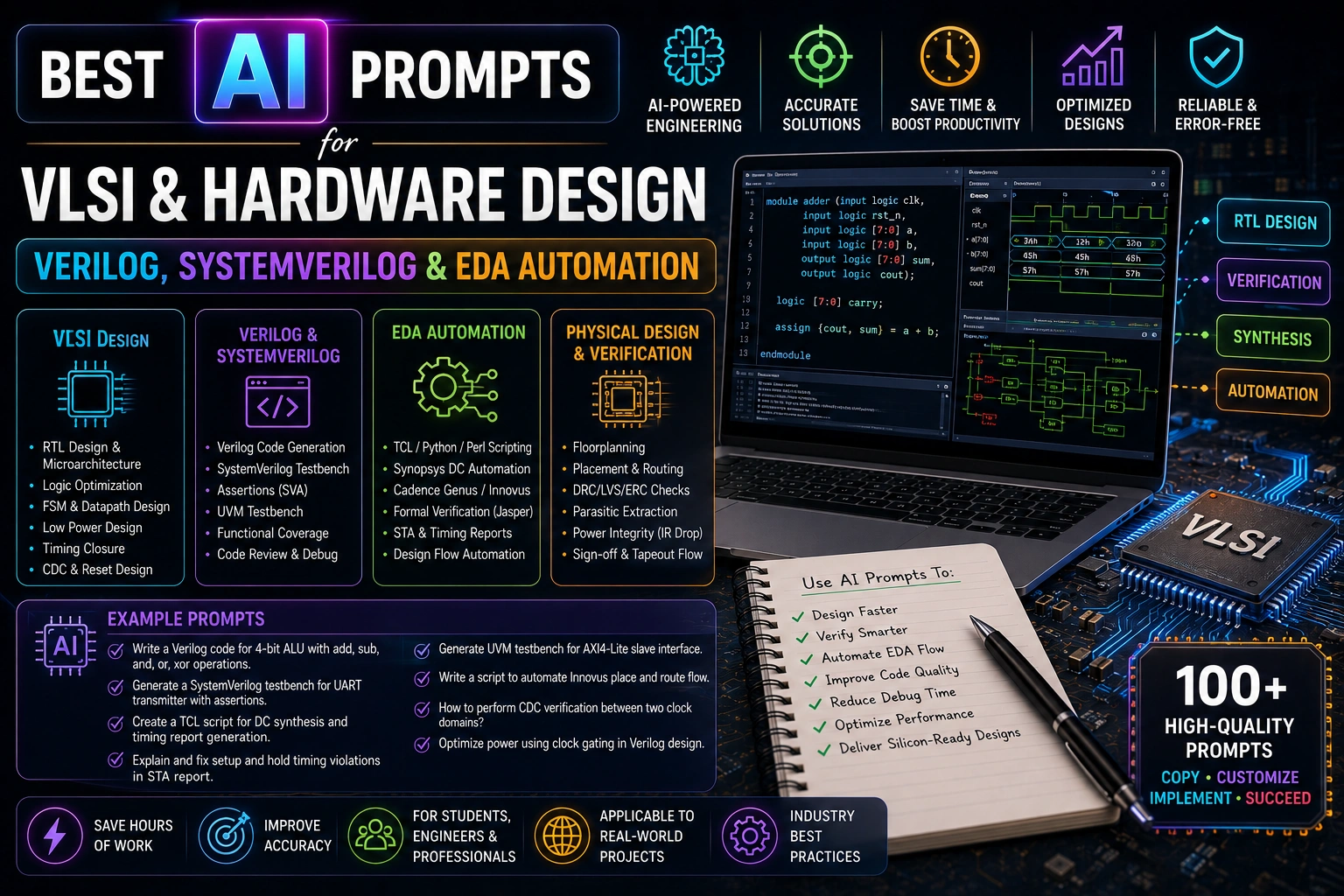
25+ Best AI Prompts for VLSI & Hardware Design (Oct 2026)
Professional AI Prompts for Verilog, SystemVerilog & EDA Automation
Written by Adnan Khan Published July 25, 2026 Updated Oct 13, 2026 10 min read
Discover 25 powerful AI prompts for VLSI and hardware design to support your Verilog, SystemVerilog, and EDA automation work. These expert-crafted prompts help you draft RTL module structure, plan verification testbenches, organize synthesis constraints, and script EDA tool flows. Whether you are a hardware engineer, verification engineer, or student, these AI prompt templates will help you think faster and document clearly always subject to simulation, synthesis, and review by an experienced engineer.
Updated for 2026 AI Tools Tested Prompt Templates Beginner Friendly Free to Copy & Use
AI Prompts for RTL Design, Verification & EDA Automation
Select a category or browse all VLSI & hardware design prompts below
1. Verilog/SystemVerilog Module Skeleton Draft
RTL DESIGN
Draft a lint-friendly module skeleton for a given function.
Act as an RTL design assistant. Draft a SystemVerilog module
skeleton for [function, e.g. an 8-bit synchronous counter with
enable and reset]. Include port list, parameter declarations,
internal signal naming, synthesizable coding style (always_ff
and always_comb), a single reset strategy, and comments
describing intended behavior for each block. List assumptions
and items to check with lint and simulation.
Input the prompt specifying target hardware specifications, interface protocols (e.g., AXI, SPI, I2C), clock domains, and state machine behaviors.
Review the generated Verilog, SystemVerilog, or VHDL code for syntax correctness, pipelining efficiency, and proper synchronous reset handling.
Import the generated RTL into your simulation and synthesis toolchain (such as ModelSim or Vivado) to execute testbenches, verify waveform correctness, and check timing closure.
Real-World Use Case Example
Rapidly scaffolding parameterized AXI-Stream interface controllers, generating comprehensive UVM testbench stimulus generators, or optimizing combinational logic blocks for reduced power consumption in custom ASIC designs.
Act as an RTL design assistant. Draft a SystemVerilog module
skeleton for [function, e.g. an 8-bit synchronous counter with
enable and reset]. Include port list, parameter declarations,
internal signal naming, synthesizable coding style (always_ff
and always_comb), a single reset strategy, and comments
describing intended behavior for each block. List assumptions
and items to check with lint and simulation.
2. RISC-V Core Pipeline & Custom Extension Draft
RTL DESIGN
Structure a RISC-V pipeline and any custom instructions before coding.
Draft a pipeline stage breakdown for a [RV32I/RV64I] RISC-V
core with [extensions, e.g. M, C, vector, custom instruction].
Include what happens in each stage, register boundaries
between stages, hazard types (structural, data, control) and
forwarding paths, CSR and privilege mode scope, how a custom
instruction would be encoded and decoded, and verification
items such as compliance tests to run.
Input the prompt specifying target hardware specifications, interface protocols (e.g., AXI, SPI, I2C), clock domains, and state machine behaviors.
Review the generated Verilog, SystemVerilog, or VHDL code for syntax correctness, pipelining efficiency, and proper synchronous reset handling.
Import the generated RTL into your simulation and synthesis toolchain (such as ModelSim or Vivado) to execute testbenches, verify waveform correctness, and check timing closure.
Real-World Use Case Example
Rapidly scaffolding parameterized AXI-Stream interface controllers, generating comprehensive UVM testbench stimulus generators, or optimizing combinational logic blocks for reduced power consumption in custom ASIC designs.
Draft a pipeline stage breakdown for a [RV32I/RV64I] RISC-V
core with [extensions, e.g. M, C, vector, custom instruction].
Include what happens in each stage, register boundaries
between stages, hazard types (structural, data, control) and
forwarding paths, CSR and privilege mode scope, how a custom
instruction would be encoded and decoded, and verification
items such as compliance tests to run.
3. AI Accelerator MAC Array Design Outline
RTL DESIGN
Outline a systolic array or MAC datapath for neural network inference.
Outline the microarchitecture of a [size, e.g. 16x16] systolic
or MAC array for neural network inference supporting [data
types, e.g. INT8, FP8, BF16]. Include dataflow choice
(weight-, output-, or input-stationary), accumulator width and
overflow handling, local buffer and memory bandwidth
requirements, control FSM, quantization and activation
function placement, and the performance, area, and power
trade-offs to evaluate with synthesis.
Input the prompt specifying target hardware specifications, interface protocols (e.g., AXI, SPI, I2C), clock domains, and state machine behaviors.
Review the generated Verilog, SystemVerilog, or VHDL code for syntax correctness, pipelining efficiency, and proper synchronous reset handling.
Import the generated RTL into your simulation and synthesis toolchain (such as ModelSim or Vivado) to execute testbenches, verify waveform correctness, and check timing closure.
Real-World Use Case Example
Rapidly scaffolding parameterized AXI-Stream interface controllers, generating comprehensive UVM testbench stimulus generators, or optimizing combinational logic blocks for reduced power consumption in custom ASIC designs.
Outline the microarchitecture of a [size, e.g. 16x16] systolic
or MAC array for neural network inference supporting [data
types, e.g. INT8, FP8, BF16]. Include dataflow choice
(weight-, output-, or input-stationary), accumulator width and
overflow handling, local buffer and memory bandwidth
requirements, control FSM, quantization and activation
function placement, and the performance, area, and power
trade-offs to evaluate with synthesis.
4. Chiplet Die-to-Die Interface (UCIe) Overview
RTL DESIGN
Organize interface planning for multi-die designs.
Summarize design considerations for a die-to-die interface
between [die A] and [die B] using [UCIe or similar] at
[bandwidth target]. Include protocol layer options (streaming,
PCIe, CXL mapping), PHY and package type assumptions, link
training and initialization, error handling and retry, power
states, test and bring-up needs, and the specification
sections to confirm.
Input the prompt specifying target hardware specifications, interface protocols (e.g., AXI, SPI, I2C), clock domains, and state machine behaviors.
Review the generated Verilog, SystemVerilog, or VHDL code for syntax correctness, pipelining efficiency, and proper synchronous reset handling.
Import the generated RTL into your simulation and synthesis toolchain (such as ModelSim or Vivado) to execute testbenches, verify waveform correctness, and check timing closure.
Real-World Use Case Example
Rapidly scaffolding parameterized AXI-Stream interface controllers, generating comprehensive UVM testbench stimulus generators, or optimizing combinational logic blocks for reduced power consumption in custom ASIC designs.
Summarize design considerations for a die-to-die interface
between [die A] and [die B] using [UCIe or similar] at
[bandwidth target]. Include protocol layer options (streaming,
PCIe, CXL mapping), PHY and package type assumptions, link
training and initialization, error handling and retry, power
states, test and bring-up needs, and the specification
sections to confirm.
5. Memory Controller Interface Draft
RTL DESIGN
Draft an interface concept for a modern memory controller.
Draft an interface specification for a memory controller
connecting to [memory type, e.g. DDR5, LPDDR5, HBM3, SRAM]
supporting [data width/burst length]. Include command and
address signals, timing parameters to reference from the
datasheet and JEDEC standard, bank and refresh management, ECC
option, handshake sequence with the on-chip bus, and PHY
boundary assumptions.
Input the prompt specifying target hardware specifications, interface protocols (e.g., AXI, SPI, I2C), clock domains, and state machine behaviors.
Review the generated Verilog, SystemVerilog, or VHDL code for syntax correctness, pipelining efficiency, and proper synchronous reset handling.
Import the generated RTL into your simulation and synthesis toolchain (such as ModelSim or Vivado) to execute testbenches, verify waveform correctness, and check timing closure.
Real-World Use Case Example
Rapidly scaffolding parameterized AXI-Stream interface controllers, generating comprehensive UVM testbench stimulus generators, or optimizing combinational logic blocks for reduced power consumption in custom ASIC designs.
Draft an interface specification for a memory controller
connecting to [memory type, e.g. DDR5, LPDDR5, HBM3, SRAM]
supporting [data width/burst length]. Include command and
address signals, timing parameters to reference from the
datasheet and JEDEC standard, bank and refresh management, ECC
option, handshake sequence with the on-chip bus, and PHY
boundary assumptions.
6. Clock & Reset Domain Crossing Review
RTL DESIGN
Review clock domain crossing and reset domain crossing hazards, including async FIFOs.
Review this design description for clock domain crossing (CDC)
and reset domain crossing (RDC) risks: [describe signal paths
between clock and reset domains]. Identify signals that need
synchronizers, recommend a synchronization scheme (2-flop,
handshake, async FIFO with gray-coded pointers), note where
metastability risk is highest, and list the CDC and RDC tool
checks and waivers that need documented justification.
Input the prompt specifying target hardware specifications, interface protocols (e.g., AXI, SPI, I2C), clock domains, and state machine behaviors.
Review the generated Verilog, SystemVerilog, or VHDL code for syntax correctness, pipelining efficiency, and proper synchronous reset handling.
Import the generated RTL into your simulation and synthesis toolchain (such as ModelSim or Vivado) to execute testbenches, verify waveform correctness, and check timing closure.
Real-World Use Case Example
Rapidly scaffolding parameterized AXI-Stream interface controllers, generating comprehensive UVM testbench stimulus generators, or optimizing combinational logic blocks for reduced power consumption in custom ASIC designs.
Review this design description for clock domain crossing (CDC)
and reset domain crossing (RDC) risks: [describe signal paths
between clock and reset domains]. Identify signals that need
synchronizers, recommend a synchronization scheme (2-flop,
handshake, async FIFO with gray-coded pointers), note where
metastability risk is highest, and list the CDC and RDC tool
checks and waivers that need documented justification.
7. Low-Power Design Strategy with UPF
RTL DESIGN
Plan power domains and low-power techniques for an SoC block.
Outline a low-power design strategy for a [block or SoC
description] targeting [power budget]. Include clock gating,
power gating with power domains, isolation cells, retention
registers, level shifters, voltage scaling modes, power-state
transition sequencing, UPF structure, and verification checks
for power-aware simulation and static power checks.
Input the prompt specifying target hardware specifications, interface protocols (e.g., AXI, SPI, I2C), clock domains, and state machine behaviors.
Review the generated Verilog, SystemVerilog, or VHDL code for syntax correctness, pipelining efficiency, and proper synchronous reset handling.
Import the generated RTL into your simulation and synthesis toolchain (such as ModelSim or Vivado) to execute testbenches, verify waveform correctness, and check timing closure.
Real-World Use Case Example
Rapidly scaffolding parameterized AXI-Stream interface controllers, generating comprehensive UVM testbench stimulus generators, or optimizing combinational logic blocks for reduced power consumption in custom ASIC designs.
Outline a low-power design strategy for a [block or SoC
description] targeting [power budget]. Include clock gating,
power gating with power domains, isolation cells, retention
registers, level shifters, voltage scaling modes, power-state
transition sequencing, UPF structure, and verification checks
for power-aware simulation and static power checks.
8. SoC Hardware Security Review Outline
RTL DESIGN
Organize hardware security items for a connected SoC.
Create a hardware security review outline for an SoC with
[features, e.g. secure boot, crypto engine, debug port,
external memory]. Include root of trust placement, secure boot
chain, key storage and lifecycle states, debug port
authentication and lockdown, memory protection and isolation,
side-channel and fault-injection considerations, and
verification and test evidence to collect.
Input the prompt specifying target hardware specifications, interface protocols (e.g., AXI, SPI, I2C), clock domains, and state machine behaviors.
Review the generated Verilog, SystemVerilog, or VHDL code for syntax correctness, pipelining efficiency, and proper synchronous reset handling.
Import the generated RTL into your simulation and synthesis toolchain (such as ModelSim or Vivado) to execute testbenches, verify waveform correctness, and check timing closure.
Real-World Use Case Example
Rapidly scaffolding parameterized AXI-Stream interface controllers, generating comprehensive UVM testbench stimulus generators, or optimizing combinational logic blocks for reduced power consumption in custom ASIC designs.
Create a hardware security review outline for an SoC with
[features, e.g. secure boot, crypto engine, debug port,
external memory]. Include root of trust placement, secure boot
chain, key storage and lifecycle states, debug port
authentication and lockdown, memory protection and isolation,
side-channel and fault-injection considerations, and
verification and test evidence to collect.
9. RTL Code Review Checklist
RTL DESIGN
Review RTL for common coding style and synthesis issues, including AI-generated code.
Create an RTL code review checklist for
[Verilog/SystemVerilog] design files. Include latch inference
risks, blocking vs. non-blocking assignment usage, reset
strategy consistency, width mismatches, X-propagation,
synthesizability, naming conventions, lint tool rules, and
extra checks for code generated by AI tools (invented signals,
missing resets, unverified protocol behavior).
Input the prompt specifying target hardware specifications, interface protocols (e.g., AXI, SPI, I2C), clock domains, and state machine behaviors.
Review the generated Verilog, SystemVerilog, or VHDL code for syntax correctness, pipelining efficiency, and proper synchronous reset handling.
Import the generated RTL into your simulation and synthesis toolchain (such as ModelSim or Vivado) to execute testbenches, verify waveform correctness, and check timing closure.
Real-World Use Case Example
Rapidly scaffolding parameterized AXI-Stream interface controllers, generating comprehensive UVM testbench stimulus generators, or optimizing combinational logic blocks for reduced power consumption in custom ASIC designs.
Create an RTL code review checklist for
[Verilog/SystemVerilog] design files. Include latch inference
risks, blocking vs. non-blocking assignment usage, reset
strategy consistency, width mismatches, X-propagation,
synthesizability, naming conventions, lint tool rules, and
extra checks for code generated by AI tools (invented signals,
missing resets, unverified protocol behavior).
10. UVM Testbench Architecture Outline
VERIFICATION
Plan a UVM environment before building it.
Outline a UVM testbench architecture for [DUT description].
Include agents (driver, monitor, sequencer) per interface,
scoreboard and reference model approach, virtual sequences,
configuration objects, functional coverage plan with
covergroups, constrained-random test list, directed corner-
case tests, and regression and seed strategy.
Input the prompt specifying target hardware specifications, interface protocols (e.g., AXI, SPI, I2C), clock domains, and state machine behaviors.
Review the generated Verilog, SystemVerilog, or VHDL code for syntax correctness, pipelining efficiency, and proper synchronous reset handling.
Import the generated RTL into your simulation and synthesis toolchain (such as ModelSim or Vivado) to execute testbenches, verify waveform correctness, and check timing closure.
Real-World Use Case Example
Rapidly scaffolding parameterized AXI-Stream interface controllers, generating comprehensive UVM testbench stimulus generators, or optimizing combinational logic blocks for reduced power consumption in custom ASIC designs.
Outline a UVM testbench architecture for [DUT description].
Include agents (driver, monitor, sequencer) per interface,
scoreboard and reference model approach, virtual sequences,
configuration objects, functional coverage plan with
covergroups, constrained-random test list, directed corner-
case tests, and regression and seed strategy.
11. SystemVerilog Assertions & Formal Property Plan
VERIFICATION
Plan assertion-based and formal verification for a block.
Draft an assertion and formal verification plan for [block,
e.g. arbiter, FIFO, bus bridge]. List properties to prove
(safety, liveness, protocol compliance), SystemVerilog
assertion examples in plain description, assumptions on
inputs, cover properties to avoid vacuous passes, complexity
reduction techniques, and how formal results complement
simulation coverage.
Input the prompt specifying target hardware specifications, interface protocols (e.g., AXI, SPI, I2C), clock domains, and state machine behaviors.
Review the generated Verilog, SystemVerilog, or VHDL code for syntax correctness, pipelining efficiency, and proper synchronous reset handling.
Import the generated RTL into your simulation and synthesis toolchain (such as ModelSim or Vivado) to execute testbenches, verify waveform correctness, and check timing closure.
Real-World Use Case Example
Rapidly scaffolding parameterized AXI-Stream interface controllers, generating comprehensive UVM testbench stimulus generators, or optimizing combinational logic blocks for reduced power consumption in custom ASIC designs.
Draft an assertion and formal verification plan for [block,
e.g. arbiter, FIFO, bus bridge]. List properties to prove
(safety, liveness, protocol compliance), SystemVerilog
assertion examples in plain description, assumptions on
inputs, cover properties to avoid vacuous passes, complexity
reduction techniques, and how formal results complement
simulation coverage.
12. Timing Closure Triage Plan
EDA FLOW
Organize the steps to analyze and fix timing violations.
Create a timing closure triage plan for a design at
[technology node] failing setup or hold at [frequency].
Include how to group violations by path type and root cause,
checks on constraints and clock definitions, common RTL-level
fixes (pipelining, retiming, logic restructuring), physical
fixes (placement, buffering, sizing), hold-fix strategy, and
the reports to review at each iteration.
Input the prompt specifying target hardware specifications, interface protocols (e.g., AXI, SPI, I2C), clock domains, and state machine behaviors.
Review the generated Verilog, SystemVerilog, or VHDL code for syntax correctness, pipelining efficiency, and proper synchronous reset handling.
Import the generated RTL into your simulation and synthesis toolchain (such as ModelSim or Vivado) to execute testbenches, verify waveform correctness, and check timing closure.
Real-World Use Case Example
Rapidly scaffolding parameterized AXI-Stream interface controllers, generating comprehensive UVM testbench stimulus generators, or optimizing combinational logic blocks for reduced power consumption in custom ASIC designs.
Create a timing closure triage plan for a design at
[technology node] failing setup or hold at [frequency].
Include how to group violations by path type and root cause,
checks on constraints and clock definitions, common RTL-level
fixes (pipelining, retiming, logic restructuring), physical
fixes (placement, buffering, sizing), hold-fix strategy, and
the reports to review at each iteration.
13. Open-Source EDA Flow Setup
EDA FLOW
Plan a simulation-to-layout flow with open-source tools.
Outline an open-source EDA flow for a [design size and type]
project using tools such as Verilator, cocotb, Yosys, and
OpenROAD with an open PDK such as [PDK]. Include directory
structure, build scripts, lint and simulation steps, synthesis
constraints, floorplan and place-and-route settings to start
with, physical verification steps, CI automation, and known
tool limitations to verify.
Input the prompt specifying target hardware specifications, interface protocols (e.g., AXI, SPI, I2C), clock domains, and state machine behaviors.
Review the generated Verilog, SystemVerilog, or VHDL code for syntax correctness, pipelining efficiency, and proper synchronous reset handling.
Import the generated RTL into your simulation and synthesis toolchain (such as ModelSim or Vivado) to execute testbenches, verify waveform correctness, and check timing closure.
Real-World Use Case Example
Rapidly scaffolding parameterized AXI-Stream interface controllers, generating comprehensive UVM testbench stimulus generators, or optimizing combinational logic blocks for reduced power consumption in custom ASIC designs.
Outline an open-source EDA flow for a [design size and type]
project using tools such as Verilator, cocotb, Yosys, and
OpenROAD with an open PDK such as [PDK]. Include directory
structure, build scripts, lint and simulation steps, synthesis
constraints, floorplan and place-and-route settings to start
with, physical verification steps, CI automation, and known
tool limitations to verify.
14. LLM-Assisted RTL & Testbench Workflow with Verification Gates
EDA FLOW
Forward-looking workflow that uses AI for drafts while keeping humans and tools in control.
Design a workflow for using an AI assistant to draft RTL and
testbench code for [block description]. Start from a written
spec, require the AI to list assumptions and interfaces first,
generate RTL and a self-checking testbench, then pass every
output through lint, simulation, formal checks, and coverage
review before acceptance. Define what the AI may not decide
(protocol timing, reset behavior, security features) and how
reviewers record sign-off.
Input the prompt specifying target hardware specifications, interface protocols (e.g., AXI, SPI, I2C), clock domains, and state machine behaviors.
Review the generated Verilog, SystemVerilog, or VHDL code for syntax correctness, pipelining efficiency, and proper synchronous reset handling.
Import the generated RTL into your simulation and synthesis toolchain (such as ModelSim or Vivado) to execute testbenches, verify waveform correctness, and check timing closure.
Real-World Use Case Example
Rapidly scaffolding parameterized AXI-Stream interface controllers, generating comprehensive UVM testbench stimulus generators, or optimizing combinational logic blocks for reduced power consumption in custom ASIC designs.
Design a workflow for using an AI assistant to draft RTL and
testbench code for [block description]. Start from a written
spec, require the AI to list assumptions and interfaces first,
generate RTL and a self-checking testbench, then pass every
output through lint, simulation, formal checks, and coverage
review before acceptance. Define what the AI may not decide
(protocol timing, reset behavior, security features) and how
reviewers record sign-off.
9. Low-Power Design Strategy Overview
RTL DESIGN
Summarize low-power design techniques for a block.
Summarize low-power design strategies (clock gating, power
gating, multi-Vt cells) applicable to [design block description]
targeting [power budget]. Include trade-offs in area, timing,
and verification complexity for each strategy.
Input the prompt specifying target hardware specifications, interface protocols (e.g., AXI, SPI, I2C), clock domains, and state machine behaviors.
Review the generated Verilog, SystemVerilog, or VHDL code for syntax correctness, pipelining efficiency, and proper synchronous reset handling.
Import the generated RTL into your simulation and synthesis toolchain (such as ModelSim or Vivado) to execute testbenches, verify waveform correctness, and check timing closure.
Real-World Use Case Example
Rapidly scaffolding parameterized AXI-Stream interface controllers, generating comprehensive UVM testbench stimulus generators, or optimizing combinational logic blocks for reduced power consumption in custom ASIC designs.
Summarize low-power design strategies (clock gating, power
gating, multi-Vt cells) applicable to [design block description]
targeting [power budget]. Include trade-offs in area, timing,
and verification complexity for each strategy.
10. Testbench Architecture Outline
VERIFICATION
Structure a UVM/testbench architecture for a DUT.
Outline a testbench architecture for verifying
[DUT description, e.g. an AXI slave module]. Include driver,
monitor, scoreboard, and sequencer components (UVM-style if
applicable), and how they connect to the DUT interface.
Input the prompt specifying target hardware specifications, interface protocols (e.g., AXI, SPI, I2C), clock domains, and state machine behaviors.
Review the generated Verilog, SystemVerilog, or VHDL code for syntax correctness, pipelining efficiency, and proper synchronous reset handling.
Import the generated RTL into your simulation and synthesis toolchain (such as ModelSim or Vivado) to execute testbenches, verify waveform correctness, and check timing closure.
Real-World Use Case Example
Rapidly scaffolding parameterized AXI-Stream interface controllers, generating comprehensive UVM testbench stimulus generators, or optimizing combinational logic blocks for reduced power consumption in custom ASIC designs.
Outline a testbench architecture for verifying
[DUT description, e.g. an AXI slave module]. Include driver,
monitor, scoreboard, and sequencer components (UVM-style if
applicable), and how they connect to the DUT interface.
11. Test Plan Draft
VERIFICATION
Draft a verification test plan for a design block.
Draft a verification test plan for [design block description].
Include functional features to verify, corner cases, error
injection scenarios, and coverage goals (functional and code
coverage) to track completeness.
Input the prompt specifying target hardware specifications, interface protocols (e.g., AXI, SPI, I2C), clock domains, and state machine behaviors.
Review the generated Verilog, SystemVerilog, or VHDL code for syntax correctness, pipelining efficiency, and proper synchronous reset handling.
Import the generated RTL into your simulation and synthesis toolchain (such as ModelSim or Vivado) to execute testbenches, verify waveform correctness, and check timing closure.
Real-World Use Case Example
Rapidly scaffolding parameterized AXI-Stream interface controllers, generating comprehensive UVM testbench stimulus generators, or optimizing combinational logic blocks for reduced power consumption in custom ASIC designs.
Draft a verification test plan for [design block description].
Include functional features to verify, corner cases, error
injection scenarios, and coverage goals (functional and code
coverage) to track completeness.
12. Constrained Random Testing Strategy
VERIFICATION
Plan a constrained random verification approach.
Design a constrained random testing strategy for
[DUT description]. Include the input variables to randomize,
constraints needed to keep stimuli legal, and how to weight
scenarios to hit important corner cases more often.
Input the prompt specifying target hardware specifications, interface protocols (e.g., AXI, SPI, I2C), clock domains, and state machine behaviors.
Review the generated Verilog, SystemVerilog, or VHDL code for syntax correctness, pipelining efficiency, and proper synchronous reset handling.
Import the generated RTL into your simulation and synthesis toolchain (such as ModelSim or Vivado) to execute testbenches, verify waveform correctness, and check timing closure.
Real-World Use Case Example
Rapidly scaffolding parameterized AXI-Stream interface controllers, generating comprehensive UVM testbench stimulus generators, or optimizing combinational logic blocks for reduced power consumption in custom ASIC designs.
Design a constrained random testing strategy for
[DUT description]. Include the input variables to randomize,
constraints needed to keep stimuli legal, and how to weight
scenarios to hit important corner cases more often.
13. Assertion (SVA) Draft Outline
VERIFICATION
Plan SystemVerilog assertions for a protocol check.
Outline SystemVerilog assertions needed to check
[protocol/behavior, e.g. a valid-ready handshake] on
[interface description]. Describe each assertion in plain
language (property being checked, trigger condition) before
converting to SVA syntax.
Input the prompt specifying target hardware specifications, interface protocols (e.g., AXI, SPI, I2C), clock domains, and state machine behaviors.
Review the generated Verilog, SystemVerilog, or VHDL code for syntax correctness, pipelining efficiency, and proper synchronous reset handling.
Import the generated RTL into your simulation and synthesis toolchain (such as ModelSim or Vivado) to execute testbenches, verify waveform correctness, and check timing closure.
Real-World Use Case Example
Rapidly scaffolding parameterized AXI-Stream interface controllers, generating comprehensive UVM testbench stimulus generators, or optimizing combinational logic blocks for reduced power consumption in custom ASIC designs.
Outline SystemVerilog assertions needed to check
[protocol/behavior, e.g. a valid-ready handshake] on
[interface description]. Describe each assertion in plain
language (property being checked, trigger condition) before
converting to SVA syntax.
14. Functional Coverage Model Draft
VERIFICATION
Plan a functional coverage model for a DUT.
Draft a functional coverage model for [DUT description].
Include coverpoints for key variables, cross-coverage between
related signals, and bins that represent important corner-case
values to track.
Input the prompt specifying target hardware specifications, interface protocols (e.g., AXI, SPI, I2C), clock domains, and state machine behaviors.
Review the generated Verilog, SystemVerilog, or VHDL code for syntax correctness, pipelining efficiency, and proper synchronous reset handling.
Import the generated RTL into your simulation and synthesis toolchain (such as ModelSim or Vivado) to execute testbenches, verify waveform correctness, and check timing closure.
Real-World Use Case Example
Rapidly scaffolding parameterized AXI-Stream interface controllers, generating comprehensive UVM testbench stimulus generators, or optimizing combinational logic blocks for reduced power consumption in custom ASIC designs.
Draft a functional coverage model for [DUT description].
Include coverpoints for key variables, cross-coverage between
related signals, and bins that represent important corner-case
values to track.
Structure a debugging approach, including where an autonomous waveform-tracing agent now fits before you dig in by hand.
Help me structure a debugging approach for a failing simulation
where [describe symptom, e.g. output signal doesn't match
expected value at time X]. Suggest which signals to trace first,
likely root cause categories, and how to narrow down the issue
systematically, and note where an AI/LLM-based waveform-tracing
agent (AST-based signal tracing tied to the RTL) could pre-narrow
the candidate signals before manual inspection, versus cases
subtle enough that it still needs an engineer's judgment call.
Input the prompt specifying target hardware specifications, interface protocols (e.g., AXI, SPI, I2C), clock domains, and state machine behaviors.
Review the generated Verilog, SystemVerilog, or VHDL code for syntax correctness, pipelining efficiency, and proper synchronous reset handling.
Import the generated RTL into your simulation and synthesis toolchain (such as ModelSim or Vivado) to execute testbenches, verify waveform correctness, and check timing closure.
Real-World Use Case Example
Rapidly scaffolding parameterized AXI-Stream interface controllers, generating comprehensive UVM testbench stimulus generators, or optimizing combinational logic blocks for reduced power consumption in custom ASIC designs.
Help me structure a debugging approach for a failing simulation
where [describe symptom, e.g. output signal doesn't match
expected value at time X]. Suggest which signals to trace first,
likely root cause categories, and how to narrow down the issue
systematically, and note where an AI/LLM-based waveform-tracing
agent (AST-based signal tracing tied to the RTL) could pre-narrow
the candidate signals before manual inspection, versus cases
subtle enough that it still needs an engineer's judgment call.
16. Regression Test Suite Organization (LLM Test-Gen Aware)
VERIFICATION
Standard regression suite structure, plus where LLM-assisted test generation fits into keeping it current.
Organize a regression test suite structure for
[project/DUT description]. Include test categorization (smoke,
nightly, full regression), pass/fail tracking approach, and
how to prioritize tests after a design change, and note where
an LLM-assisted test-generation step could draft new directed
tests from an RTL diff or spec change, with the requirement
that any AI-generated test is reviewed and understood by a
verification engineer before being trusted in the suite.
Input the prompt specifying target hardware specifications, interface protocols (e.g., AXI, SPI, I2C), clock domains, and state machine behaviors.
Review the generated Verilog, SystemVerilog, or VHDL code for syntax correctness, pipelining efficiency, and proper synchronous reset handling.
Import the generated RTL into your simulation and synthesis toolchain (such as ModelSim or Vivado) to execute testbenches, verify waveform correctness, and check timing closure.
Real-World Use Case Example
Rapidly scaffolding parameterized AXI-Stream interface controllers, generating comprehensive UVM testbench stimulus generators, or optimizing combinational logic blocks for reduced power consumption in custom ASIC designs.
Organize a regression test suite structure for
[project/DUT description]. Include test categorization (smoke,
nightly, full regression), pass/fail tracking approach, and
how to prioritize tests after a design change, and note where
an LLM-assisted test-generation step could draft new directed
tests from an RTL diff or spec change, with the requirement
that any AI-generated test is reviewed and understood by a
verification engineer before being trusted in the suite.
Safety and liveness properties, plus the security-focused properties now standard on any block handling sensitive data.
Suggest properties well-suited for formal verification (rather
than simulation) for [design block description, e.g. an
arbiter or FIFO]. Include safety properties, liveness
properties, and reasons formal analysis fits this block well,
and if this block handles keys, credentials, or privileged
control paths, add security properties to check (information-
flow isolation between trust domains, absence of an
unauthorized bypass path/hardware-Trojan-style trigger) as a
third property category.
Input the prompt specifying target hardware specifications, interface protocols (e.g., AXI, SPI, I2C), clock domains, and state machine behaviors.
Review the generated Verilog, SystemVerilog, or VHDL code for syntax correctness, pipelining efficiency, and proper synchronous reset handling.
Import the generated RTL into your simulation and synthesis toolchain (such as ModelSim or Vivado) to execute testbenches, verify waveform correctness, and check timing closure.
Real-World Use Case Example
Rapidly scaffolding parameterized AXI-Stream interface controllers, generating comprehensive UVM testbench stimulus generators, or optimizing combinational logic blocks for reduced power consumption in custom ASIC designs.
Suggest properties well-suited for formal verification (rather
than simulation) for [design block description, e.g. an
arbiter or FIFO]. Include safety properties, liveness
properties, and reasons formal analysis fits this block well,
and if this block handles keys, credentials, or privileged
control paths, add security properties to check (information-
flow isolation between trust domains, absence of an
unauthorized bypass path/hardware-Trojan-style trigger) as a
third property category.
Standard SDC constraints, plus die-to-die interface timing if this block sits on a chiplet.
Draft an SDC constraints outline for a design running at
[target frequency] with clock named [clock name].
Include clock definition, input/output delay constraints, and
false path/multicycle path considerations to review with the
synthesis engineer, and if this block interfaces across a
chiplet/die-to-die boundary (UCIe or similar), add the
additional interface-timing and clock-domain-crossing
constraints that boundary requires.
Input the prompt specifying target hardware specifications, interface protocols (e.g., AXI, SPI, I2C), clock domains, and state machine behaviors.
Review the generated Verilog, SystemVerilog, or VHDL code for syntax correctness, pipelining efficiency, and proper synchronous reset handling.
Import the generated RTL into your simulation and synthesis toolchain (such as ModelSim or Vivado) to execute testbenches, verify waveform correctness, and check timing closure.
Real-World Use Case Example
Rapidly scaffolding parameterized AXI-Stream interface controllers, generating comprehensive UVM testbench stimulus generators, or optimizing combinational logic blocks for reduced power consumption in custom ASIC designs.
Draft an SDC constraints outline for a design running at
[target frequency] with clock named [clock name].
Include clock definition, input/output delay constraints, and
false path/multicycle path considerations to review with the
synthesis engineer, and if this block interfaces across a
chiplet/die-to-die boundary (UCIe or similar), add the
additional interface-timing and clock-domain-crossing
constraints that boundary requires.
19. Synthesis Script Structure (TCL) with QoR Review Step
EDA AUTOMATION
A synthesis flow script plus a checkpoint for where an LLM-assisted QoR review can flag issues before P&R.
Draft a TCL script structure for synthesizing
[design name] targeting [technology library/FPGA].
Include steps for reading RTL, applying constraints, running
synthesis, and generating reports, organized as clear
commented sections, and add a QoR-review checkpoint after
synthesis where an LLM-assisted report summarizer highlights
timing/area/power outliers worth a human look before the
design proceeds to place-and-route.
Input the prompt specifying target hardware specifications, interface protocols (e.g., AXI, SPI, I2C), clock domains, and state machine behaviors.
Review the generated Verilog, SystemVerilog, or VHDL code for syntax correctness, pipelining efficiency, and proper synchronous reset handling.
Import the generated RTL into your simulation and synthesis toolchain (such as ModelSim or Vivado) to execute testbenches, verify waveform correctness, and check timing closure.
Real-World Use Case Example
Rapidly scaffolding parameterized AXI-Stream interface controllers, generating comprehensive UVM testbench stimulus generators, or optimizing combinational logic blocks for reduced power consumption in custom ASIC designs.
Draft a TCL script structure for synthesizing
[design name] targeting [technology library/FPGA].
Include steps for reading RTL, applying constraints, running
synthesis, and generating reports, organized as clear
commented sections, and add a QoR-review checkpoint after
synthesis where an LLM-assisted report summarizer highlights
timing/area/power outliers worth a human look before the
design proceeds to place-and-route.
Standard STA triage, plus how an AI-ranked violation list changes the fix order on a large design.
Help me structure a review approach for a static timing
analysis report showing [describe violation, e.g. setup
violations on a specific path]. Suggest what to check first
(logic depth, clock skew, false paths) and how to prioritize
fixing the worst offenders, and note how an AI-assisted
violation-clustering pass (grouping violations by shared root
cause across hundreds of paths) changes the fix order compared
to fixing the single worst slack path first.
Input the prompt specifying target hardware specifications, interface protocols (e.g., AXI, SPI, I2C), clock domains, and state machine behaviors.
Review the generated Verilog, SystemVerilog, or VHDL code for syntax correctness, pipelining efficiency, and proper synchronous reset handling.
Import the generated RTL into your simulation and synthesis toolchain (such as ModelSim or Vivado) to execute testbenches, verify waveform correctness, and check timing closure.
Real-World Use Case Example
Rapidly scaffolding parameterized AXI-Stream interface controllers, generating comprehensive UVM testbench stimulus generators, or optimizing combinational logic blocks for reduced power consumption in custom ASIC designs.
Help me structure a review approach for a static timing
analysis report showing [describe violation, e.g. setup
violations on a specific path]. Suggest what to check first
(logic depth, clock skew, false paths) and how to prioritize
fixing the worst offenders, and note how an AI-assisted
violation-clustering pass (grouping violations by shared root
cause across hundreds of paths) changes the fix order compared
to fixing the single worst slack path first.
21. Floorplanning Strategy Overview (Chiplet/3D-IC & AI Placement)
EDA AUTOMATION
Floorplanning fundamentals, extended to chiplet/2.5D-3D IC thermal considerations and AI-driven macro placement.
Summarize floorplanning strategy considerations for a
[chip/block description] with [number] major functional
blocks. Include macro placement guidance, power grid planning,
and I/O pad ring considerations relevant to the design, note
where an AI-driven placement tool (reinforcement-learning-based
macro placement) is worth using over manual placement at this
block count, and if this design spans multiple dies in a
2.5D/3D chiplet package, add thermal co-simulation and
interposer routing-channel considerations across die boundaries.
Input the prompt specifying target hardware specifications, interface protocols (e.g., AXI, SPI, I2C), clock domains, and state machine behaviors.
Review the generated Verilog, SystemVerilog, or VHDL code for syntax correctness, pipelining efficiency, and proper synchronous reset handling.
Import the generated RTL into your simulation and synthesis toolchain (such as ModelSim or Vivado) to execute testbenches, verify waveform correctness, and check timing closure.
Real-World Use Case Example
Rapidly scaffolding parameterized AXI-Stream interface controllers, generating comprehensive UVM testbench stimulus generators, or optimizing combinational logic blocks for reduced power consumption in custom ASIC designs.
Summarize floorplanning strategy considerations for a
[chip/block description] with [number] major functional
blocks. Include macro placement guidance, power grid planning,
and I/O pad ring considerations relevant to the design, note
where an AI-driven placement tool (reinforcement-learning-based
macro placement) is worth using over manual placement at this
block count, and if this design spans multiple dies in a
2.5D/3D chiplet package, add thermal co-simulation and
interposer routing-channel considerations across die boundaries.
22. DRC Debug Approach (Advanced-Node Aware)
EDA AUTOMATION
DRC debugging fundamentals, plus the added complexity at 3nm/2nm-class nodes.
Help me structure a debug approach for DRC violations reported
during [layout stage, e.g. place-and-route] involving
[violation type, e.g. spacing, via enclosure].
Suggest common causes for this violation type and a
prioritized order to investigate and fix them, and if this
design targets an advanced node (3nm/2nm-class, gate-all-around
transistors), note which additional multi-patterning and
density-related rule categories tend to generate the most
violations at that node versus an older, more mature node.
Input the prompt specifying target hardware specifications, interface protocols (e.g., AXI, SPI, I2C), clock domains, and state machine behaviors.
Review the generated Verilog, SystemVerilog, or VHDL code for syntax correctness, pipelining efficiency, and proper synchronous reset handling.
Import the generated RTL into your simulation and synthesis toolchain (such as ModelSim or Vivado) to execute testbenches, verify waveform correctness, and check timing closure.
Real-World Use Case Example
Rapidly scaffolding parameterized AXI-Stream interface controllers, generating comprehensive UVM testbench stimulus generators, or optimizing combinational logic blocks for reduced power consumption in custom ASIC designs.
Help me structure a debug approach for DRC violations reported
during [layout stage, e.g. place-and-route] involving
[violation type, e.g. spacing, via enclosure].
Suggest common causes for this violation type and a
prioritized order to investigate and fix them, and if this
design targets an advanced node (3nm/2nm-class, gate-all-around
transistors), note which additional multi-patterning and
density-related rule categories tend to generate the most
violations at that node versus an older, more mature node.
23. Regression Automation Script (Python, with LLM Failure Triage)
EDA AUTOMATION
Standard regression automation, plus an LLM-based first-pass triage step on failing logs.
Draft a Python script structure for automating a regression
run across [number] test cases using [simulator name].
Include steps for launching tests in parallel, collecting
pass/fail results, and generating a summary report, and add a
step where an LLM reads failing-test logs and drafts a
first-pass triage summary (likely failure category, similar
past failures) for the verification engineer to confirm rather
than starting the log review from scratch.
Input the prompt specifying target hardware specifications, interface protocols (e.g., AXI, SPI, I2C), clock domains, and state machine behaviors.
Review the generated Verilog, SystemVerilog, or VHDL code for syntax correctness, pipelining efficiency, and proper synchronous reset handling.
Import the generated RTL into your simulation and synthesis toolchain (such as ModelSim or Vivado) to execute testbenches, verify waveform correctness, and check timing closure.
Real-World Use Case Example
Rapidly scaffolding parameterized AXI-Stream interface controllers, generating comprehensive UVM testbench stimulus generators, or optimizing combinational logic blocks for reduced power consumption in custom ASIC designs.
Draft a Python script structure for automating a regression
run across [number] test cases using [simulator name].
Include steps for launching tests in parallel, collecting
pass/fail results, and generating a summary report, and add a
step where an LLM reads failing-test logs and drafts a
first-pass triage summary (likely failure category, similar
past failures) for the verification engineer to confirm rather
than starting the log review from scratch.
24. Power Analysis Review Notes (Package/3D-IC Thermal-Aware)
EDA AUTOMATION
Standard dynamic power review, plus the package-level thermal picture that matters once dies are stacked.
Summarize the key factors for reviewing a power analysis
report for [design block] showing [describe result, e.g. higher
than expected dynamic power]. Include switching activity,
clock tree power contribution, and areas to investigate for
reduction, and if this block sits in a stacked/3D-IC package,
note why a package-level thermal co-analysis (heat from
neighboring dies, not just this die's own power map) is needed
in addition to the single-die power report.
Input the prompt specifying target hardware specifications, interface protocols (e.g., AXI, SPI, I2C), clock domains, and state machine behaviors.
Review the generated Verilog, SystemVerilog, or VHDL code for syntax correctness, pipelining efficiency, and proper synchronous reset handling.
Import the generated RTL into your simulation and synthesis toolchain (such as ModelSim or Vivado) to execute testbenches, verify waveform correctness, and check timing closure.
Real-World Use Case Example
Rapidly scaffolding parameterized AXI-Stream interface controllers, generating comprehensive UVM testbench stimulus generators, or optimizing combinational logic blocks for reduced power consumption in custom ASIC designs.
Summarize the key factors for reviewing a power analysis
report for [design block] showing [describe result, e.g. higher
than expected dynamic power]. Include switching activity,
clock tree power contribution, and areas to investigate for
reduction, and if this block sits in a stacked/3D-IC package,
note why a package-level thermal co-analysis (heat from
neighboring dies, not just this die's own power map) is needed
in addition to the single-die power report.
A hardware spec template written precisely enough to also serve as input to an LLM-based RTL-generation tool.
Create a design specification documentation template for
[design block name]. Include sections for overview, interface
definition, register map (if applicable), timing diagrams
description, and known limitations for other engineers to
reference, and write the interface and behavior sections at a
level of unambiguous, structured detail that could also be fed
into an LLM-based RTL-generation tool, since vague natural-
language specs are the main reason generated RTL doesn't match
intended behavior.
Input the prompt specifying target hardware specifications, interface protocols (e.g., AXI, SPI, I2C), clock domains, and state machine behaviors.
Review the generated Verilog, SystemVerilog, or VHDL code for syntax correctness, pipelining efficiency, and proper synchronous reset handling.
Import the generated RTL into your simulation and synthesis toolchain (such as ModelSim or Vivado) to execute testbenches, verify waveform correctness, and check timing closure.
Real-World Use Case Example
Rapidly scaffolding parameterized AXI-Stream interface controllers, generating comprehensive UVM testbench stimulus generators, or optimizing combinational logic blocks for reduced power consumption in custom ASIC designs.
Create a design specification documentation template for
[design block name]. Include sections for overview, interface
definition, register map (if applicable), timing diagrams
description, and known limitations for other engineers to
reference, and write the interface and behavior sections at a
level of unambiguous, structured detail that could also be fed
into an LLM-based RTL-generation tool, since vague natural-
language specs are the main reason generated RTL doesn't match
intended behavior.
Optimizing Your VLSI and Hardware Design Workflow with AI
Use AI to turn a clear hardware specification into reviewable design artifacts. Start with requirements, interfaces, reset behavior, clock assumptions, constraints, and acceptance criteria. Ask the model to state assumptions before drafting RTL, scripts, or verification plans.
Define the design objective, target device or process, interfaces, clock domains, reset behavior, and measurable constraints.
Request a modular plan and explicit assumptions before asking for implementation details.
Use lint, simulation, formal checks where appropriate, synthesis reports, and engineer review as acceptance gates.
Step-by-Step Guide: Generating RTL and Verilog Code from Prompts
Describe the block, parameters, interface protocol, timing, reset style, and expected behavior. Request synthesizable RTL plus a self-checking testbench and a list of assumptions; do not rely on code generation alone.
Provide the specification and representative normal, boundary, and error cases.
Ask for Verilog/SystemVerilog or VHDL with comments, parameter definitions, reset behavior, and no inferred latches.
Compile and lint the RTL, run testbenches, inspect waveforms, and compare behavior against the specification.
The Science Behind Effective AI Semiconductor and Logic Design Prompts
Effective prompts reduce ambiguity by specifying constraints, context, output format, and verification expectations. For semiconductor and logic design, name the target architecture, clock and reset rules, interface protocol, performance goals, and tool/version assumptions.
Replace vague requests with measurable requirements and explicit inputs/outputs.
Ask for trade-offs, unknowns, and unsupported assumptions to be separated from facts.
Request testable properties and expected results alongside code or design recommendations.
Best Practices for Synthesizing and Verifying AI-Generated Hardware Blocks
AI-generated hardware is a draft, not a sign-off artifact. Verify syntax, synthesizability, behavior, reset handling, clock-domain crossings, parameter edge cases, and protocol compliance before integration.
Run lint and compile checks, then directed and constrained-random simulation as appropriate.
Use assertions, formal verification, CDC/RDC analysis, and coverage review where the design warrants them.
Unlocking Advanced ASIC, FPGA, and Timing Closure Solutions with Expert Prompts
For ASIC and FPGA work, use AI to help explore architecture, parameterized RTL, testbench scaffolding, constraints, and timing-report triage. Final PPA and timing closure depend on target libraries/devices, constraints, and the real EDA flow.
State the target ASIC library or FPGA family, clock targets, area/power limits, and interface requirements.
Ask for alternatives and trade-offs rather than claiming one architecture is universally optimal.
Validate with the intended synthesis, implementation, static timing, and sign-off tools; never treat AI output as sign-off.
AI Prompt Templates for VLSI & Hardware Design Work
Use these AI prompt templates to draft RTL module structure, plan verification testbenches, and organize EDA automation scripts. These prompts are designed to help hardware engineers, verification engineers, and students move faster through early-stage design and documentation always subject to simulation, synthesis, and review by an experienced engineer.
How Can AI Prompts Improve VLSI & Hardware Design Work?
AI prompts improve VLSI and hardware design work by helping structure
Verilog/SystemVerilog module design, plan testbench architecture and
coverage models, and draft EDA tool scripts for synthesis and analysis.
They speed up early-stage thinking while final RTL and constraints remain
subject to simulation, synthesis, and review by an experienced engineer.
About the Author
Adnan Khan
Founder of I Love AI Prompt • AI Prompt Researcher • Prompt Engineering Enthusiast
Hi, I'm Adnan Khan, the founder of I Love AI Prompt. I research, test, and publish AI prompts for creators, developers, marketers, designers, students, and businesses. Every prompt on this website is reviewed and refined to improve output quality, consistency, and usability across today's leading AI tools.
This guide was created by reviewing practical AI prompt workflows and refining reusable templates for real-world results. The prompts are intended as adaptable starting points for better, faster, and more consistent AI outputs.
Frequently Asked Questions
What was updated on this page for Oct 2026?
This page was refreshed on Oct 13, 2026 with updated prompt wording, cleaner formatting, and improved guidance so readers can quickly find the most useful AI prompt templates.
What are AI prompts for VLSI and hardware design?
AI prompts for VLSI and hardware design are structured instructions
that help AI assist with Verilog/SystemVerilog code structure,
verification planning, and EDA automation scripting.
Can AI prompts write production-ready RTL code?
AI prompts can draft RTL structure and testbenches, but all code
must be simulated, synthesized, and reviewed by an experienced
hardware engineer before tapeout or production use.
Are these prompts beginner-friendly?
Yes. Students and early-career hardware engineers can use these
prompts to structure their thinking, though results should always
be verified through simulation.
Which AI tools work best for VLSI and hardware design prompts?
These prompts work well with tools like ChatGPT, Claude, and
other AI platforms, often alongside simulators and EDA tools
such as Verilator, VCS, and industry synthesis tools.
Can these prompts help with EDA tool scripting?
Yes. They can help draft TCL/Python scripting structure and flow
automation ideas for synthesis, place-and-route, and verification
tool chains.
Related Guides
You May Also Like
Explore related prompt guides selected for this topic.