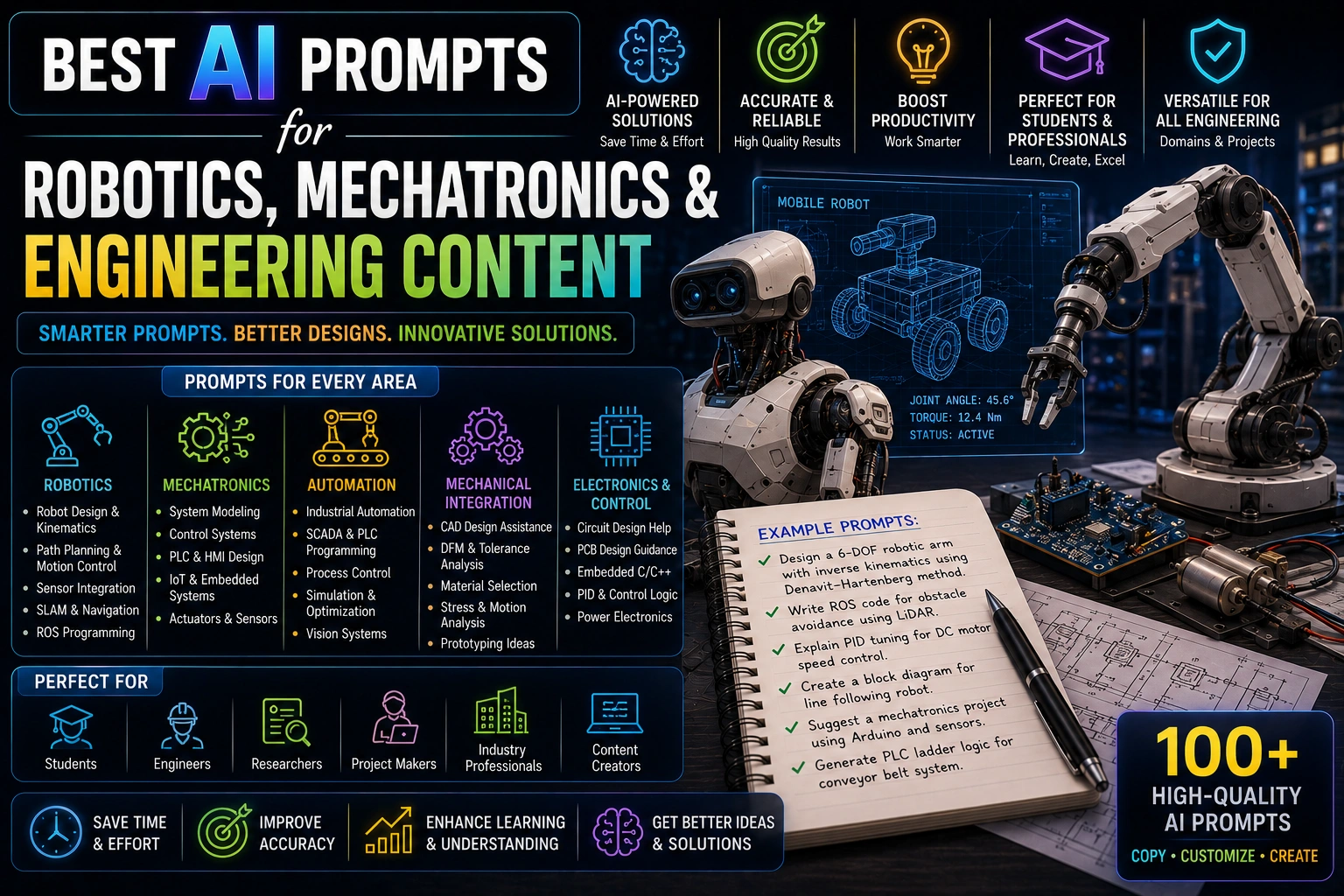
25+ Best AI Prompts for Robotics, Mechatronics & Engineering Content (Oct 2026)
Professional AI Prompts for Robot Design, Control Systems & Technical Content Creation
Written by Adnan Khan Published July 25, 2026 Updated Oct 15, 2026 10 min read
Discover 25 powerful AI prompts for robotics, mechatronics, and engineering content creation. These expert-crafted prompts help you plan robot mechanical design, structure control system logic, organize sensor and actuator integration, and turn technical projects into clear, engaging content. Whether you are a robotics engineer, hobbyist, student, or engineering content creator, these AI prompt templates will help you think faster and communicate clearly always subject to real-world testing and validation.
Updated for 2026 AI Tools Tested Prompt Templates Beginner Friendly Free to Copy & Use
AI Prompts for Robot Design, Mechatronics & Technical Content
Select a category or browse all robotics & mechatronics prompts below
1. Robot Mechanical Design Concept (VLA-Ready)
ROBOTICS
A mechanical design concept that also accounts for the onboard compute and sensor payload a modern AI "brain" needs.
Act as a robotics design assistant. Draft a mechanical design
concept for a [robot type, e.g. mobile robot, robotic arm]
intended to [task/goal]. Include chassis/frame approach,
degrees of freedom needed, material choices to consider
for weight and durability, and note the mounting/thermal
allowance needed if this robot will run an onboard vision-
language-action (VLA) foundation model for perception and
control rather than a purely classical control stack.
Act as a robotics design assistant. Draft a mechanical design
concept for a [robot type, e.g. mobile robot, robotic arm]
intended to [task/goal]. Include chassis/frame approach,
degrees of freedom needed, material choices to consider
for weight and durability, and note the mounting/thermal
allowance needed if this robot will run an onboard vision-
language-action (VLA) foundation model for perception and
control rather than a purely classical control stack.
Specify the robot's kinematics and dynamics, sensor types (such as LiDAR, IMU, or ultrasonic sensors), microcontroller or compute platform, and control-loop requirements (such as PID).
Review generated control code, ROS node architecture, and mathematical models for safety limits, real-time performance, error handling, units, and hardware compatibility.
Test code and configuration in simulation (for example, Gazebo) before staged physical validation on suitable hardware such as ESP32, Raspberry Pi, or STM32. Keep emergency-stop and safe-state mechanisms independent of AI-generated logic.
Real-World Use Case Example
Scaffold ROS 2 navigation nodes for a mobile robot, design and tune an adaptive PID motor-control loop, or prototype sensor-fusion logic combining IMU and LiDAR data.
2. Drive System Comparison
ROBOTICS
Compare drive system options for a mobile robot's terrain and payload.
Compare drive system options (differential drive, mecanum
wheels, tracked, legged) for a mobile robot operating on
[terrain type] carrying [payload weight]. Include maneuverability,
complexity, and cost trade-offs for each option.
Compare drive system options (differential drive, mecanum
wheels, tracked, legged) for a mobile robot operating on
[terrain type] carrying [payload weight]. Include maneuverability,
complexity, and cost trade-offs for each option.
Specify the robot's kinematics and dynamics, sensor types (such as LiDAR, IMU, or ultrasonic sensors), microcontroller or compute platform, and control-loop requirements (such as PID).
Review generated control code, ROS node architecture, and mathematical models for safety limits, real-time performance, error handling, units, and hardware compatibility.
Test code and configuration in simulation (for example, Gazebo) before staged physical validation on suitable hardware such as ESP32, Raspberry Pi, or STM32. Keep emergency-stop and safe-state mechanisms independent of AI-generated logic.
Real-World Use Case Example
Scaffold ROS 2 navigation nodes for a mobile robot, design and tune an adaptive PID motor-control loop, or prototype sensor-fusion logic combining IMU and LiDAR data.
3. Robotic Arm Kinematics Overview (Classical vs. Learned)
ROBOTICS
Standard kinematics planning, plus when a learned end-to-end policy is now a realistic alternative.
Summarize the forward and inverse kinematics approach for a
[number]-DOF robotic arm intended for [task, e.g. pick-and-place].
Include joint configuration considerations and reach/workspace
factors to evaluate before finalizing the design, and note when
a learned end-to-end manipulation policy (trained via imitation
learning on demonstration data) would be a more practical
approach than classical inverse kinematics for this specific
task - typically true for irregular objects or contact-rich
manipulation, less true for simple, well-defined reach-and-grasp
motions.
Summarize the forward and inverse kinematics approach for a
[number]-DOF robotic arm intended for [task, e.g. pick-and-place].
Include joint configuration considerations and reach/workspace
factors to evaluate before finalizing the design, and note when
a learned end-to-end manipulation policy (trained via imitation
learning on demonstration data) would be a more practical
approach than classical inverse kinematics for this specific
task - typically true for irregular objects or contact-rich
manipulation, less true for simple, well-defined reach-and-grasp
motions.
Specify the robot's kinematics and dynamics, sensor types (such as LiDAR, IMU, or ultrasonic sensors), microcontroller or compute platform, and control-loop requirements (such as PID).
Review generated control code, ROS node architecture, and mathematical models for safety limits, real-time performance, error handling, units, and hardware compatibility.
Test code and configuration in simulation (for example, Gazebo) before staged physical validation on suitable hardware such as ESP32, Raspberry Pi, or STM32. Keep emergency-stop and safe-state mechanisms independent of AI-generated logic.
Real-World Use Case Example
Scaffold ROS 2 navigation nodes for a mobile robot, design and tune an adaptive PID motor-control loop, or prototype sensor-fusion logic combining IMU and LiDAR data.
4. Sensor Selection for Navigation (Vision-First Cost Trade-off)
ROBOTICS
Sensor comparison including the camera-first, LiDAR-light approach many foundation-model-driven robots now use.
Compare sensor options (LiDAR, ultrasonic, camera, IMU) for
enabling [navigation task, e.g. obstacle avoidance, SLAM] on a
[robot type] operating in [environment type].
Include cost, accuracy, and processing requirement trade-offs,
and specifically note the trade-off between a traditional
LiDAR-heavy sensor stack versus a camera-first approach paired
with a vision-based foundation model, which many current
platforms favor for cost reasons at the expense of some raw
depth-accuracy in cluttered or low-light environments.
Compare sensor options (LiDAR, ultrasonic, camera, IMU) for
enabling [navigation task, e.g. obstacle avoidance, SLAM] on a
[robot type] operating in [environment type].
Include cost, accuracy, and processing requirement trade-offs,
and specifically note the trade-off between a traditional
LiDAR-heavy sensor stack versus a camera-first approach paired
with a vision-based foundation model, which many current
platforms favor for cost reasons at the expense of some raw
depth-accuracy in cluttered or low-light environments.
Specify the robot's kinematics and dynamics, sensor types (such as LiDAR, IMU, or ultrasonic sensors), microcontroller or compute platform, and control-loop requirements (such as PID).
Review generated control code, ROS node architecture, and mathematical models for safety limits, real-time performance, error handling, units, and hardware compatibility.
Test code and configuration in simulation (for example, Gazebo) before staged physical validation on suitable hardware such as ESP32, Raspberry Pi, or STM32. Keep emergency-stop and safe-state mechanisms independent of AI-generated logic.
Real-World Use Case Example
Scaffold ROS 2 navigation nodes for a mobile robot, design and tune an adaptive PID motor-control loop, or prototype sensor-fusion logic combining IMU and LiDAR data.
Standard ROS2 architecture, plus where a foundation-model inference node plugs into the perception/planning/control pipeline.
Draft a ROS2 node architecture for a robot performing
[task description]. Include the nodes needed, topics/services
each publishes or subscribes to, how data flows between
perception, planning, and control components, and where a
vision-language-action foundation model would sit in this graph
if used - typically as a node taking camera/sensor topics and a
natural-language goal as input and publishing action commands,
running either onboard (for latency-sensitive control) or via a
compute-offload service (for heavier reasoning).
Draft a ROS2 node architecture for a robot performing
[task description]. Include the nodes needed, topics/services
each publishes or subscribes to, how data flows between
perception, planning, and control components, and where a
vision-language-action foundation model would sit in this graph
if used - typically as a node taking camera/sensor topics and a
natural-language goal as input and publishing action commands,
running either onboard (for latency-sensitive control) or via a
compute-offload service (for heavier reasoning).
Specify the robot's kinematics and dynamics, sensor types (such as LiDAR, IMU, or ultrasonic sensors), microcontroller or compute platform, and control-loop requirements (such as PID).
Review generated control code, ROS node architecture, and mathematical models for safety limits, real-time performance, error handling, units, and hardware compatibility.
Test code and configuration in simulation (for example, Gazebo) before staged physical validation on suitable hardware such as ESP32, Raspberry Pi, or STM32. Keep emergency-stop and safe-state mechanisms independent of AI-generated logic.
Real-World Use Case Example
Scaffold ROS 2 navigation nodes for a mobile robot, design and tune an adaptive PID motor-control loop, or prototype sensor-fusion logic combining IMU and LiDAR data.
Classical planners, plus when a learned or "world model"-based planner is worth considering for dynamic environments.
Compare path planning algorithms (A*, RRT, Dijkstra, potential
fields) for navigating a [robot type] through
[environment description, e.g. cluttered indoor space].
Include computation cost, path optimality, and dynamic obstacle
handling trade-offs, and note where a learned planner or a
predictive "world model" (which lets the robot simulate the
likely outcome of a candidate path before committing to it)
would outperform classical planners in a highly dynamic,
hard-to-model environment, at the cost of needing training data
and being less interpretable.
Compare path planning algorithms (A*, RRT, Dijkstra, potential
fields) for navigating a [robot type] through
[environment description, e.g. cluttered indoor space].
Include computation cost, path optimality, and dynamic obstacle
handling trade-offs, and note where a learned planner or a
predictive "world model" (which lets the robot simulate the
likely outcome of a candidate path before committing to it)
would outperform classical planners in a highly dynamic,
hard-to-model environment, at the cost of needing training data
and being less interpretable.
Specify the robot's kinematics and dynamics, sensor types (such as LiDAR, IMU, or ultrasonic sensors), microcontroller or compute platform, and control-loop requirements (such as PID).
Review generated control code, ROS node architecture, and mathematical models for safety limits, real-time performance, error handling, units, and hardware compatibility.
Test code and configuration in simulation (for example, Gazebo) before staged physical validation on suitable hardware such as ESP32, Raspberry Pi, or STM32. Keep emergency-stop and safe-state mechanisms independent of AI-generated logic.
Real-World Use Case Example
Scaffold ROS 2 navigation nodes for a mobile robot, design and tune an adaptive PID motor-control loop, or prototype sensor-fusion logic combining IMU and LiDAR data.
Gripper fundamentals plus the dexterous, human-hand-like manipulation now central to humanoid development.
Draft a gripper/end-effector design concept for handling
[object type, e.g. fragile, irregular shaped, variable size]
objects. Include gripping mechanism options (parallel jaw,
suction, soft robotic), actuation method, and force
considerations, and if the application eventually needs
human-like dexterity (multi-fingered, in-hand reorientation, or
bimanual coordination), note why that remains one of the harder
open problems in current robotics versus a simpler task-specific
gripper.
Draft a gripper/end-effector design concept for handling
[object type, e.g. fragile, irregular shaped, variable size]
objects. Include gripping mechanism options (parallel jaw,
suction, soft robotic), actuation method, and force
considerations, and if the application eventually needs
human-like dexterity (multi-fingered, in-hand reorientation, or
bimanual coordination), note why that remains one of the harder
open problems in current robotics versus a simpler task-specific
gripper.
Specify the robot's kinematics and dynamics, sensor types (such as LiDAR, IMU, or ultrasonic sensors), microcontroller or compute platform, and control-loop requirements (such as PID).
Review generated control code, ROS node architecture, and mathematical models for safety limits, real-time performance, error handling, units, and hardware compatibility.
Test code and configuration in simulation (for example, Gazebo) before staged physical validation on suitable hardware such as ESP32, Raspberry Pi, or STM32. Keep emergency-stop and safe-state mechanisms independent of AI-generated logic.
Real-World Use Case Example
Scaffold ROS 2 navigation nodes for a mobile robot, design and tune an adaptive PID motor-control loop, or prototype sensor-fusion logic combining IMU and LiDAR data.
8. Robot Behavior Tree Design (LLM-Grounded Task Planning)
ROBOTICS
Behavior tree fundamentals plus how an LLM can translate a natural-language goal into that tree's structure.
Design a behavior tree for a robot performing
[task description, e.g. autonomous delivery with obstacle
handling]. Include the sequence, selector, and condition nodes
needed, how failure/fallback behaviors are structured, and
describe how an LLM-based task planner ("code as policies"
style) could take a plain natural-language instruction from an
operator and generate or select the appropriate behavior-tree
nodes at runtime, including what safety checks should gate any
LLM-generated action before it reaches the physical robot.
Design a behavior tree for a robot performing
[task description, e.g. autonomous delivery with obstacle
handling]. Include the sequence, selector, and condition nodes
needed, how failure/fallback behaviors are structured, and
describe how an LLM-based task planner ("code as policies"
style) could take a plain natural-language instruction from an
operator and generate or select the appropriate behavior-tree
nodes at runtime, including what safety checks should gate any
LLM-generated action before it reaches the physical robot.
Specify the robot's kinematics and dynamics, sensor types (such as LiDAR, IMU, or ultrasonic sensors), microcontroller or compute platform, and control-loop requirements (such as PID).
Review generated control code, ROS node architecture, and mathematical models for safety limits, real-time performance, error handling, units, and hardware compatibility.
Test code and configuration in simulation (for example, Gazebo) before staged physical validation on suitable hardware such as ESP32, Raspberry Pi, or STM32. Keep emergency-stop and safe-state mechanisms independent of AI-generated logic.
Real-World Use Case Example
Scaffold ROS 2 navigation nodes for a mobile robot, design and tune an adaptive PID motor-control loop, or prototype sensor-fusion logic combining IMU and LiDAR data.
9. Multi-Robot Coordination Strategy
ROBOTICS
Coordination logic for multiple robots collaborating on a shared task.
Outline a coordination strategy for [number] robots
collaborating on [task, e.g. warehouse item retrieval].
Include task allocation approach, collision avoidance between
robots, and communication method for sharing status updates.
Outline a coordination strategy for [number] robots
collaborating on [task, e.g. warehouse item retrieval].
Include task allocation approach, collision avoidance between
robots, and communication method for sharing status updates.
Specify the robot's kinematics and dynamics, sensor types (such as LiDAR, IMU, or ultrasonic sensors), microcontroller or compute platform, and control-loop requirements (such as PID).
Review generated control code, ROS node architecture, and mathematical models for safety limits, real-time performance, error handling, units, and hardware compatibility.
Test code and configuration in simulation (for example, Gazebo) before staged physical validation on suitable hardware such as ESP32, Raspberry Pi, or STM32. Keep emergency-stop and safe-state mechanisms independent of AI-generated logic.
Real-World Use Case Example
Scaffold ROS 2 navigation nodes for a mobile robot, design and tune an adaptive PID motor-control loop, or prototype sensor-fusion logic combining IMU and LiDAR data.
Standard actuator comparison, plus the shift toward higher-power-density electric actuators in place of hydraulics.
Compare actuator options (DC motor, stepper motor, servo,
linear actuator) for [motion requirement, e.g. precise
positioning, continuous rotation] in a
[system description]. Include torque/speed, precision, and
cost trade-offs for each option, and if this system needs
high force in a compact package (as in humanoid joints), note
how newer high-power-density electric actuators are increasingly
replacing hydraulic actuation for this use case, trading some
peak force for lower maintenance and easier control integration.
Compare actuator options (DC motor, stepper motor, servo,
linear actuator) for [motion requirement, e.g. precise
positioning, continuous rotation] in a
[system description]. Include torque/speed, precision, and
cost trade-offs for each option, and if this system needs
high force in a compact package (as in humanoid joints), note
how newer high-power-density electric actuators are increasingly
replacing hydraulic actuation for this use case, trading some
peak force for lower maintenance and easier control integration.
Specify the robot's kinematics and dynamics, sensor types (such as LiDAR, IMU, or ultrasonic sensors), microcontroller or compute platform, and control-loop requirements (such as PID).
Review generated control code, ROS node architecture, and mathematical models for safety limits, real-time performance, error handling, units, and hardware compatibility.
Test code and configuration in simulation (for example, Gazebo) before staged physical validation on suitable hardware such as ESP32, Raspberry Pi, or STM32. Keep emergency-stop and safe-state mechanisms independent of AI-generated logic.
Real-World Use Case Example
Scaffold ROS 2 navigation nodes for a mobile robot, design and tune an adaptive PID motor-control loop, or prototype sensor-fusion logic combining IMU and LiDAR data.
11. Motor Driver & Control Circuit Overview
MECHATRONICS
Motor driver selection for a given motor and control platform.
Summarize motor driver options for controlling a
[motor type] rated at [voltage/current] from a
[microcontroller/embedded platform]. Include H-bridge
considerations, PWM control approach, and protection circuitry
to include.
Summarize motor driver options for controlling a
[motor type] rated at [voltage/current] from a
[microcontroller/embedded platform]. Include H-bridge
considerations, PWM control approach, and protection circuitry
to include.
Specify the robot's kinematics and dynamics, sensor types (such as LiDAR, IMU, or ultrasonic sensors), microcontroller or compute platform, and control-loop requirements (such as PID).
Review generated control code, ROS node architecture, and mathematical models for safety limits, real-time performance, error handling, units, and hardware compatibility.
Test code and configuration in simulation (for example, Gazebo) before staged physical validation on suitable hardware such as ESP32, Raspberry Pi, or STM32. Keep emergency-stop and safe-state mechanisms independent of AI-generated logic.
Real-World Use Case Example
Scaffold ROS 2 navigation nodes for a mobile robot, design and tune an adaptive PID motor-control loop, or prototype sensor-fusion logic combining IMU and LiDAR data.
Standard PID tuning, plus when a learned control policy is now the more realistic choice for highly nonlinear balance tasks.
Help me structure a PID control approach for
[system description, e.g. balancing a two-wheeled robot,
controlling a motor's speed]. Include which variable to control,
starting gain tuning approach, and signs the system is
oscillating vs. sluggish, and if this is a highly nonlinear,
whole-body balance problem (like bipedal or humanoid locomotion),
note why a reinforcement-learning-trained control policy has
become the more common approach for that specific class of
problem versus a hand-tuned PID/cascaded-PID controller.
Help me structure a PID control approach for
[system description, e.g. balancing a two-wheeled robot,
controlling a motor's speed]. Include which variable to control,
starting gain tuning approach, and signs the system is
oscillating vs. sluggish, and if this is a highly nonlinear,
whole-body balance problem (like bipedal or humanoid locomotion),
note why a reinforcement-learning-trained control policy has
become the more common approach for that specific class of
problem versus a hand-tuned PID/cascaded-PID controller.
Specify the robot's kinematics and dynamics, sensor types (such as LiDAR, IMU, or ultrasonic sensors), microcontroller or compute platform, and control-loop requirements (such as PID).
Review generated control code, ROS node architecture, and mathematical models for safety limits, real-time performance, error handling, units, and hardware compatibility.
Test code and configuration in simulation (for example, Gazebo) before staged physical validation on suitable hardware such as ESP32, Raspberry Pi, or STM32. Keep emergency-stop and safe-state mechanisms independent of AI-generated logic.
Real-World Use Case Example
Scaffold ROS 2 navigation nodes for a mobile robot, design and tune an adaptive PID motor-control loop, or prototype sensor-fusion logic combining IMU and LiDAR data.
Standard firmware architecture, plus the interface needed to an onboard edge-AI inference module.
Draft a firmware architecture for an embedded system
controlling [device description] on
[microcontroller platform, e.g. Arduino, STM32, ESP32].
Include main loop structure, interrupt usage, and sensor
polling/reading strategy, and if this device receives commands
from an onboard edge-AI inference module (e.g. a lightweight
on-device vision-language-action model) rather than purely
hard-coded logic, define the message-passing interface and a
watchdog/fallback rule for what the firmware does if the AI
module produces no command or an out-of-range one.
Draft a firmware architecture for an embedded system
controlling [device description] on
[microcontroller platform, e.g. Arduino, STM32, ESP32].
Include main loop structure, interrupt usage, and sensor
polling/reading strategy, and if this device receives commands
from an onboard edge-AI inference module (e.g. a lightweight
on-device vision-language-action model) rather than purely
hard-coded logic, define the message-passing interface and a
watchdog/fallback rule for what the firmware does if the AI
module produces no command or an out-of-range one.
Specify the robot's kinematics and dynamics, sensor types (such as LiDAR, IMU, or ultrasonic sensors), microcontroller or compute platform, and control-loop requirements (such as PID).
Review generated control code, ROS node architecture, and mathematical models for safety limits, real-time performance, error handling, units, and hardware compatibility.
Test code and configuration in simulation (for example, Gazebo) before staged physical validation on suitable hardware such as ESP32, Raspberry Pi, or STM32. Keep emergency-stop and safe-state mechanisms independent of AI-generated logic.
Real-World Use Case Example
Scaffold ROS 2 navigation nodes for a mobile robot, design and tune an adaptive PID motor-control loop, or prototype sensor-fusion logic combining IMU and LiDAR data.
14. Sensor Integration & ROS 2 Wiring Overview
MECHATRONICS
Wiring, communication, and software setup for integrating a sensor with a microcontroller or onboard computer.
Summarize the wiring and communication setup for integrating a
[sensor type, e.g. IMU, LiDAR, depth camera, encoder] with a
[microcontroller or onboard computer]. Include protocol
(I2C/SPI/UART/CAN/USB/Ethernet), pull-up resistor and level-shifting
needs, power and grounding practices, cable shielding, time
synchronization between sensors, how the data is published into a
ROS 2 node, and common wiring mistakes to avoid. List the datasheet
values to verify before powering the system.
Summarize the wiring and communication setup for integrating a
[sensor type, e.g. IMU, LiDAR, depth camera, encoder] with a
[microcontroller or onboard computer]. Include protocol
(I2C/SPI/UART/CAN/USB/Ethernet), pull-up resistor and level-shifting
needs, power and grounding practices, cable shielding, time
synchronization between sensors, how the data is published into a
ROS 2 node, and common wiring mistakes to avoid. List the datasheet
values to verify before powering the system.
Specify the robot's kinematics and dynamics, sensor types (such as LiDAR, IMU, or ultrasonic sensors), microcontroller or compute platform, and control-loop requirements (such as PID).
Review generated control code, ROS node architecture, and mathematical models for safety limits, real-time performance, error handling, units, and hardware compatibility.
Test code and configuration in simulation (for example, Gazebo) before staged physical validation on suitable hardware such as ESP32, Raspberry Pi, or STM32. Keep emergency-stop and safe-state mechanisms independent of AI-generated logic.
Real-World Use Case Example
Scaffold ROS 2 navigation nodes for a mobile robot, design and tune an adaptive PID motor-control loop, or prototype sensor-fusion logic combining IMU and LiDAR data.
15. Power Budget Planning (Battery-Life & Compute Aware)
MECHATRONICS
A power budget worksheet that includes onboard AI compute and peak motor loads, which now drive battery life.
Create a power budget worksheet for a robot with these
components: [list components, e.g. motors, microcontroller,
onboard AI computer, cameras, LiDAR, radio]. Include average and
peak current draw per component, total system draw, voltage rails
and converter efficiency, battery capacity and runtime calculation
approach, and the effect of onboard AI compute load on runtime.
Compare the resulting runtime against the task's required operating
duration, and list options to close any gap (larger battery, lower
compute load, duty cycling, charging strategy).
Create a power budget worksheet for a robot with these
components: [list components, e.g. motors, microcontroller,
onboard AI computer, cameras, LiDAR, radio]. Include average and
peak current draw per component, total system draw, voltage rails
and converter efficiency, battery capacity and runtime calculation
approach, and the effect of onboard AI compute load on runtime.
Compare the resulting runtime against the task's required operating
duration, and list options to close any gap (larger battery, lower
compute load, duty cycling, charging strategy).
Specify the robot's kinematics and dynamics, sensor types (such as LiDAR, IMU, or ultrasonic sensors), microcontroller or compute platform, and control-loop requirements (such as PID).
Review generated control code, ROS node architecture, and mathematical models for safety limits, real-time performance, error handling, units, and hardware compatibility.
Test code and configuration in simulation (for example, Gazebo) before staged physical validation on suitable hardware such as ESP32, Raspberry Pi, or STM32. Keep emergency-stop and safe-state mechanisms independent of AI-generated logic.
Real-World Use Case Example
Scaffold ROS 2 navigation nodes for a mobile robot, design and tune an adaptive PID motor-control loop, or prototype sensor-fusion logic combining IMU and LiDAR data.
16. Sim-to-Real Validation & Safety Test Plan
MECHATRONICS
Plan how a robot is tested in simulation, then in the real world, with safety checks before each step.
Draft a validation plan for a [prototype description, e.g. a
mobile manipulator, robotic arm, legged robot] moving from
simulation to hardware. Include simulation tests and the physics
parameters to match to the real robot, hardware-in-the-loop tests,
low-speed and low-torque first trials, emergency stop and
speed-limit checks, functional tests, stress and durability tests,
and what data to log during each test. List the pass/fail criteria
for moving to the next stage and the safety standards to confirm
for the intended workplace.
Draft a validation plan for a [prototype description, e.g. a
mobile manipulator, robotic arm, legged robot] moving from
simulation to hardware. Include simulation tests and the physics
parameters to match to the real robot, hardware-in-the-loop tests,
low-speed and low-torque first trials, emergency stop and
speed-limit checks, functional tests, stress and durability tests,
and what data to log during each test. List the pass/fail criteria
for moving to the next stage and the safety standards to confirm
for the intended workplace.
Specify the robot's kinematics and dynamics, sensor types (such as LiDAR, IMU, or ultrasonic sensors), microcontroller or compute platform, and control-loop requirements (such as PID).
Review generated control code, ROS node architecture, and mathematical models for safety limits, real-time performance, error handling, units, and hardware compatibility.
Test code and configuration in simulation (for example, Gazebo) before staged physical validation on suitable hardware such as ESP32, Raspberry Pi, or STM32. Keep emergency-stop and safe-state mechanisms independent of AI-generated logic.
Real-World Use Case Example
Scaffold ROS 2 navigation nodes for a mobile robot, design and tune an adaptive PID motor-control loop, or prototype sensor-fusion logic combining IMU and LiDAR data.
17. Humanoid & Legged Robot Actuator Selection
MECHATRONICS
Organize joint actuator selection for humanoid and legged robot designs.
Summarize actuator selection considerations for the
[joint, e.g. knee, hip, shoulder, gripper] of a [humanoid / legged
robot] with a total mass of [kg]. Include required peak and
continuous torque, speed range, backdrivability, gear ratio options
(quasi-direct drive, planetary, harmonic), motor type, encoder and
torque sensing options, thermal limits, efficiency, weight, cost,
and the control interface (CAN, EtherCAT). Present as a comparison
table for engineer review, noting values to confirm with
manufacturer data.
Summarize actuator selection considerations for the
[joint, e.g. knee, hip, shoulder, gripper] of a [humanoid / legged
robot] with a total mass of [kg]. Include required peak and
continuous torque, speed range, backdrivability, gear ratio options
(quasi-direct drive, planetary, harmonic), motor type, encoder and
torque sensing options, thermal limits, efficiency, weight, cost,
and the control interface (CAN, EtherCAT). Present as a comparison
table for engineer review, noting values to confirm with
manufacturer data.
Specify the robot's kinematics and dynamics, sensor types (such as LiDAR, IMU, or ultrasonic sensors), microcontroller or compute platform, and control-loop requirements (such as PID).
Review generated control code, ROS node architecture, and mathematical models for safety limits, real-time performance, error handling, units, and hardware compatibility.
Test code and configuration in simulation (for example, Gazebo) before staged physical validation on suitable hardware such as ESP32, Raspberry Pi, or STM32. Keep emergency-stop and safe-state mechanisms independent of AI-generated logic.
Real-World Use Case Example
Scaffold ROS 2 navigation nodes for a mobile robot, design and tune an adaptive PID motor-control loop, or prototype sensor-fusion logic combining IMU and LiDAR data.
18. Robotics Demo Short-Form Video Script
CONTENT
Write a 30-60 second script that shows a robot project working, built for Reels, Shorts, and TikTok.
Write a 30-60 second short-form video script for my robotics
project: [project/robot description]. Open with the most impressive
result in the first 2 seconds, show the robot working before
explaining it, explain the one key idea with a simple analogy, show
one failure or surprise to build trust, and end with what I'm
building next. Include on-screen text for each beat, a shot list
for filming with a phone, and a caption. Do not claim performance
numbers I haven't measured.
Write a 30-60 second short-form video script for my robotics
project: [project/robot description]. Open with the most impressive
result in the first 2 seconds, show the robot working before
explaining it, explain the one key idea with a simple analogy, show
one failure or surprise to build trust, and end with what I'm
building next. Include on-screen text for each beat, a shot list
for filming with a phone, and a caption. Do not claim performance
numbers I haven't measured.
Specify the robot's kinematics and dynamics, sensor types (such as LiDAR, IMU, or ultrasonic sensors), microcontroller or compute platform, and control-loop requirements (such as PID).
Review generated control code, ROS node architecture, and mathematical models for safety limits, real-time performance, error handling, units, and hardware compatibility.
Test code and configuration in simulation (for example, Gazebo) before staged physical validation on suitable hardware such as ESP32, Raspberry Pi, or STM32. Keep emergency-stop and safe-state mechanisms independent of AI-generated logic.
Real-World Use Case Example
Scaffold ROS 2 navigation nodes for a mobile robot, design and tune an adaptive PID motor-control loop, or prototype sensor-fusion logic combining IMU and LiDAR data.
19. Build Log Post with Reproducibility Section
CONTENT
Turn project notes into a build log that others can actually reproduce.
Turn these rough project notes into a polished build log blog
post: [paste notes]. Organize into sections (goal, design
decisions, challenges faced, results), then add a reproducibility
section with the parts list, software versions, wiring summary,
settings used, a link placeholder for code and CAD files, and known
limitations. Keep the tone practical and specific, include what
failed and why, and do not invent measurements or results that are
not in my notes.
Turn these rough project notes into a polished build log blog
post: [paste notes]. Organize into sections (goal, design
decisions, challenges faced, results), then add a reproducibility
section with the parts list, software versions, wiring summary,
settings used, a link placeholder for code and CAD files, and known
limitations. Keep the tone practical and specific, include what
failed and why, and do not invent measurements or results that are
not in my notes.
Specify the robot's kinematics and dynamics, sensor types (such as LiDAR, IMU, or ultrasonic sensors), microcontroller or compute platform, and control-loop requirements (such as PID).
Review generated control code, ROS node architecture, and mathematical models for safety limits, real-time performance, error handling, units, and hardware compatibility.
Test code and configuration in simulation (for example, Gazebo) before staged physical validation on suitable hardware such as ESP32, Raspberry Pi, or STM32. Keep emergency-stop and safe-state mechanisms independent of AI-generated logic.
Real-World Use Case Example
Scaffold ROS 2 navigation nodes for a mobile robot, design and tune an adaptive PID motor-control loop, or prototype sensor-fusion logic combining IMU and LiDAR data.
20. Technical Concept Simplifier (Including AI Robotics)
CONTENT
Explain a complex robotics or AI concept in plain language without losing accuracy.
Explain [technical concept, e.g. inverse kinematics, PID control,
sensor fusion, SLAM, imitation learning, vision-language-action
models] in plain language for someone with no engineering
background. Use a relatable analogy, avoid jargon, and keep the
explanation technically accurate. Then add a "where the analogy
breaks down" note, one real example of it in a robot, and a
one-sentence version suitable for a video caption.
Explain [technical concept, e.g. inverse kinematics, PID control,
sensor fusion, SLAM, imitation learning, vision-language-action
models] in plain language for someone with no engineering
background. Use a relatable analogy, avoid jargon, and keep the
explanation technically accurate. Then add a "where the analogy
breaks down" note, one real example of it in a robot, and a
one-sentence version suitable for a video caption.
Specify the robot's kinematics and dynamics, sensor types (such as LiDAR, IMU, or ultrasonic sensors), microcontroller or compute platform, and control-loop requirements (such as PID).
Review generated control code, ROS node architecture, and mathematical models for safety limits, real-time performance, error handling, units, and hardware compatibility.
Test code and configuration in simulation (for example, Gazebo) before staged physical validation on suitable hardware such as ESP32, Raspberry Pi, or STM32. Keep emergency-stop and safe-state mechanisms independent of AI-generated logic.
Real-World Use Case Example
Scaffold ROS 2 navigation nodes for a mobile robot, design and tune an adaptive PID motor-control loop, or prototype sensor-fusion logic combining IMU and LiDAR data.
21. Low-Cost Robot Arm & Imitation Learning Tutorial Outline
CONTENT
Structure a step-by-step tutorial for building a small robot and teaching it a task by demonstration.
Create a step-by-step tutorial outline for building [project, e.g.
a low-cost robot arm or a line-following robot] with a [controller
platform], then training it to do [simple task] using demonstration
data and simulation. Include a parts list with approximate costs,
ordered build steps, software setup with ROS 2 or an open-source
robot learning toolkit, how to record demonstrations, how to train
and test safely in simulation first, a troubleshooting section for
common beginner issues, and safety notes for working with motors
and batteries.
Create a step-by-step tutorial outline for building [project, e.g.
a low-cost robot arm or a line-following robot] with a [controller
platform], then training it to do [simple task] using demonstration
data and simulation. Include a parts list with approximate costs,
ordered build steps, software setup with ROS 2 or an open-source
robot learning toolkit, how to record demonstrations, how to train
and test safely in simulation first, a troubleshooting section for
common beginner issues, and safety notes for working with motors
and batteries.
Specify the robot's kinematics and dynamics, sensor types (such as LiDAR, IMU, or ultrasonic sensors), microcontroller or compute platform, and control-loop requirements (such as PID).
Review generated control code, ROS node architecture, and mathematical models for safety limits, real-time performance, error handling, units, and hardware compatibility.
Test code and configuration in simulation (for example, Gazebo) before staged physical validation on suitable hardware such as ESP32, Raspberry Pi, or STM32. Keep emergency-stop and safe-state mechanisms independent of AI-generated logic.
Real-World Use Case Example
Scaffold ROS 2 navigation nodes for a mobile robot, design and tune an adaptive PID motor-control loop, or prototype sensor-fusion logic combining IMU and LiDAR data.
22. Engineering Content Title & Thumbnail Ideas
CONTENT
Generate accurate, engaging titles for technical content.
Generate 8 title options and 3 thumbnail concept ideas for a
video/post about [project/topic]. Titles should be clear about
what the viewer will learn, avoiding exaggerated claims that
don't match the content.
Generate 8 title options and 3 thumbnail concept ideas for a
video/post about [project/topic]. Titles should be clear about
what the viewer will learn, avoiding exaggerated claims that
don't match the content.
Specify the robot's kinematics and dynamics, sensor types (such as LiDAR, IMU, or ultrasonic sensors), microcontroller or compute platform, and control-loop requirements (such as PID).
Review generated control code, ROS node architecture, and mathematical models for safety limits, real-time performance, error handling, units, and hardware compatibility.
Test code and configuration in simulation (for example, Gazebo) before staged physical validation on suitable hardware such as ESP32, Raspberry Pi, or STM32. Keep emergency-stop and safe-state mechanisms independent of AI-generated logic.
Real-World Use Case Example
Scaffold ROS 2 navigation nodes for a mobile robot, design and tune an adaptive PID motor-control loop, or prototype sensor-fusion logic combining IMU and LiDAR data.
23. Failure/Lessons-Learned Post Draft
CONTENT
Turn a project setback into an honest, useful lessons-learned post.
Help me write a lessons-learned post about
[describe what went wrong in the project].
Explain what was tried, why it didn't work, what was changed,
and the key takeaway other builders can apply to their own
projects.
Help me write a lessons-learned post about
[describe what went wrong in the project].
Explain what was tried, why it didn't work, what was changed,
and the key takeaway other builders can apply to their own
projects.
Specify the robot's kinematics and dynamics, sensor types (such as LiDAR, IMU, or ultrasonic sensors), microcontroller or compute platform, and control-loop requirements (such as PID).
Review generated control code, ROS node architecture, and mathematical models for safety limits, real-time performance, error handling, units, and hardware compatibility.
Test code and configuration in simulation (for example, Gazebo) before staged physical validation on suitable hardware such as ESP32, Raspberry Pi, or STM32. Keep emergency-stop and safe-state mechanisms independent of AI-generated logic.
Real-World Use Case Example
Scaffold ROS 2 navigation nodes for a mobile robot, design and tune an adaptive PID motor-control loop, or prototype sensor-fusion logic combining IMU and LiDAR data.
24. Engineering Project Comparison Post
CONTENT
Compare two approaches or platforms for a technical audience.
Write a comparison post between [approach/platform A] and
[approach/platform B] for [use case, e.g. hobbyist robotics
projects]. Include a clear criteria table, pros and cons for
each, and a recommendation based on different use cases.
Write a comparison post between [approach/platform A] and
[approach/platform B] for [use case, e.g. hobbyist robotics
projects]. Include a clear criteria table, pros and cons for
each, and a recommendation based on different use cases.
Specify the robot's kinematics and dynamics, sensor types (such as LiDAR, IMU, or ultrasonic sensors), microcontroller or compute platform, and control-loop requirements (such as PID).
Review generated control code, ROS node architecture, and mathematical models for safety limits, real-time performance, error handling, units, and hardware compatibility.
Test code and configuration in simulation (for example, Gazebo) before staged physical validation on suitable hardware such as ESP32, Raspberry Pi, or STM32. Keep emergency-stop and safe-state mechanisms independent of AI-generated logic.
Real-World Use Case Example
Scaffold ROS 2 navigation nodes for a mobile robot, design and tune an adaptive PID motor-control loop, or prototype sensor-fusion logic combining IMU and LiDAR data.
25. Simulation-Before-Hardware Test Plan
ROBOTICS
Plan what to validate in simulation before building hardware.
Outline what aspects of [robot/system description] should be
validated in simulation (e.g. Gazebo, Webots) before committing
to physical hardware. Include control logic checks, expected
edge cases to simulate, and what simulation can't fully replace.
Outline what aspects of [robot/system description] should be
validated in simulation (e.g. Gazebo, Webots) before committing
to physical hardware. Include control logic checks, expected
edge cases to simulate, and what simulation can't fully replace.
Specify the robot's kinematics and dynamics, sensor types (such as LiDAR, IMU, or ultrasonic sensors), microcontroller or compute platform, and control-loop requirements (such as PID).
Review generated control code, ROS node architecture, and mathematical models for safety limits, real-time performance, error handling, units, and hardware compatibility.
Test code and configuration in simulation (for example, Gazebo) before staged physical validation on suitable hardware such as ESP32, Raspberry Pi, or STM32. Keep emergency-stop and safe-state mechanisms independent of AI-generated logic.
Real-World Use Case Example
Scaffold ROS 2 navigation nodes for a mobile robot, design and tune an adaptive PID motor-control loop, or prototype sensor-fusion logic combining IMU and LiDAR data.
Optimizing Your Robotics and Mechatronics Engineering Workflow with AI
Use AI as a design and documentation assistant across requirements, system architecture, modeling, implementation, simulation, and verification. Begin with measurable requirements: payload, workspace, speed, accuracy, operating environment, power budget, compute limits, and safety constraints. Ask for assumptions and missing inputs before requesting a design. Keep requirements, CAD revisions, firmware versions, calibration values, and test results in a version-controlled project record.
For robotics software, use ROS 2 interfaces and modular nodes where appropriate; use MATLAB/Simulink for modeling and controller analysis, and Gazebo for repeatable simulation. Treat model-generated equations, code, wiring suggestions, and component ratings as drafts that require engineering review.
Step-by-Step Guide: Generating Embedded Control Logic and Kinematic Models from Prompts
Define the system: provide the robot type, joint count, coordinate frames, actuator and sensor models, units, operating range, target behavior, and available compute resources.
Request explicit assumptions: ask for coordinate-frame conventions, equations, parameter definitions, sample rates, interface contracts, and missing data instead of allowing the model to invent specifications.
Generate a reviewable design: request forward/inverse kinematics, controller pseudocode, ROS 2 node/topic diagrams, error handling, and test cases in separate deliverables.
Verify incrementally: check dimensions and equations independently, run unit and integration tests, simulate expected and edge-case behavior, and compare results against known reference cases.
Deploy in stages: move from simulation to hardware-in-the-loop and then controlled, low-speed hardware tests with physical safeguards and a documented rollback plan.
The Science Behind Effective AI Mechatronics and Robotic Simulation Prompts
Simulation quality depends on the fidelity of the model and the quality of the prompt. Specify geometry, mass and inertia, joint limits, friction, actuator dynamics, sensor noise and latency, update rates, coordinate frames, and environmental conditions. Ask the AI to identify uncertain parameters and explain how they affect the result.
In Gazebo or another simulator, compare simulated behavior with measured hardware data where available. Record the simulator version, physics settings, random seeds, initial conditions, and test scenarios so results are reproducible. Simulation cannot fully reproduce every real-world effect, including unmodeled friction, manufacturing tolerances, electrical noise, wear, or unexpected interactions.
Best Practices for Testing and Validating AI-Generated Robotic Code and Hardware Specs
Confirm all part numbers, voltage/current ratings, thermal limits, communication protocols, pinouts, and protection requirements against manufacturer datasheets.
Review generated code for unit consistency, boundary checks, timeouts, watchdog behavior, stale sensor data, communication failures, and safe handling of invalid commands.
Use static checks, unit tests, integration tests, simulation, hardware-in-the-loop, and controlled physical trials; define measurable pass/fail criteria before testing.
Verify emergency stops, mechanical limits, current limits, speed/torque limits, and safe-state behavior independently of the AI model.
Document test setup, firmware and dependency versions, logs, failures, and changes. Follow applicable machinery and robot safety requirements for the actual application and jurisdiction.
Safety note: Never connect AI-generated firmware directly to hazardous machinery without qualified review and staged testing. This guide is not a substitute for a formal risk assessment or applicable safety standards.
Unlocking Advanced Autonomous Navigation, Actuator Control, and Sensor Fusion with Expert Prompts
For autonomous navigation, specify the map representation, localization method, obstacle assumptions, operating speed, recovery behaviors, and what the robot should do when localization or communications fail. For actuator control, state torque/speed limits, control frequency, feedback source, saturation handling, and required safe states.
For sensor fusion, identify each sensor's frame, units, timestamp source, update rate, calibration status, noise characteristics, and expected failure modes. Ask for a method appropriate to the problem—such as a complementary filter, Kalman filter, or an established ROS 2 localization pipeline—and require uncertainty estimates and tests for delayed, missing, or inconsistent measurements. Validate autonomy in progressively more demanding simulations and controlled environments before operational use.
AI Prompt Templates for Robotics, Mechatronics & Engineering Content
Use these AI prompt templates to plan robot mechanical design, structure control system logic, organize sensor and actuator integration, and turn technical projects into clear engineering content. These prompts are designed to help robotics engineers, hobbyists, and content creators move faster through early-stage design and communication always subject to real-world testing and validation.
How Can AI Prompts Improve Robotics & Mechatronics Work?
AI prompts improve robotics and mechatronics work by helping compare
drive systems, sensors, and actuators, structure control logic like PID
loops and behavior trees, and organize testing plans. They also help
turn technical projects into clear tutorials, build logs, and explainer
content for wider audiences while physical designs are always
validated through real-world testing.
About the Author
Adnan Khan
Founder of I Love AI Prompt • AI Prompt Researcher • Prompt Engineering Enthusiast
Hi, I'm Adnan Khan, the founder of I Love AI Prompt. I research, test, and publish AI prompts for creators, developers, marketers, designers, students, and businesses. Every prompt on this website is reviewed and refined to improve output quality, consistency, and usability across today's leading AI tools.
This guide was created by reviewing practical AI prompt workflows and refining reusable templates for real-world results. The prompts are intended as adaptable starting points for better, faster, and more consistent AI outputs.
Frequently Asked Questions
What was updated on this page for October 2026?
This page was refreshed on October 15, 2026 with clearer robotics and mechatronics prompt guidance, implementation workflows, and additional safety and validation considerations.
What are AI prompts for robotics and mechatronics?
AI prompts for robotics and mechatronics are structured instructions
that help AI organize robot design reasoning, control system logic,
and sensor integration planning.
Can AI prompts replace hands-on robotics testing?
No. These prompts help organize design ideas, code structure, and
documentation, but physical prototypes must always be tested and
validated in the real world.
Are these prompts beginner-friendly?
Yes. Students and hobbyists can use these prompts to structure
robotics projects, though results should always be verified
through testing.
Which AI tools work best for robotics and mechatronics prompts?
These prompts work well with tools like ChatGPT and Claude, often
alongside ROS, CAD software, and microcontroller IDEs like
Arduino or PlatformIO.
Can these prompts help create engineering content for YouTube or blogs?
Yes. Several prompts are designed to help engineers and makers
turn their projects into clear, engaging technical content for
video or written platforms.
Related Guides
You May Also Like
Explore related prompt guides selected for this topic.