Professional AI Prompts for Productivity, Writing, Coding, Learning & Business
Written by Adnan Khan Published July 25, 2026 Updated Oct 15, 2026 10 min read
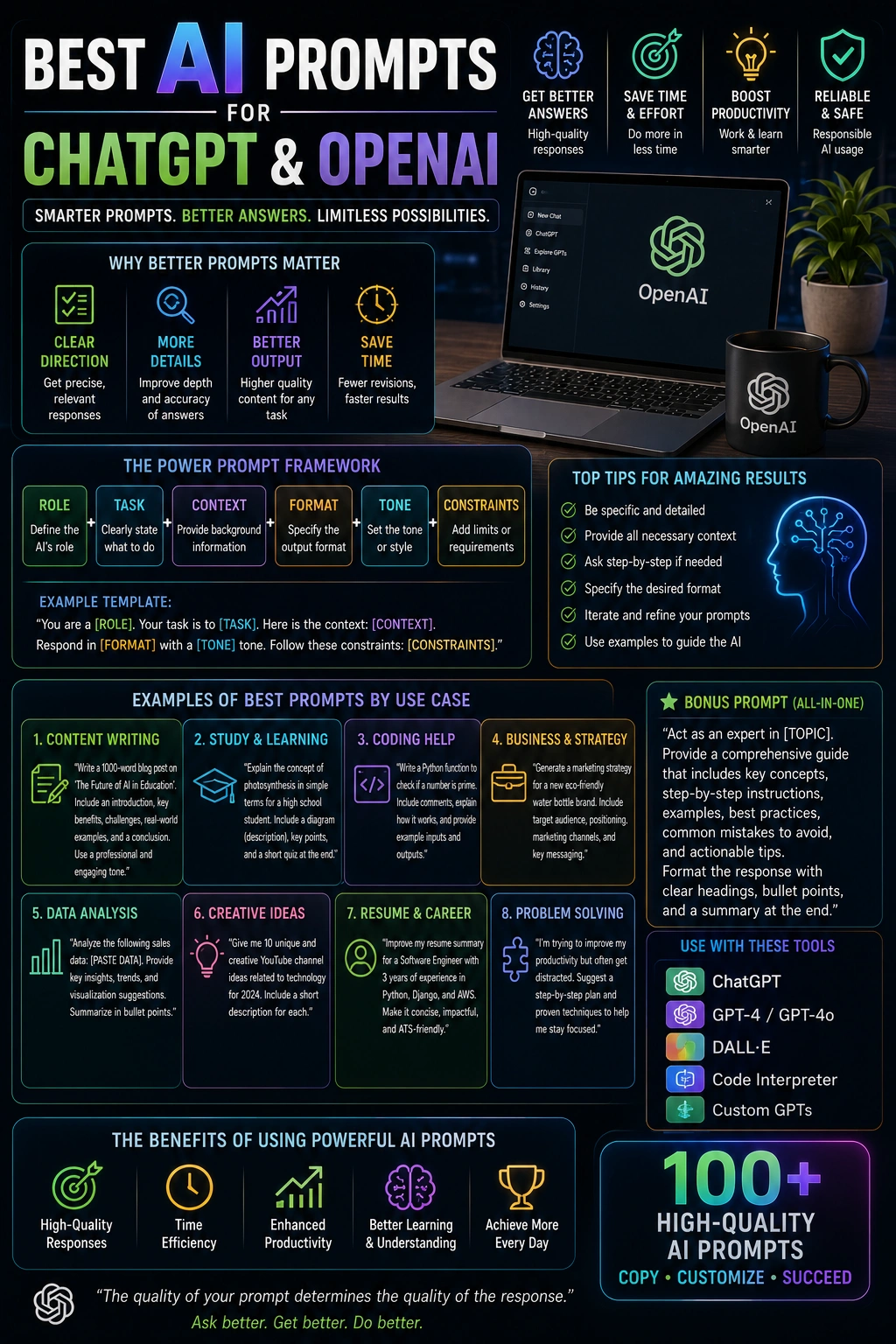
Discover 50 powerful AI prompts for ChatGPT and OpenAI to get more out of every conversation in 2026. These expert-crafted prompts help you boost daily productivity, sharpen your writing, debug and explain code, learn new topics faster, and tackle business tasks with confidence. Whether you are a student, professional, or everyday ChatGPT user, these AI prompt templates will help you get clearer, more useful answers every time.
Updated for 2026 AI Tools Tested Prompt Templates Beginner Friendly Free to Copy & Use
AI Prompts for Productivity, Writing, Coding & Business
Select a category or browse all ChatGPT & OpenAI prompts below
1. Backwards Calendar Planner
PRODUCTIVITY
Plan a goal by starting from the finish line and working backwards.
My goal is [goal] and my deadline is [date]. Plan it backwards:
describe what must be true on the deadline, then work back to
the milestones, weekly targets, and first actions needed. Flag
the tasks most likely to slip, add buffer time, and tell me
exactly what to do this week.
Recommended Tech Stack
ChatGPT (GPT-4o and available OpenAI reasoning models such as o-series where supported), OpenAI Playground, Custom GPTs, and the OpenAI API with Python or Node.js. Confirm current model names, endpoint support, and settings in OpenAI's documentation before deployment.
Quick Implementation Guide
Specify the task, persona or role, constraints, relevant context, success criteria, and a precise output schema such as Markdown or JSON. For reasoning tasks, request a concise rationale, assumptions, and verifiable checks rather than hidden chain-of-thought.
Test the prompt in ChatGPT or the OpenAI Playground using typical inputs, edge cases, and ambiguous requests. Tune system instructions and any sampling controls that are actually supported by the selected model; verify factual claims and validate structured outputs.
Package the refined prompt in a Custom GPT or production API workflow. Add input validation, secure server-side API-key handling, error handling, logging/privacy controls, and human review for consequential actions.
Real-World Use Case Example
Build a customer-support assistant that drafts policy-grounded replies with clear escalation rules, or create a data-extraction pipeline that returns schema-validated JSON for downstream processing.
My goal is [goal] and my deadline is [date]. Plan it backwards:
describe what must be true on the deadline, then work back to
the milestones, weekly targets, and first actions needed. Flag
the tasks most likely to slip, add buffer time, and tell me
exactly what to do this week.
2. AI Daily Work Agent
PRODUCTIVITY
Turn today's tasks and meetings into a realistic time-blocked plan.
Here are my tasks and meetings for today: [tasks and meetings].
Organize them by priority, effort, dependencies, and deadline.
Build a realistic time-blocked schedule, protect two hours of
focus time, group similar tasks, and flag anything that will not
fit. Identify what can be automated, delegated, or removed.
Recommended Tech Stack
ChatGPT (GPT-4o and available OpenAI reasoning models such as o-series where supported), OpenAI Playground, Custom GPTs, and the OpenAI API with Python or Node.js. Confirm current model names, endpoint support, and settings in OpenAI's documentation before deployment.
Quick Implementation Guide
Specify the task, persona or role, constraints, relevant context, success criteria, and a precise output schema such as Markdown or JSON. For reasoning tasks, request a concise rationale, assumptions, and verifiable checks rather than hidden chain-of-thought.
Test the prompt in ChatGPT or the OpenAI Playground using typical inputs, edge cases, and ambiguous requests. Tune system instructions and any sampling controls that are actually supported by the selected model; verify factual claims and validate structured outputs.
Package the refined prompt in a Custom GPT or production API workflow. Add input validation, secure server-side API-key handling, error handling, logging/privacy controls, and human review for consequential actions.
Real-World Use Case Example
Build a customer-support assistant that drafts policy-grounded replies with clear escalation rules, or create a data-extraction pipeline that returns schema-validated JSON for downstream processing.
Here are my tasks and meetings for today: [tasks and meetings].
Organize them by priority, effort, dependencies, and deadline.
Build a realistic time-blocked schedule, protect two hours of
focus time, group similar tasks, and flag anything that will not
fit. Identify what can be automated, delegated, or removed.
3. Prompt Improver (Role, Task, Context, Format)
PROMPTING
Turn a vague request into a clear prompt that gets a better answer.
Here is a rough prompt I wrote: [prompt]. Improve it using four
parts: a role for the AI, a clear task, the context it needs
(audience, goal, constraints), and the output format. Ask me up to
3 questions if important details are missing, then give me the
final improved prompt ready to copy.
Recommended Tech Stack
ChatGPT (GPT-4o and available OpenAI reasoning models such as o-series where supported), OpenAI Playground, Custom GPTs, and the OpenAI API with Python or Node.js. Confirm current model names, endpoint support, and settings in OpenAI's documentation before deployment.
Quick Implementation Guide
Specify the task, persona or role, constraints, relevant context, success criteria, and a precise output schema such as Markdown or JSON. For reasoning tasks, request a concise rationale, assumptions, and verifiable checks rather than hidden chain-of-thought.
Test the prompt in ChatGPT or the OpenAI Playground using typical inputs, edge cases, and ambiguous requests. Tune system instructions and any sampling controls that are actually supported by the selected model; verify factual claims and validate structured outputs.
Package the refined prompt in a Custom GPT or production API workflow. Add input validation, secure server-side API-key handling, error handling, logging/privacy controls, and human review for consequential actions.
Real-World Use Case Example
Build a customer-support assistant that drafts policy-grounded replies with clear escalation rules, or create a data-extraction pipeline that returns schema-validated JSON for downstream processing.
Here is a rough prompt I wrote: [prompt]. Improve it using four
parts: a role for the AI, a clear task, the context it needs
(audience, goal, constraints), and the output format. Ask me up to
3 questions if important details are missing, then give me the
final improved prompt ready to copy.
4. AI Meeting-to-Action Agent
PRODUCTIVITY
Convert meeting transcripts into decisions and next actions.
Analyze these meeting notes: [notes]. Extract decisions, action
items, owners, deadlines, unresolved questions, and follow-ups.
Return everything in a simple action table, then write a
3-sentence follow-up message I can send to the group. Mark any
owner or deadline that was not clearly stated as "unclear".
Recommended Tech Stack
ChatGPT (GPT-4o and available OpenAI reasoning models such as o-series where supported), OpenAI Playground, Custom GPTs, and the OpenAI API with Python or Node.js. Confirm current model names, endpoint support, and settings in OpenAI's documentation before deployment.
Quick Implementation Guide
Specify the task, persona or role, constraints, relevant context, success criteria, and a precise output schema such as Markdown or JSON. For reasoning tasks, request a concise rationale, assumptions, and verifiable checks rather than hidden chain-of-thought.
Test the prompt in ChatGPT or the OpenAI Playground using typical inputs, edge cases, and ambiguous requests. Tune system instructions and any sampling controls that are actually supported by the selected model; verify factual claims and validate structured outputs.
Package the refined prompt in a Custom GPT or production API workflow. Add input validation, secure server-side API-key handling, error handling, logging/privacy controls, and human review for consequential actions.
Real-World Use Case Example
Build a customer-support assistant that drafts policy-grounded replies with clear escalation rules, or create a data-extraction pipeline that returns schema-validated JSON for downstream processing.
Analyze these meeting notes: [notes]. Extract decisions, action
items, owners, deadlines, unresolved questions, and follow-ups.
Return everything in a simple action table, then write a
3-sentence follow-up message I can send to the group. Mark any
owner or deadline that was not clearly stated as "unclear".
5. AI Research Assistant (Source-Checked)
RESEARCH
Turn a research question into a plan that separates facts from claims.
I need to research [topic]. Create a research plan covering key
questions, important subtopics, the types of sources I should
trust, competing viewpoints, and the claims I must verify before
reaching a conclusion. When you give facts, label each as
well-established, disputed, or uncertain, and tell me what to
search to confirm it. Do not invent sources or statistics.
Recommended Tech Stack
ChatGPT (GPT-4o and available OpenAI reasoning models such as o-series where supported), OpenAI Playground, Custom GPTs, and the OpenAI API with Python or Node.js. Confirm current model names, endpoint support, and settings in OpenAI's documentation before deployment.
Quick Implementation Guide
Specify the task, persona or role, constraints, relevant context, success criteria, and a precise output schema such as Markdown or JSON. For reasoning tasks, request a concise rationale, assumptions, and verifiable checks rather than hidden chain-of-thought.
Test the prompt in ChatGPT or the OpenAI Playground using typical inputs, edge cases, and ambiguous requests. Tune system instructions and any sampling controls that are actually supported by the selected model; verify factual claims and validate structured outputs.
Package the refined prompt in a Custom GPT or production API workflow. Add input validation, secure server-side API-key handling, error handling, logging/privacy controls, and human review for consequential actions.
Real-World Use Case Example
Build a customer-support assistant that drafts policy-grounded replies with clear escalation rules, or create a data-extraction pipeline that returns schema-validated JSON for downstream processing.
I need to research [topic]. Create a research plan covering key
questions, important subtopics, the types of sources I should
trust, competing viewpoints, and the claims I must verify before
reaching a conclusion. When you give facts, label each as
well-established, disputed, or uncertain, and tell me what to
search to confirm it. Do not invent sources or statistics.
6. AI Study Coach
LEARNING
Learn any topic faster with a study plan, practice questions, and revision checks.
I want to learn [topic] for [exam or goal] in [time available].
Create a study plan with daily topics, short explanations in simple
language, 5 practice questions per session, and a quick revision
check every few days. Start by asking me 3 questions to find what I
already know, then explain my weak areas using an analogy.
Recommended Tech Stack
ChatGPT (GPT-4o and available OpenAI reasoning models such as o-series where supported), OpenAI Playground, Custom GPTs, and the OpenAI API with Python or Node.js. Confirm current model names, endpoint support, and settings in OpenAI's documentation before deployment.
Quick Implementation Guide
Specify the task, persona or role, constraints, relevant context, success criteria, and a precise output schema such as Markdown or JSON. For reasoning tasks, request a concise rationale, assumptions, and verifiable checks rather than hidden chain-of-thought.
Test the prompt in ChatGPT or the OpenAI Playground using typical inputs, edge cases, and ambiguous requests. Tune system instructions and any sampling controls that are actually supported by the selected model; verify factual claims and validate structured outputs.
Package the refined prompt in a Custom GPT or production API workflow. Add input validation, secure server-side API-key handling, error handling, logging/privacy controls, and human review for consequential actions.
Real-World Use Case Example
Build a customer-support assistant that drafts policy-grounded replies with clear escalation rules, or create a data-extraction pipeline that returns schema-validated JSON for downstream processing.
I want to learn [topic] for [exam or goal] in [time available].
Create a study plan with daily topics, short explanations in simple
language, 5 practice questions per session, and a quick revision
check every few days. Start by asking me 3 questions to find what I
already know, then explain my weak areas using an analogy.
7. AI Decision Assistant (Pre-Mortem)
DECISIONS
Test a decision or idea by imagining how it could fail before you commit.
I need to decide on [decision or idea]. Act as a skeptical advisor.
Compare my options using cost, benefits, risks, time, long-term
impact, and reversibility. Then run a pre-mortem: imagine it failed
six months from now and list the 5 most likely reasons. Name the one
assumption I depend on most and one cheap way to test it this week.
Recommended Tech Stack
ChatGPT (GPT-4o and available OpenAI reasoning models such as o-series where supported), OpenAI Playground, Custom GPTs, and the OpenAI API with Python or Node.js. Confirm current model names, endpoint support, and settings in OpenAI's documentation before deployment.
Quick Implementation Guide
Specify the task, persona or role, constraints, relevant context, success criteria, and a precise output schema such as Markdown or JSON. For reasoning tasks, request a concise rationale, assumptions, and verifiable checks rather than hidden chain-of-thought.
Test the prompt in ChatGPT or the OpenAI Playground using typical inputs, edge cases, and ambiguous requests. Tune system instructions and any sampling controls that are actually supported by the selected model; verify factual claims and validate structured outputs.
Package the refined prompt in a Custom GPT or production API workflow. Add input validation, secure server-side API-key handling, error handling, logging/privacy controls, and human review for consequential actions.
Real-World Use Case Example
Build a customer-support assistant that drafts policy-grounded replies with clear escalation rules, or create a data-extraction pipeline that returns schema-validated JSON for downstream processing.
I need to decide on [decision or idea]. Act as a skeptical advisor.
Compare my options using cost, benefits, risks, time, long-term
impact, and reversibility. Then run a pre-mortem: imagine it failed
six months from now and list the 5 most likely reasons. Name the one
assumption I depend on most and one cheap way to test it this week.
8. AI Email Response Assistant
COMMUNICATION
Create faster and clearer responses to important emails, in the right tone.
Analyze this email: [email]. Identify what the sender needs, the
urgency, and the best response. Draft a concise reply in a
[professional/friendly/direct] tone with a clear next step. Then
give me a shorter version and a firmer version, and tell me if
anything in the email needs a phone call instead of a reply.
Recommended Tech Stack
ChatGPT (GPT-4o and available OpenAI reasoning models such as o-series where supported), OpenAI Playground, Custom GPTs, and the OpenAI API with Python or Node.js. Confirm current model names, endpoint support, and settings in OpenAI's documentation before deployment.
Quick Implementation Guide
Specify the task, persona or role, constraints, relevant context, success criteria, and a precise output schema such as Markdown or JSON. For reasoning tasks, request a concise rationale, assumptions, and verifiable checks rather than hidden chain-of-thought.
Test the prompt in ChatGPT or the OpenAI Playground using typical inputs, edge cases, and ambiguous requests. Tune system instructions and any sampling controls that are actually supported by the selected model; verify factual claims and validate structured outputs.
Package the refined prompt in a Custom GPT or production API workflow. Add input validation, secure server-side API-key handling, error handling, logging/privacy controls, and human review for consequential actions.
Real-World Use Case Example
Build a customer-support assistant that drafts policy-grounded replies with clear escalation rules, or create a data-extraction pipeline that returns schema-validated JSON for downstream processing.
Analyze this email: [email]. Identify what the sender needs, the
urgency, and the best response. Draft a concise reply in a
[professional/friendly/direct] tone with a clear next step. Then
give me a shorter version and a firmer version, and tell me if
anything in the email needs a phone call instead of a reply.
9. AI Career & Interview Coach
CAREER
Tailor your resume and practice interviews for a specific job.
Here is my experience: [resume bullets] and the job I want:
[job description]. Rewrite my resume bullets to match the job using
only my real experience. Then act as the interviewer and ask me one
question at a time, giving feedback on each answer for clarity,
confidence, and relevance. Finish with my 3 weakest answers and how
to improve them.
Recommended Tech Stack
ChatGPT (GPT-4o and available OpenAI reasoning models such as o-series where supported), OpenAI Playground, Custom GPTs, and the OpenAI API with Python or Node.js. Confirm current model names, endpoint support, and settings in OpenAI's documentation before deployment.
Quick Implementation Guide
Specify the task, persona or role, constraints, relevant context, success criteria, and a precise output schema such as Markdown or JSON. For reasoning tasks, request a concise rationale, assumptions, and verifiable checks rather than hidden chain-of-thought.
Test the prompt in ChatGPT or the OpenAI Playground using typical inputs, edge cases, and ambiguous requests. Tune system instructions and any sampling controls that are actually supported by the selected model; verify factual claims and validate structured outputs.
Package the refined prompt in a Custom GPT or production API workflow. Add input validation, secure server-side API-key handling, error handling, logging/privacy controls, and human review for consequential actions.
Real-World Use Case Example
Build a customer-support assistant that drafts policy-grounded replies with clear escalation rules, or create a data-extraction pipeline that returns schema-validated JSON for downstream processing.
Here is my experience: [resume bullets] and the job I want:
[job description]. Rewrite my resume bullets to match the job using
only my real experience. Then act as the interviewer and ask me one
question at a time, giving feedback on each answer for clarity,
confidence, and relevance. Finish with my 3 weakest answers and how
to improve them.
10. AI Journaling & Reflection Guide
JOURNALING
A short guided reflection that replaces mindless scrolling with clear thinking.
Guide me through a 10-minute journaling session about [today / this
week / a decision]. Ask me one question at a time, starting with how
I feel and what happened, then what mattered most, what I learned,
and one small action for tomorrow. After my answers, summarize my
main insight in three sentences. Keep the tone calm and practical.
Recommended Tech Stack
ChatGPT (GPT-4o and available OpenAI reasoning models such as o-series where supported), OpenAI Playground, Custom GPTs, and the OpenAI API with Python or Node.js. Confirm current model names, endpoint support, and settings in OpenAI's documentation before deployment.
Quick Implementation Guide
Specify the task, persona or role, constraints, relevant context, success criteria, and a precise output schema such as Markdown or JSON. For reasoning tasks, request a concise rationale, assumptions, and verifiable checks rather than hidden chain-of-thought.
Test the prompt in ChatGPT or the OpenAI Playground using typical inputs, edge cases, and ambiguous requests. Tune system instructions and any sampling controls that are actually supported by the selected model; verify factual claims and validate structured outputs.
Package the refined prompt in a Custom GPT or production API workflow. Add input validation, secure server-side API-key handling, error handling, logging/privacy controls, and human review for consequential actions.
Real-World Use Case Example
Build a customer-support assistant that drafts policy-grounded replies with clear escalation rules, or create a data-extraction pipeline that returns schema-validated JSON for downstream processing.
Guide me through a 10-minute journaling session about [today / this
week / a decision]. Ask me one question at a time, starting with how
I feel and what happened, then what mattered most, what I learned,
and one small action for tomorrow. After my answers, summarize my
main insight in three sentences. Keep the tone calm and practical.
11. AI Weekly Review
PRODUCTIVITY
Review your week and decide what should change next week.
Review my week using these notes and completed tasks: [information].
Identify wins, unfinished work, wasted effort, recurring problems,
important lessons, and the 3 highest-priority improvements for next
week. Then draft next week's top 3 goals and the first action for
each.
Recommended Tech Stack
ChatGPT (GPT-4o and available OpenAI reasoning models such as o-series where supported), OpenAI Playground, Custom GPTs, and the OpenAI API with Python or Node.js. Confirm current model names, endpoint support, and settings in OpenAI's documentation before deployment.
Quick Implementation Guide
Specify the task, persona or role, constraints, relevant context, success criteria, and a precise output schema such as Markdown or JSON. For reasoning tasks, request a concise rationale, assumptions, and verifiable checks rather than hidden chain-of-thought.
Test the prompt in ChatGPT or the OpenAI Playground using typical inputs, edge cases, and ambiguous requests. Tune system instructions and any sampling controls that are actually supported by the selected model; verify factual claims and validate structured outputs.
Package the refined prompt in a Custom GPT or production API workflow. Add input validation, secure server-side API-key handling, error handling, logging/privacy controls, and human review for consequential actions.
Real-World Use Case Example
Build a customer-support assistant that drafts policy-grounded replies with clear escalation rules, or create a data-extraction pipeline that returns schema-validated JSON for downstream processing.
Review my week using these notes and completed tasks: [information].
Identify wins, unfinished work, wasted effort, recurring problems,
important lessons, and the 3 highest-priority improvements for next
week. Then draft next week's top 3 goals and the first action for
each.
12. AI Automation & Agent Task Finder
AUTOMATION
Find which tasks to hand to AI agents and plugins, with limits and approvals.
Review my regular tasks: [tasks]. Identify which could be handled
by an AI agent, a plugin or connected app, or a simple automation.
Rank them by time saved, difficulty, and risk. For the best 3, write
the exact instruction I would give the agent, what it should never
do without asking me first (sending messages, spending money,
deleting data), and how I will check its work.
Recommended Tech Stack
ChatGPT (GPT-4o and available OpenAI reasoning models such as o-series where supported), OpenAI Playground, Custom GPTs, and the OpenAI API with Python or Node.js. Confirm current model names, endpoint support, and settings in OpenAI's documentation before deployment.
Quick Implementation Guide
Specify the task, persona or role, constraints, relevant context, success criteria, and a precise output schema such as Markdown or JSON. For reasoning tasks, request a concise rationale, assumptions, and verifiable checks rather than hidden chain-of-thought.
Test the prompt in ChatGPT or the OpenAI Playground using typical inputs, edge cases, and ambiguous requests. Tune system instructions and any sampling controls that are actually supported by the selected model; verify factual claims and validate structured outputs.
Package the refined prompt in a Custom GPT or production API workflow. Add input validation, secure server-side API-key handling, error handling, logging/privacy controls, and human review for consequential actions.
Real-World Use Case Example
Build a customer-support assistant that drafts policy-grounded replies with clear escalation rules, or create a data-extraction pipeline that returns schema-validated JSON for downstream processing.
Review my regular tasks: [tasks]. Identify which could be handled
by an AI agent, a plugin or connected app, or a simple automation.
Rank them by time saved, difficulty, and risk. For the best 3, write
the exact instruction I would give the agent, what it should never
do without asking me first (sending messages, spending money,
deleting data), and how I will check its work.
13. Personal AI Context Profile Builder
PERSONALIZATION
Forward-looking prompt to write the custom instructions that make every future answer fit you.
Help me write a personal context profile for my AI assistant.
Interview me one question at a time about my work, goals, writing
style, preferred answer length and format, tools I use, and things I
want it to avoid. Do not ask for sensitive personal details such as
health, finances, or ID numbers. After 8 questions, write a concise
profile of under 200 words that I can paste into custom instructions
or memory, and a short checklist for reviewing it every 3 months.
Recommended Tech Stack
ChatGPT (GPT-4o and available OpenAI reasoning models such as o-series where supported), OpenAI Playground, Custom GPTs, and the OpenAI API with Python or Node.js. Confirm current model names, endpoint support, and settings in OpenAI's documentation before deployment.
Quick Implementation Guide
Specify the task, persona or role, constraints, relevant context, success criteria, and a precise output schema such as Markdown or JSON. For reasoning tasks, request a concise rationale, assumptions, and verifiable checks rather than hidden chain-of-thought.
Test the prompt in ChatGPT or the OpenAI Playground using typical inputs, edge cases, and ambiguous requests. Tune system instructions and any sampling controls that are actually supported by the selected model; verify factual claims and validate structured outputs.
Package the refined prompt in a Custom GPT or production API workflow. Add input validation, secure server-side API-key handling, error handling, logging/privacy controls, and human review for consequential actions.
Real-World Use Case Example
Build a customer-support assistant that drafts policy-grounded replies with clear escalation rules, or create a data-extraction pipeline that returns schema-validated JSON for downstream processing.
Help me write a personal context profile for my AI assistant.
Interview me one question at a time about my work, goals, writing
style, preferred answer length and format, tools I use, and things I
want it to avoid. Do not ask for sensitive personal details such as
health, finances, or ID numbers. After 8 questions, write a concise
profile of under 200 words that I can paste into custom instructions
or memory, and a short checklist for reviewing it every 3 months.
14. AI Priority Matrix
PRIORITIES
Separate high-impact work from low-value tasks.
Evaluate these tasks: [tasks]. Score each by urgency, importance,
impact, effort, and deadline. Put them into four groups:
do now, schedule, delegate/automate, and eliminate.
Recommended Tech Stack
ChatGPT (GPT-4o and available OpenAI reasoning models such as o-series where supported), OpenAI Playground, Custom GPTs, and the OpenAI API with Python or Node.js. Confirm current model names, endpoint support, and settings in OpenAI's documentation before deployment.
Quick Implementation Guide
Specify the task, persona or role, constraints, relevant context, success criteria, and a precise output schema such as Markdown or JSON. For reasoning tasks, request a concise rationale, assumptions, and verifiable checks rather than hidden chain-of-thought.
Test the prompt in ChatGPT or the OpenAI Playground using typical inputs, edge cases, and ambiguous requests. Tune system instructions and any sampling controls that are actually supported by the selected model; verify factual claims and validate structured outputs.
Package the refined prompt in a Custom GPT or production API workflow. Add input validation, secure server-side API-key handling, error handling, logging/privacy controls, and human review for consequential actions.
Real-World Use Case Example
Build a customer-support assistant that drafts policy-grounded replies with clear escalation rules, or create a data-extraction pipeline that returns schema-validated JSON for downstream processing.
Evaluate these tasks: [tasks]. Score each by urgency, importance,
impact, effort, and deadline. Put them into four groups:
do now, schedule, delegate/automate, and eliminate.
15. AI Brain Dump Organizer
ORGANIZATION
Turn a messy brain dump into an organized action list.
Here is my brain dump: [text]. Organize it into tasks, ideas,
questions, decisions, reminders, and someday items. Remove
duplicates and finish with the most important next actions.
Recommended Tech Stack
ChatGPT (GPT-4o and available OpenAI reasoning models such as o-series where supported), OpenAI Playground, Custom GPTs, and the OpenAI API with Python or Node.js. Confirm current model names, endpoint support, and settings in OpenAI's documentation before deployment.
Quick Implementation Guide
Specify the task, persona or role, constraints, relevant context, success criteria, and a precise output schema such as Markdown or JSON. For reasoning tasks, request a concise rationale, assumptions, and verifiable checks rather than hidden chain-of-thought.
Test the prompt in ChatGPT or the OpenAI Playground using typical inputs, edge cases, and ambiguous requests. Tune system instructions and any sampling controls that are actually supported by the selected model; verify factual claims and validate structured outputs.
Package the refined prompt in a Custom GPT or production API workflow. Add input validation, secure server-side API-key handling, error handling, logging/privacy controls, and human review for consequential actions.
Real-World Use Case Example
Build a customer-support assistant that drafts policy-grounded replies with clear escalation rules, or create a data-extraction pipeline that returns schema-validated JSON for downstream processing.
Here is my brain dump: [text]. Organize it into tasks, ideas,
questions, decisions, reminders, and someday items. Remove
duplicates and finish with the most important next actions.
16. AI Deadline Planner
PLANNING
Work backward from a deadline to create a realistic schedule.
I need to finish [project] by [deadline]. Work backward from the
deadline and create milestones, weekly targets, dependencies, and
buffer time. Flag anything that makes the deadline unrealistic.
Recommended Tech Stack
ChatGPT (GPT-4o and available OpenAI reasoning models such as o-series where supported), OpenAI Playground, Custom GPTs, and the OpenAI API with Python or Node.js. Confirm current model names, endpoint support, and settings in OpenAI's documentation before deployment.
Quick Implementation Guide
Specify the task, persona or role, constraints, relevant context, success criteria, and a precise output schema such as Markdown or JSON. For reasoning tasks, request a concise rationale, assumptions, and verifiable checks rather than hidden chain-of-thought.
Test the prompt in ChatGPT or the OpenAI Playground using typical inputs, edge cases, and ambiguous requests. Tune system instructions and any sampling controls that are actually supported by the selected model; verify factual claims and validate structured outputs.
Package the refined prompt in a Custom GPT or production API workflow. Add input validation, secure server-side API-key handling, error handling, logging/privacy controls, and human review for consequential actions.
Real-World Use Case Example
Build a customer-support assistant that drafts policy-grounded replies with clear escalation rules, or create a data-extraction pipeline that returns schema-validated JSON for downstream processing.
I need to finish [project] by [deadline]. Work backward from the
deadline and create milestones, weekly targets, dependencies, and
buffer time. Flag anything that makes the deadline unrealistic.
17. AI Personal Knowledge Assistant
KNOWLEDGE
Turn your saved information into a reusable personal knowledge base.
Using the information below: [notes/documents], create a structured
knowledge base. Organize topics, important facts, relationships,
open questions, and useful references so I can quickly retrieve
the information later.
Recommended Tech Stack
ChatGPT (GPT-4o and available OpenAI reasoning models such as o-series where supported), OpenAI Playground, Custom GPTs, and the OpenAI API with Python or Node.js. Confirm current model names, endpoint support, and settings in OpenAI's documentation before deployment.
Quick Implementation Guide
Specify the task, persona or role, constraints, relevant context, success criteria, and a precise output schema such as Markdown or JSON. For reasoning tasks, request a concise rationale, assumptions, and verifiable checks rather than hidden chain-of-thought.
Test the prompt in ChatGPT or the OpenAI Playground using typical inputs, edge cases, and ambiguous requests. Tune system instructions and any sampling controls that are actually supported by the selected model; verify factual claims and validate structured outputs.
Package the refined prompt in a Custom GPT or production API workflow. Add input validation, secure server-side API-key handling, error handling, logging/privacy controls, and human review for consequential actions.
Real-World Use Case Example
Build a customer-support assistant that drafts policy-grounded replies with clear escalation rules, or create a data-extraction pipeline that returns schema-validated JSON for downstream processing.
Using the information below: [notes/documents], create a structured
knowledge base. Organize topics, important facts, relationships,
open questions, and useful references so I can quickly retrieve
the information later.
18. AI Project Risk Scanner
PROJECTS
Identify problems that could delay or derail a project.
Analyze this project plan: [plan]. Identify schedule risks,
dependencies, missing tasks, resource problems, unclear requirements,
and likely failure points. Rank each risk and suggest a mitigation.
Recommended Tech Stack
ChatGPT (GPT-4o and available OpenAI reasoning models such as o-series where supported), OpenAI Playground, Custom GPTs, and the OpenAI API with Python or Node.js. Confirm current model names, endpoint support, and settings in OpenAI's documentation before deployment.
Quick Implementation Guide
Specify the task, persona or role, constraints, relevant context, success criteria, and a precise output schema such as Markdown or JSON. For reasoning tasks, request a concise rationale, assumptions, and verifiable checks rather than hidden chain-of-thought.
Test the prompt in ChatGPT or the OpenAI Playground using typical inputs, edge cases, and ambiguous requests. Tune system instructions and any sampling controls that are actually supported by the selected model; verify factual claims and validate structured outputs.
Package the refined prompt in a Custom GPT or production API workflow. Add input validation, secure server-side API-key handling, error handling, logging/privacy controls, and human review for consequential actions.
Real-World Use Case Example
Build a customer-support assistant that drafts policy-grounded replies with clear escalation rules, or create a data-extraction pipeline that returns schema-validated JSON for downstream processing.
Analyze this project plan: [plan]. Identify schedule risks,
dependencies, missing tasks, resource problems, unclear requirements,
and likely failure points. Rank each risk and suggest a mitigation.
19. AI End-of-Day Review
REVIEW
Quickly review the day and prepare for tomorrow.
Here is what I completed and what remains: [tasks]. Summarize
today's progress, identify unfinished priorities, explain what
should move to tomorrow, and create a short plan for the next day.
Recommended Tech Stack
ChatGPT (GPT-4o and available OpenAI reasoning models such as o-series where supported), OpenAI Playground, Custom GPTs, and the OpenAI API with Python or Node.js. Confirm current model names, endpoint support, and settings in OpenAI's documentation before deployment.
Quick Implementation Guide
Specify the task, persona or role, constraints, relevant context, success criteria, and a precise output schema such as Markdown or JSON. For reasoning tasks, request a concise rationale, assumptions, and verifiable checks rather than hidden chain-of-thought.
Test the prompt in ChatGPT or the OpenAI Playground using typical inputs, edge cases, and ambiguous requests. Tune system instructions and any sampling controls that are actually supported by the selected model; verify factual claims and validate structured outputs.
Package the refined prompt in a Custom GPT or production API workflow. Add input validation, secure server-side API-key handling, error handling, logging/privacy controls, and human review for consequential actions.
Real-World Use Case Example
Build a customer-support assistant that drafts policy-grounded replies with clear escalation rules, or create a data-extraction pipeline that returns schema-validated JSON for downstream processing.
Here is what I completed and what remains: [tasks]. Summarize
today's progress, identify unfinished priorities, explain what
should move to tomorrow, and create a short plan for the next day.
20. AI Productivity System Builder
PRODUCTIVITY
Build a personalized AI-powered productivity system.
Design a simple AI productivity system for me. My goals are [goals],
my recurring tasks are [tasks], and I have [available time].
Create a system for planning, prioritizing, reviewing, organizing
information, and automating repetitive work.
Recommended Tech Stack
ChatGPT (GPT-4o and available OpenAI reasoning models such as o-series where supported), OpenAI Playground, Custom GPTs, and the OpenAI API with Python or Node.js. Confirm current model names, endpoint support, and settings in OpenAI's documentation before deployment.
Quick Implementation Guide
Specify the task, persona or role, constraints, relevant context, success criteria, and a precise output schema such as Markdown or JSON. For reasoning tasks, request a concise rationale, assumptions, and verifiable checks rather than hidden chain-of-thought.
Test the prompt in ChatGPT or the OpenAI Playground using typical inputs, edge cases, and ambiguous requests. Tune system instructions and any sampling controls that are actually supported by the selected model; verify factual claims and validate structured outputs.
Package the refined prompt in a Custom GPT or production API workflow. Add input validation, secure server-side API-key handling, error handling, logging/privacy controls, and human review for consequential actions.
Real-World Use Case Example
Build a customer-support assistant that drafts policy-grounded replies with clear escalation rules, or create a data-extraction pipeline that returns schema-validated JSON for downstream processing.
Design a simple AI productivity system for me. My goals are [goals],
my recurring tasks are [tasks], and I have [available time].
Create a system for planning, prioritizing, reviewing, organizing
information, and automating repetitive work.
21. Bug Debugging Assistant
CODING
Get structured help diagnosing a bug.
I'm getting this error: [paste error message] when running
this code: [paste code]. Explain what's likely causing it,
suggest a fix, and explain why the fix resolves the issue.
Recommended Tech Stack
ChatGPT (GPT-4o and available OpenAI reasoning models such as o-series where supported), OpenAI Playground, Custom GPTs, and the OpenAI API with Python or Node.js. Confirm current model names, endpoint support, and settings in OpenAI's documentation before deployment.
Quick Implementation Guide
Specify the task, persona or role, constraints, relevant context, success criteria, and a precise output schema such as Markdown or JSON. For reasoning tasks, request a concise rationale, assumptions, and verifiable checks rather than hidden chain-of-thought.
Test the prompt in ChatGPT or the OpenAI Playground using typical inputs, edge cases, and ambiguous requests. Tune system instructions and any sampling controls that are actually supported by the selected model; verify factual claims and validate structured outputs.
Package the refined prompt in a Custom GPT or production API workflow. Add input validation, secure server-side API-key handling, error handling, logging/privacy controls, and human review for consequential actions.
Real-World Use Case Example
Build a customer-support assistant that drafts policy-grounded replies with clear escalation rules, or create a data-extraction pipeline that returns schema-validated JSON for downstream processing.
I'm getting this error: [paste error message] when running
this code: [paste code]. Explain what's likely causing it,
suggest a fix, and explain why the fix resolves the issue.
22. Code Review & Improvement Suggestions
CODING
Get a review of code quality and improvement suggestions.
Review this code for readability, performance, and best
practices: [paste code]. Suggest specific improvements and
explain the reasoning behind each suggestion.
Recommended Tech Stack
ChatGPT (GPT-4o and available OpenAI reasoning models such as o-series where supported), OpenAI Playground, Custom GPTs, and the OpenAI API with Python or Node.js. Confirm current model names, endpoint support, and settings in OpenAI's documentation before deployment.
Quick Implementation Guide
Specify the task, persona or role, constraints, relevant context, success criteria, and a precise output schema such as Markdown or JSON. For reasoning tasks, request a concise rationale, assumptions, and verifiable checks rather than hidden chain-of-thought.
Test the prompt in ChatGPT or the OpenAI Playground using typical inputs, edge cases, and ambiguous requests. Tune system instructions and any sampling controls that are actually supported by the selected model; verify factual claims and validate structured outputs.
Package the refined prompt in a Custom GPT or production API workflow. Add input validation, secure server-side API-key handling, error handling, logging/privacy controls, and human review for consequential actions.
Real-World Use Case Example
Build a customer-support assistant that drafts policy-grounded replies with clear escalation rules, or create a data-extraction pipeline that returns schema-validated JSON for downstream processing.
Review this code for readability, performance, and best
practices: [paste code]. Suggest specific improvements and
explain the reasoning behind each suggestion.
23. Regex Pattern Builder
CODING
Get a working regex pattern with an explanation.
Write a regex pattern that matches [describe pattern, e.g.
email addresses, phone numbers in a specific format].
Explain what each part of the pattern does and provide 2 test
strings that should match and 2 that shouldn't.
Recommended Tech Stack
ChatGPT (GPT-4o and available OpenAI reasoning models such as o-series where supported), OpenAI Playground, Custom GPTs, and the OpenAI API with Python or Node.js. Confirm current model names, endpoint support, and settings in OpenAI's documentation before deployment.
Quick Implementation Guide
Specify the task, persona or role, constraints, relevant context, success criteria, and a precise output schema such as Markdown or JSON. For reasoning tasks, request a concise rationale, assumptions, and verifiable checks rather than hidden chain-of-thought.
Test the prompt in ChatGPT or the OpenAI Playground using typical inputs, edge cases, and ambiguous requests. Tune system instructions and any sampling controls that are actually supported by the selected model; verify factual claims and validate structured outputs.
Package the refined prompt in a Custom GPT or production API workflow. Add input validation, secure server-side API-key handling, error handling, logging/privacy controls, and human review for consequential actions.
Real-World Use Case Example
Build a customer-support assistant that drafts policy-grounded replies with clear escalation rules, or create a data-extraction pipeline that returns schema-validated JSON for downstream processing.
Write a regex pattern that matches [describe pattern, e.g.
email addresses, phone numbers in a specific format].
Explain what each part of the pattern does and provide 2 test
strings that should match and 2 that shouldn't.
24. SQL Query Builder
CODING
Draft a SQL query from a plain-language description.
Write a SQL query to [describe what you want, e.g. find the
top 10 customers by total spend] given a table structure of:
[describe tables/columns]. Explain each part of the query.
Recommended Tech Stack
ChatGPT (GPT-4o and available OpenAI reasoning models such as o-series where supported), OpenAI Playground, Custom GPTs, and the OpenAI API with Python or Node.js. Confirm current model names, endpoint support, and settings in OpenAI's documentation before deployment.
Quick Implementation Guide
Specify the task, persona or role, constraints, relevant context, success criteria, and a precise output schema such as Markdown or JSON. For reasoning tasks, request a concise rationale, assumptions, and verifiable checks rather than hidden chain-of-thought.
Test the prompt in ChatGPT or the OpenAI Playground using typical inputs, edge cases, and ambiguous requests. Tune system instructions and any sampling controls that are actually supported by the selected model; verify factual claims and validate structured outputs.
Package the refined prompt in a Custom GPT or production API workflow. Add input validation, secure server-side API-key handling, error handling, logging/privacy controls, and human review for consequential actions.
Real-World Use Case Example
Build a customer-support assistant that drafts policy-grounded replies with clear escalation rules, or create a data-extraction pipeline that returns schema-validated JSON for downstream processing.
Write a SQL query to [describe what you want, e.g. find the
top 10 customers by total spend] given a table structure of:
[describe tables/columns]. Explain each part of the query.
25. API Integration Planner
CODING
Plan how to integrate a third-party API into a project.
I want to integrate [API/service name] into my
[project type, e.g. web app] to [goal].
Outline the steps needed: authentication setup, key endpoints
to call, and error handling considerations to plan for.
Recommended Tech Stack
ChatGPT (GPT-4o and available OpenAI reasoning models such as o-series where supported), OpenAI Playground, Custom GPTs, and the OpenAI API with Python or Node.js. Confirm current model names, endpoint support, and settings in OpenAI's documentation before deployment.
Quick Implementation Guide
Specify the task, persona or role, constraints, relevant context, success criteria, and a precise output schema such as Markdown or JSON. For reasoning tasks, request a concise rationale, assumptions, and verifiable checks rather than hidden chain-of-thought.
Test the prompt in ChatGPT or the OpenAI Playground using typical inputs, edge cases, and ambiguous requests. Tune system instructions and any sampling controls that are actually supported by the selected model; verify factual claims and validate structured outputs.
Package the refined prompt in a Custom GPT or production API workflow. Add input validation, secure server-side API-key handling, error handling, logging/privacy controls, and human review for consequential actions.
Real-World Use Case Example
Build a customer-support assistant that drafts policy-grounded replies with clear escalation rules, or create a data-extraction pipeline that returns schema-validated JSON for downstream processing.
I want to integrate [API/service name] into my
[project type, e.g. web app] to [goal].
Outline the steps needed: authentication setup, key endpoints
to call, and error handling considerations to plan for.
26. Unit Test Case Generator
CODING
Generate test cases for a function to check coverage.
Suggest unit test cases for this function: [paste function].
Include normal cases, edge cases, and invalid input cases,
explaining what each test is checking for.
Recommended Tech Stack
ChatGPT (GPT-4o and available OpenAI reasoning models such as o-series where supported), OpenAI Playground, Custom GPTs, and the OpenAI API with Python or Node.js. Confirm current model names, endpoint support, and settings in OpenAI's documentation before deployment.
Quick Implementation Guide
Specify the task, persona or role, constraints, relevant context, success criteria, and a precise output schema such as Markdown or JSON. For reasoning tasks, request a concise rationale, assumptions, and verifiable checks rather than hidden chain-of-thought.
Test the prompt in ChatGPT or the OpenAI Playground using typical inputs, edge cases, and ambiguous requests. Tune system instructions and any sampling controls that are actually supported by the selected model; verify factual claims and validate structured outputs.
Package the refined prompt in a Custom GPT or production API workflow. Add input validation, secure server-side API-key handling, error handling, logging/privacy controls, and human review for consequential actions.
Real-World Use Case Example
Build a customer-support assistant that drafts policy-grounded replies with clear escalation rules, or create a data-extraction pipeline that returns schema-validated JSON for downstream processing.
Suggest unit test cases for this function: [paste function].
Include normal cases, edge cases, and invalid input cases,
explaining what each test is checking for.
27. Business Idea Feasibility Check
BUSINESS
Get a balanced first look at a new business idea.
Evaluate the feasibility of this business idea: [describe idea].
Include potential target customers, likely competitors,
possible challenges, and questions I should research further
before committing.
Recommended Tech Stack
ChatGPT (GPT-4o and available OpenAI reasoning models such as o-series where supported), OpenAI Playground, Custom GPTs, and the OpenAI API with Python or Node.js. Confirm current model names, endpoint support, and settings in OpenAI's documentation before deployment.
Quick Implementation Guide
Specify the task, persona or role, constraints, relevant context, success criteria, and a precise output schema such as Markdown or JSON. For reasoning tasks, request a concise rationale, assumptions, and verifiable checks rather than hidden chain-of-thought.
Test the prompt in ChatGPT or the OpenAI Playground using typical inputs, edge cases, and ambiguous requests. Tune system instructions and any sampling controls that are actually supported by the selected model; verify factual claims and validate structured outputs.
Package the refined prompt in a Custom GPT or production API workflow. Add input validation, secure server-side API-key handling, error handling, logging/privacy controls, and human review for consequential actions.
Real-World Use Case Example
Build a customer-support assistant that drafts policy-grounded replies with clear escalation rules, or create a data-extraction pipeline that returns schema-validated JSON for downstream processing.
Evaluate the feasibility of this business idea: [describe idea].
Include potential target customers, likely competitors,
possible challenges, and questions I should research further
before committing.
28. SWOT Analysis Generator
BUSINESS
Build a SWOT analysis for a business or project.
Create a SWOT analysis for [business/project description].
Include specific, realistic points under strengths, weaknesses,
opportunities, and threats, not generic statements.
Recommended Tech Stack
ChatGPT (GPT-4o and available OpenAI reasoning models such as o-series where supported), OpenAI Playground, Custom GPTs, and the OpenAI API with Python or Node.js. Confirm current model names, endpoint support, and settings in OpenAI's documentation before deployment.
Quick Implementation Guide
Specify the task, persona or role, constraints, relevant context, success criteria, and a precise output schema such as Markdown or JSON. For reasoning tasks, request a concise rationale, assumptions, and verifiable checks rather than hidden chain-of-thought.
Test the prompt in ChatGPT or the OpenAI Playground using typical inputs, edge cases, and ambiguous requests. Tune system instructions and any sampling controls that are actually supported by the selected model; verify factual claims and validate structured outputs.
Package the refined prompt in a Custom GPT or production API workflow. Add input validation, secure server-side API-key handling, error handling, logging/privacy controls, and human review for consequential actions.
Real-World Use Case Example
Build a customer-support assistant that drafts policy-grounded replies with clear escalation rules, or create a data-extraction pipeline that returns schema-validated JSON for downstream processing.
Create a SWOT analysis for [business/project description].
Include specific, realistic points under strengths, weaknesses,
opportunities, and threats, not generic statements.
29. Pricing Strategy Overview
BUSINESS
Compare pricing strategy options for a product or service.
Compare pricing strategy options (cost-plus, value-based,
competitor-based, freemium) for [product/service description]
targeting [customer segment]. Include pros, cons, and which
option best fits this situation.
Recommended Tech Stack
ChatGPT (GPT-4o and available OpenAI reasoning models such as o-series where supported), OpenAI Playground, Custom GPTs, and the OpenAI API with Python or Node.js. Confirm current model names, endpoint support, and settings in OpenAI's documentation before deployment.
Quick Implementation Guide
Specify the task, persona or role, constraints, relevant context, success criteria, and a precise output schema such as Markdown or JSON. For reasoning tasks, request a concise rationale, assumptions, and verifiable checks rather than hidden chain-of-thought.
Test the prompt in ChatGPT or the OpenAI Playground using typical inputs, edge cases, and ambiguous requests. Tune system instructions and any sampling controls that are actually supported by the selected model; verify factual claims and validate structured outputs.
Package the refined prompt in a Custom GPT or production API workflow. Add input validation, secure server-side API-key handling, error handling, logging/privacy controls, and human review for consequential actions.
Real-World Use Case Example
Build a customer-support assistant that drafts policy-grounded replies with clear escalation rules, or create a data-extraction pipeline that returns schema-validated JSON for downstream processing.
Compare pricing strategy options (cost-plus, value-based,
competitor-based, freemium) for [product/service description]
targeting [customer segment]. Include pros, cons, and which
option best fits this situation.
30. Business Plan Outline
BUSINESS
Draft a structured outline for a business plan.
Create a business plan outline for [business idea].
Include sections for executive summary, market analysis,
product/service description, marketing plan, and financial
overview, with a few guiding questions under each section.
Recommended Tech Stack
ChatGPT (GPT-4o and available OpenAI reasoning models such as o-series where supported), OpenAI Playground, Custom GPTs, and the OpenAI API with Python or Node.js. Confirm current model names, endpoint support, and settings in OpenAI's documentation before deployment.
Quick Implementation Guide
Specify the task, persona or role, constraints, relevant context, success criteria, and a precise output schema such as Markdown or JSON. For reasoning tasks, request a concise rationale, assumptions, and verifiable checks rather than hidden chain-of-thought.
Test the prompt in ChatGPT or the OpenAI Playground using typical inputs, edge cases, and ambiguous requests. Tune system instructions and any sampling controls that are actually supported by the selected model; verify factual claims and validate structured outputs.
Package the refined prompt in a Custom GPT or production API workflow. Add input validation, secure server-side API-key handling, error handling, logging/privacy controls, and human review for consequential actions.
Real-World Use Case Example
Build a customer-support assistant that drafts policy-grounded replies with clear escalation rules, or create a data-extraction pipeline that returns schema-validated JSON for downstream processing.
Create a business plan outline for [business idea].
Include sections for executive summary, market analysis,
product/service description, marketing plan, and financial
overview, with a few guiding questions under each section.
31. Meeting Agenda Builder
BUSINESS
Structure a clear, time-boxed meeting agenda.
Create a meeting agenda for a [meeting length] meeting about
[purpose] with [number] attendees. Include time allocations
per topic, desired outcomes, and a section for open discussion.
Recommended Tech Stack
ChatGPT (GPT-4o and available OpenAI reasoning models such as o-series where supported), OpenAI Playground, Custom GPTs, and the OpenAI API with Python or Node.js. Confirm current model names, endpoint support, and settings in OpenAI's documentation before deployment.
Quick Implementation Guide
Specify the task, persona or role, constraints, relevant context, success criteria, and a precise output schema such as Markdown or JSON. For reasoning tasks, request a concise rationale, assumptions, and verifiable checks rather than hidden chain-of-thought.
Test the prompt in ChatGPT or the OpenAI Playground using typical inputs, edge cases, and ambiguous requests. Tune system instructions and any sampling controls that are actually supported by the selected model; verify factual claims and validate structured outputs.
Package the refined prompt in a Custom GPT or production API workflow. Add input validation, secure server-side API-key handling, error handling, logging/privacy controls, and human review for consequential actions.
Real-World Use Case Example
Build a customer-support assistant that drafts policy-grounded replies with clear escalation rules, or create a data-extraction pipeline that returns schema-validated JSON for downstream processing.
Create a meeting agenda for a [meeting length] meeting about
[purpose] with [number] attendees. Include time allocations
per topic, desired outcomes, and a section for open discussion.
32. Negotiation Preparation Assistant
BUSINESS
Prepare talking points and strategy for a negotiation.
Help me prepare for a negotiation about [topic] with
[counterpart description]. Include my likely leverage points,
possible objections they might raise, and how I could respond
to each.
Recommended Tech Stack
ChatGPT (GPT-4o and available OpenAI reasoning models such as o-series where supported), OpenAI Playground, Custom GPTs, and the OpenAI API with Python or Node.js. Confirm current model names, endpoint support, and settings in OpenAI's documentation before deployment.
Quick Implementation Guide
Specify the task, persona or role, constraints, relevant context, success criteria, and a precise output schema such as Markdown or JSON. For reasoning tasks, request a concise rationale, assumptions, and verifiable checks rather than hidden chain-of-thought.
Test the prompt in ChatGPT or the OpenAI Playground using typical inputs, edge cases, and ambiguous requests. Tune system instructions and any sampling controls that are actually supported by the selected model; verify factual claims and validate structured outputs.
Package the refined prompt in a Custom GPT or production API workflow. Add input validation, secure server-side API-key handling, error handling, logging/privacy controls, and human review for consequential actions.
Real-World Use Case Example
Build a customer-support assistant that drafts policy-grounded replies with clear escalation rules, or create a data-extraction pipeline that returns schema-validated JSON for downstream processing.
Help me prepare for a negotiation about [topic] with
[counterpart description]. Include my likely leverage points,
possible objections they might raise, and how I could respond
to each.
33. Job Interview Preparation
BUSINESS
Prepare for a job interview with likely questions and answers.
Help me prepare for a [job title] interview at
[company/industry type]. Generate 8 likely interview questions
and help me draft strong answer frameworks using my background:
[brief background].
Recommended Tech Stack
ChatGPT (GPT-4o and available OpenAI reasoning models such as o-series where supported), OpenAI Playground, Custom GPTs, and the OpenAI API with Python or Node.js. Confirm current model names, endpoint support, and settings in OpenAI's documentation before deployment.
Quick Implementation Guide
Specify the task, persona or role, constraints, relevant context, success criteria, and a precise output schema such as Markdown or JSON. For reasoning tasks, request a concise rationale, assumptions, and verifiable checks rather than hidden chain-of-thought.
Test the prompt in ChatGPT or the OpenAI Playground using typical inputs, edge cases, and ambiguous requests. Tune system instructions and any sampling controls that are actually supported by the selected model; verify factual claims and validate structured outputs.
Package the refined prompt in a Custom GPT or production API workflow. Add input validation, secure server-side API-key handling, error handling, logging/privacy controls, and human review for consequential actions.
Real-World Use Case Example
Build a customer-support assistant that drafts policy-grounded replies with clear escalation rules, or create a data-extraction pipeline that returns schema-validated JSON for downstream processing.
Help me prepare for a [job title] interview at
[company/industry type]. Generate 8 likely interview questions
and help me draft strong answer frameworks using my background:
[brief background].
34. Customer Feedback Theme Analyzer
BUSINESS
Find patterns in a batch of customer feedback.
Here is a batch of customer feedback: [paste feedback].
Identify the top 3-5 recurring themes, whether sentiment is
generally positive or negative for each, and one actionable
takeaway per theme.
Recommended Tech Stack
ChatGPT (GPT-4o and available OpenAI reasoning models such as o-series where supported), OpenAI Playground, Custom GPTs, and the OpenAI API with Python or Node.js. Confirm current model names, endpoint support, and settings in OpenAI's documentation before deployment.
Quick Implementation Guide
Specify the task, persona or role, constraints, relevant context, success criteria, and a precise output schema such as Markdown or JSON. For reasoning tasks, request a concise rationale, assumptions, and verifiable checks rather than hidden chain-of-thought.
Test the prompt in ChatGPT or the OpenAI Playground using typical inputs, edge cases, and ambiguous requests. Tune system instructions and any sampling controls that are actually supported by the selected model; verify factual claims and validate structured outputs.
Package the refined prompt in a Custom GPT or production API workflow. Add input validation, secure server-side API-key handling, error handling, logging/privacy controls, and human review for consequential actions.
Real-World Use Case Example
Build a customer-support assistant that drafts policy-grounded replies with clear escalation rules, or create a data-extraction pipeline that returns schema-validated JSON for downstream processing.
Here is a batch of customer feedback: [paste feedback].
Identify the top 3-5 recurring themes, whether sentiment is
generally positive or negative for each, and one actionable
takeaway per theme.
35. Explain Like I'm New to This
LEARNING
Get a beginner-friendly explanation of any topic.
Explain [topic/concept] to me as if I'm learning it for the
first time. Use a simple analogy, avoid jargon, and check my
understanding with one short question at the end.
Recommended Tech Stack
ChatGPT (GPT-4o and available OpenAI reasoning models such as o-series where supported), OpenAI Playground, Custom GPTs, and the OpenAI API with Python or Node.js. Confirm current model names, endpoint support, and settings in OpenAI's documentation before deployment.
Quick Implementation Guide
Specify the task, persona or role, constraints, relevant context, success criteria, and a precise output schema such as Markdown or JSON. For reasoning tasks, request a concise rationale, assumptions, and verifiable checks rather than hidden chain-of-thought.
Test the prompt in ChatGPT or the OpenAI Playground using typical inputs, edge cases, and ambiguous requests. Tune system instructions and any sampling controls that are actually supported by the selected model; verify factual claims and validate structured outputs.
Package the refined prompt in a Custom GPT or production API workflow. Add input validation, secure server-side API-key handling, error handling, logging/privacy controls, and human review for consequential actions.
Real-World Use Case Example
Build a customer-support assistant that drafts policy-grounded replies with clear escalation rules, or create a data-extraction pipeline that returns schema-validated JSON for downstream processing.
Explain [topic/concept] to me as if I'm learning it for the
first time. Use a simple analogy, avoid jargon, and check my
understanding with one short question at the end.
36. Study Plan Generator
LEARNING
Build a structured study plan for an exam or subject.
Create a study plan for [subject/exam] with [time available]
before the deadline. Break the material into topics, allocate
study time per topic, and suggest a review schedule to
reinforce retention.
Recommended Tech Stack
ChatGPT (GPT-4o and available OpenAI reasoning models such as o-series where supported), OpenAI Playground, Custom GPTs, and the OpenAI API with Python or Node.js. Confirm current model names, endpoint support, and settings in OpenAI's documentation before deployment.
Quick Implementation Guide
Specify the task, persona or role, constraints, relevant context, success criteria, and a precise output schema such as Markdown or JSON. For reasoning tasks, request a concise rationale, assumptions, and verifiable checks rather than hidden chain-of-thought.
Test the prompt in ChatGPT or the OpenAI Playground using typical inputs, edge cases, and ambiguous requests. Tune system instructions and any sampling controls that are actually supported by the selected model; verify factual claims and validate structured outputs.
Package the refined prompt in a Custom GPT or production API workflow. Add input validation, secure server-side API-key handling, error handling, logging/privacy controls, and human review for consequential actions.
Real-World Use Case Example
Build a customer-support assistant that drafts policy-grounded replies with clear escalation rules, or create a data-extraction pipeline that returns schema-validated JSON for downstream processing.
Create a study plan for [subject/exam] with [time available]
before the deadline. Break the material into topics, allocate
study time per topic, and suggest a review schedule to
reinforce retention.
37. Practice Quiz Generator
LEARNING
Test your knowledge on a topic with a quick quiz.
Create a 10-question quiz on [topic] at a
[beginner/intermediate/advanced] level. Include a mix of
multiple choice and short answer questions, and provide the
answer key with brief explanations at the end.
Recommended Tech Stack
ChatGPT (GPT-4o and available OpenAI reasoning models such as o-series where supported), OpenAI Playground, Custom GPTs, and the OpenAI API with Python or Node.js. Confirm current model names, endpoint support, and settings in OpenAI's documentation before deployment.
Quick Implementation Guide
Specify the task, persona or role, constraints, relevant context, success criteria, and a precise output schema such as Markdown or JSON. For reasoning tasks, request a concise rationale, assumptions, and verifiable checks rather than hidden chain-of-thought.
Test the prompt in ChatGPT or the OpenAI Playground using typical inputs, edge cases, and ambiguous requests. Tune system instructions and any sampling controls that are actually supported by the selected model; verify factual claims and validate structured outputs.
Package the refined prompt in a Custom GPT or production API workflow. Add input validation, secure server-side API-key handling, error handling, logging/privacy controls, and human review for consequential actions.
Real-World Use Case Example
Build a customer-support assistant that drafts policy-grounded replies with clear escalation rules, or create a data-extraction pipeline that returns schema-validated JSON for downstream processing.
Create a 10-question quiz on [topic] at a
[beginner/intermediate/advanced] level. Include a mix of
multiple choice and short answer questions, and provide the
answer key with brief explanations at the end.
38. Book/Article Summary & Key Takeaways
LEARNING
Get key takeaways from a book or long article.
Summarize the key ideas and practical takeaways from
[book/article title] on the topic of [topic].
Structure it as the 5 most important lessons, each with a
short explanation of how to apply it.
Recommended Tech Stack
ChatGPT (GPT-4o and available OpenAI reasoning models such as o-series where supported), OpenAI Playground, Custom GPTs, and the OpenAI API with Python or Node.js. Confirm current model names, endpoint support, and settings in OpenAI's documentation before deployment.
Quick Implementation Guide
Specify the task, persona or role, constraints, relevant context, success criteria, and a precise output schema such as Markdown or JSON. For reasoning tasks, request a concise rationale, assumptions, and verifiable checks rather than hidden chain-of-thought.
Test the prompt in ChatGPT or the OpenAI Playground using typical inputs, edge cases, and ambiguous requests. Tune system instructions and any sampling controls that are actually supported by the selected model; verify factual claims and validate structured outputs.
Package the refined prompt in a Custom GPT or production API workflow. Add input validation, secure server-side API-key handling, error handling, logging/privacy controls, and human review for consequential actions.
Real-World Use Case Example
Build a customer-support assistant that drafts policy-grounded replies with clear escalation rules, or create a data-extraction pipeline that returns schema-validated JSON for downstream processing.
Summarize the key ideas and practical takeaways from
[book/article title] on the topic of [topic].
Structure it as the 5 most important lessons, each with a
short explanation of how to apply it.
39. Language Learning Practice Partner
LEARNING
Practice conversational skills in a new language.
Act as a conversation partner to help me practice
[language] at a [beginner/intermediate/advanced] level.
Start a simple conversation about [topic], correct my mistakes
gently, and explain corrections in English.
Recommended Tech Stack
ChatGPT (GPT-4o and available OpenAI reasoning models such as o-series where supported), OpenAI Playground, Custom GPTs, and the OpenAI API with Python or Node.js. Confirm current model names, endpoint support, and settings in OpenAI's documentation before deployment.
Quick Implementation Guide
Specify the task, persona or role, constraints, relevant context, success criteria, and a precise output schema such as Markdown or JSON. For reasoning tasks, request a concise rationale, assumptions, and verifiable checks rather than hidden chain-of-thought.
Test the prompt in ChatGPT or the OpenAI Playground using typical inputs, edge cases, and ambiguous requests. Tune system instructions and any sampling controls that are actually supported by the selected model; verify factual claims and validate structured outputs.
Package the refined prompt in a Custom GPT or production API workflow. Add input validation, secure server-side API-key handling, error handling, logging/privacy controls, and human review for consequential actions.
Real-World Use Case Example
Build a customer-support assistant that drafts policy-grounded replies with clear escalation rules, or create a data-extraction pipeline that returns schema-validated JSON for downstream processing.
Act as a conversation partner to help me practice
[language] at a [beginner/intermediate/advanced] level.
Start a simple conversation about [topic], correct my mistakes
gently, and explain corrections in English.
40. Concept Comparison Table
LEARNING
Compare two related concepts side by side to understand differences.
Create a comparison table explaining the difference between
[concept A] and [concept B]. Include definition, key
characteristics, and a simple example for each, so the
distinction is clear.
Recommended Tech Stack
ChatGPT (GPT-4o and available OpenAI reasoning models such as o-series where supported), OpenAI Playground, Custom GPTs, and the OpenAI API with Python or Node.js. Confirm current model names, endpoint support, and settings in OpenAI's documentation before deployment.
Quick Implementation Guide
Specify the task, persona or role, constraints, relevant context, success criteria, and a precise output schema such as Markdown or JSON. For reasoning tasks, request a concise rationale, assumptions, and verifiable checks rather than hidden chain-of-thought.
Test the prompt in ChatGPT or the OpenAI Playground using typical inputs, edge cases, and ambiguous requests. Tune system instructions and any sampling controls that are actually supported by the selected model; verify factual claims and validate structured outputs.
Package the refined prompt in a Custom GPT or production API workflow. Add input validation, secure server-side API-key handling, error handling, logging/privacy controls, and human review for consequential actions.
Real-World Use Case Example
Build a customer-support assistant that drafts policy-grounded replies with clear escalation rules, or create a data-extraction pipeline that returns schema-validated JSON for downstream processing.
Create a comparison table explaining the difference between
[concept A] and [concept B]. Include definition, key
characteristics, and a simple example for each, so the
distinction is clear.
41. Skill Roadmap Builder
LEARNING
Plan a learning path to build a new skill from scratch.
Create a learning roadmap for going from beginner to
[target skill level] in [skill], starting with
[current experience level]. Break it into stages with
recommended resources or practice methods for each stage.
Recommended Tech Stack
ChatGPT (GPT-4o and available OpenAI reasoning models such as o-series where supported), OpenAI Playground, Custom GPTs, and the OpenAI API with Python or Node.js. Confirm current model names, endpoint support, and settings in OpenAI's documentation before deployment.
Quick Implementation Guide
Specify the task, persona or role, constraints, relevant context, success criteria, and a precise output schema such as Markdown or JSON. For reasoning tasks, request a concise rationale, assumptions, and verifiable checks rather than hidden chain-of-thought.
Test the prompt in ChatGPT or the OpenAI Playground using typical inputs, edge cases, and ambiguous requests. Tune system instructions and any sampling controls that are actually supported by the selected model; verify factual claims and validate structured outputs.
Package the refined prompt in a Custom GPT or production API workflow. Add input validation, secure server-side API-key handling, error handling, logging/privacy controls, and human review for consequential actions.
Real-World Use Case Example
Build a customer-support assistant that drafts policy-grounded replies with clear escalation rules, or create a data-extraction pipeline that returns schema-validated JSON for downstream processing.
Create a learning roadmap for going from beginner to
[target skill level] in [skill], starting with
[current experience level]. Break it into stages with
recommended resources or practice methods for each stage.
42. Custom Instructions/System Prompt Builder
PRODUCTIVITY
Write custom instructions to personalize ChatGPT's responses.
Help me write custom instructions for ChatGPT based on how I
work: [describe your role, tone preference, and common tasks].
Keep it concise and focused on the response style and context
that will actually make future answers more useful.
Recommended Tech Stack
ChatGPT (GPT-4o and available OpenAI reasoning models such as o-series where supported), OpenAI Playground, Custom GPTs, and the OpenAI API with Python or Node.js. Confirm current model names, endpoint support, and settings in OpenAI's documentation before deployment.
Quick Implementation Guide
Specify the task, persona or role, constraints, relevant context, success criteria, and a precise output schema such as Markdown or JSON. For reasoning tasks, request a concise rationale, assumptions, and verifiable checks rather than hidden chain-of-thought.
Test the prompt in ChatGPT or the OpenAI Playground using typical inputs, edge cases, and ambiguous requests. Tune system instructions and any sampling controls that are actually supported by the selected model; verify factual claims and validate structured outputs.
Package the refined prompt in a Custom GPT or production API workflow. Add input validation, secure server-side API-key handling, error handling, logging/privacy controls, and human review for consequential actions.
Real-World Use Case Example
Build a customer-support assistant that drafts policy-grounded replies with clear escalation rules, or create a data-extraction pipeline that returns schema-validated JSON for downstream processing.
Help me write custom instructions for ChatGPT based on how I
work: [describe your role, tone preference, and common tasks].
Keep it concise and focused on the response style and context
that will actually make future answers more useful.
43. Elevator Pitch Writer
WRITING
Draft a short, memorable elevator pitch.
Write a 30-second elevator pitch for [project/business/yourself]
aimed at [audience, e.g. investors, hiring managers].
Keep it clear, specific, and free of buzzwords, ending with a
natural call to action.
Recommended Tech Stack
ChatGPT (GPT-4o and available OpenAI reasoning models such as o-series where supported), OpenAI Playground, Custom GPTs, and the OpenAI API with Python or Node.js. Confirm current model names, endpoint support, and settings in OpenAI's documentation before deployment.
Quick Implementation Guide
Specify the task, persona or role, constraints, relevant context, success criteria, and a precise output schema such as Markdown or JSON. For reasoning tasks, request a concise rationale, assumptions, and verifiable checks rather than hidden chain-of-thought.
Test the prompt in ChatGPT or the OpenAI Playground using typical inputs, edge cases, and ambiguous requests. Tune system instructions and any sampling controls that are actually supported by the selected model; verify factual claims and validate structured outputs.
Package the refined prompt in a Custom GPT or production API workflow. Add input validation, secure server-side API-key handling, error handling, logging/privacy controls, and human review for consequential actions.
Real-World Use Case Example
Build a customer-support assistant that drafts policy-grounded replies with clear escalation rules, or create a data-extraction pipeline that returns schema-validated JSON for downstream processing.
Write a 30-second elevator pitch for [project/business/yourself]
aimed at [audience, e.g. investors, hiring managers].
Keep it clear, specific, and free of buzzwords, ending with a
natural call to action.
44. Function Documentation Generator
CODING
Generate clear documentation comments for a function.
Write documentation comments for this function following
[docstring style, e.g. Google, JSDoc]: [paste function].
Include a description, parameters, return value, and one
usage example.
Recommended Tech Stack
ChatGPT (GPT-4o and available OpenAI reasoning models such as o-series where supported), OpenAI Playground, Custom GPTs, and the OpenAI API with Python or Node.js. Confirm current model names, endpoint support, and settings in OpenAI's documentation before deployment.
Quick Implementation Guide
Specify the task, persona or role, constraints, relevant context, success criteria, and a precise output schema such as Markdown or JSON. For reasoning tasks, request a concise rationale, assumptions, and verifiable checks rather than hidden chain-of-thought.
Test the prompt in ChatGPT or the OpenAI Playground using typical inputs, edge cases, and ambiguous requests. Tune system instructions and any sampling controls that are actually supported by the selected model; verify factual claims and validate structured outputs.
Package the refined prompt in a Custom GPT or production API workflow. Add input validation, secure server-side API-key handling, error handling, logging/privacy controls, and human review for consequential actions.
Real-World Use Case Example
Build a customer-support assistant that drafts policy-grounded replies with clear escalation rules, or create a data-extraction pipeline that returns schema-validated JSON for downstream processing.
Write documentation comments for this function following
[docstring style, e.g. Google, JSDoc]: [paste function].
Include a description, parameters, return value, and one
usage example.
45. Performance Review Self-Assessment Draft
BUSINESS
Draft a clear, confident self-assessment for a review.
Help me write a self-assessment for my performance review.
My key accomplishments this period: [list accomplishments].
Organize into strengths, areas of growth, and goals for next
period, in a confident but not boastful tone.
Recommended Tech Stack
ChatGPT (GPT-4o and available OpenAI reasoning models such as o-series where supported), OpenAI Playground, Custom GPTs, and the OpenAI API with Python or Node.js. Confirm current model names, endpoint support, and settings in OpenAI's documentation before deployment.
Quick Implementation Guide
Specify the task, persona or role, constraints, relevant context, success criteria, and a precise output schema such as Markdown or JSON. For reasoning tasks, request a concise rationale, assumptions, and verifiable checks rather than hidden chain-of-thought.
Test the prompt in ChatGPT or the OpenAI Playground using typical inputs, edge cases, and ambiguous requests. Tune system instructions and any sampling controls that are actually supported by the selected model; verify factual claims and validate structured outputs.
Package the refined prompt in a Custom GPT or production API workflow. Add input validation, secure server-side API-key handling, error handling, logging/privacy controls, and human review for consequential actions.
Real-World Use Case Example
Build a customer-support assistant that drafts policy-grounded replies with clear escalation rules, or create a data-extraction pipeline that returns schema-validated JSON for downstream processing.
Help me write a self-assessment for my performance review.
My key accomplishments this period: [list accomplishments].
Organize into strengths, areas of growth, and goals for next
period, in a confident but not boastful tone.
46. Socratic Tutor Mode
LEARNING
Learn a topic through guided questions instead of direct answers.
Act as a Socratic tutor teaching me about [topic].
Instead of giving me the answer directly, ask me guiding
questions one at a time that help me reason through it myself,
and confirm when my understanding is correct.
Recommended Tech Stack
ChatGPT (GPT-4o and available OpenAI reasoning models such as o-series where supported), OpenAI Playground, Custom GPTs, and the OpenAI API with Python or Node.js. Confirm current model names, endpoint support, and settings in OpenAI's documentation before deployment.
Quick Implementation Guide
Specify the task, persona or role, constraints, relevant context, success criteria, and a precise output schema such as Markdown or JSON. For reasoning tasks, request a concise rationale, assumptions, and verifiable checks rather than hidden chain-of-thought.
Test the prompt in ChatGPT or the OpenAI Playground using typical inputs, edge cases, and ambiguous requests. Tune system instructions and any sampling controls that are actually supported by the selected model; verify factual claims and validate structured outputs.
Package the refined prompt in a Custom GPT or production API workflow. Add input validation, secure server-side API-key handling, error handling, logging/privacy controls, and human review for consequential actions.
Real-World Use Case Example
Build a customer-support assistant that drafts policy-grounded replies with clear escalation rules, or create a data-extraction pipeline that returns schema-validated JSON for downstream processing.
Act as a Socratic tutor teaching me about [topic].
Instead of giving me the answer directly, ask me guiding
questions one at a time that help me reason through it myself,
and confirm when my understanding is correct.
47. Gift Idea Brainstorm
PRODUCTIVITY
Generate thoughtful gift ideas within a budget.
Suggest 8 gift ideas for [recipient description, e.g. interests,
age, relationship] within a budget of [budget].
Include a short reason why each idea could be a good fit.
Recommended Tech Stack
ChatGPT (GPT-4o and available OpenAI reasoning models such as o-series where supported), OpenAI Playground, Custom GPTs, and the OpenAI API with Python or Node.js. Confirm current model names, endpoint support, and settings in OpenAI's documentation before deployment.
Quick Implementation Guide
Specify the task, persona or role, constraints, relevant context, success criteria, and a precise output schema such as Markdown or JSON. For reasoning tasks, request a concise rationale, assumptions, and verifiable checks rather than hidden chain-of-thought.
Test the prompt in ChatGPT or the OpenAI Playground using typical inputs, edge cases, and ambiguous requests. Tune system instructions and any sampling controls that are actually supported by the selected model; verify factual claims and validate structured outputs.
Package the refined prompt in a Custom GPT or production API workflow. Add input validation, secure server-side API-key handling, error handling, logging/privacy controls, and human review for consequential actions.
Real-World Use Case Example
Build a customer-support assistant that drafts policy-grounded replies with clear escalation rules, or create a data-extraction pipeline that returns schema-validated JSON for downstream processing.
Suggest 8 gift ideas for [recipient description, e.g. interests,
age, relationship] within a budget of [budget].
Include a short reason why each idea could be a good fit.
48. Speech/Toast Writer
WRITING
Write a short speech or toast for a special occasion.
Write a [length, e.g. 2-minute] speech/toast for
[occasion, e.g. a wedding, retirement, birthday] about
[person/subject]. Include a warm opening, one specific
personal anecdote placeholder, and a heartfelt closing line.
Recommended Tech Stack
ChatGPT (GPT-4o and available OpenAI reasoning models such as o-series where supported), OpenAI Playground, Custom GPTs, and the OpenAI API with Python or Node.js. Confirm current model names, endpoint support, and settings in OpenAI's documentation before deployment.
Quick Implementation Guide
Specify the task, persona or role, constraints, relevant context, success criteria, and a precise output schema such as Markdown or JSON. For reasoning tasks, request a concise rationale, assumptions, and verifiable checks rather than hidden chain-of-thought.
Test the prompt in ChatGPT or the OpenAI Playground using typical inputs, edge cases, and ambiguous requests. Tune system instructions and any sampling controls that are actually supported by the selected model; verify factual claims and validate structured outputs.
Package the refined prompt in a Custom GPT or production API workflow. Add input validation, secure server-side API-key handling, error handling, logging/privacy controls, and human review for consequential actions.
Real-World Use Case Example
Build a customer-support assistant that drafts policy-grounded replies with clear escalation rules, or create a data-extraction pipeline that returns schema-validated JSON for downstream processing.
Write a [length, e.g. 2-minute] speech/toast for
[occasion, e.g. a wedding, retirement, birthday] about
[person/subject]. Include a warm opening, one specific
personal anecdote placeholder, and a heartfelt closing line.
49. Competitor Research Summary
BUSINESS
Organize a competitor overview before deeper research.
Help me organize a competitor research summary for
[your business/product] against [competitor names].
Include categories to research (pricing, features, positioning,
reviews) as a template I can fill in with real findings.
Recommended Tech Stack
ChatGPT (GPT-4o and available OpenAI reasoning models such as o-series where supported), OpenAI Playground, Custom GPTs, and the OpenAI API with Python or Node.js. Confirm current model names, endpoint support, and settings in OpenAI's documentation before deployment.
Quick Implementation Guide
Specify the task, persona or role, constraints, relevant context, success criteria, and a precise output schema such as Markdown or JSON. For reasoning tasks, request a concise rationale, assumptions, and verifiable checks rather than hidden chain-of-thought.
Test the prompt in ChatGPT or the OpenAI Playground using typical inputs, edge cases, and ambiguous requests. Tune system instructions and any sampling controls that are actually supported by the selected model; verify factual claims and validate structured outputs.
Package the refined prompt in a Custom GPT or production API workflow. Add input validation, secure server-side API-key handling, error handling, logging/privacy controls, and human review for consequential actions.
Real-World Use Case Example
Build a customer-support assistant that drafts policy-grounded replies with clear escalation rules, or create a data-extraction pipeline that returns schema-validated JSON for downstream processing.
Help me organize a competitor research summary for
[your business/product] against [competitor names].
Include categories to research (pricing, features, positioning,
reviews) as a template I can fill in with real findings.
50. Learn-to-Code Explainer with Analogy
CODING
Understand a programming concept through a relatable analogy.
Explain the programming concept of [concept, e.g. recursion,
closures, async/await] using a real-world analogy that has
nothing to do with computers, then connect the analogy back
to how it works in code.
Recommended Tech Stack
ChatGPT (GPT-4o and available OpenAI reasoning models such as o-series where supported), OpenAI Playground, Custom GPTs, and the OpenAI API with Python or Node.js. Confirm current model names, endpoint support, and settings in OpenAI's documentation before deployment.
Quick Implementation Guide
Specify the task, persona or role, constraints, relevant context, success criteria, and a precise output schema such as Markdown or JSON. For reasoning tasks, request a concise rationale, assumptions, and verifiable checks rather than hidden chain-of-thought.
Test the prompt in ChatGPT or the OpenAI Playground using typical inputs, edge cases, and ambiguous requests. Tune system instructions and any sampling controls that are actually supported by the selected model; verify factual claims and validate structured outputs.
Package the refined prompt in a Custom GPT or production API workflow. Add input validation, secure server-side API-key handling, error handling, logging/privacy controls, and human review for consequential actions.
Real-World Use Case Example
Build a customer-support assistant that drafts policy-grounded replies with clear escalation rules, or create a data-extraction pipeline that returns schema-validated JSON for downstream processing.
Explain the programming concept of [concept, e.g. recursion,
closures, async/await] using a real-world analogy that has
nothing to do with computers, then connect the analogy back
to how it works in code.
51. Flashcard Set Generator
LEARNING
Create a set of flashcards for memorization-based learning.
Create 15 flashcards (question and answer format) for studying
[topic]. Keep questions specific and answers concise enough to
recall quickly during review.
Recommended Tech Stack
ChatGPT (GPT-4o and available OpenAI reasoning models such as o-series where supported), OpenAI Playground, Custom GPTs, and the OpenAI API with Python or Node.js. Confirm current model names, endpoint support, and settings in OpenAI's documentation before deployment.
Quick Implementation Guide
Specify the task, persona or role, constraints, relevant context, success criteria, and a precise output schema such as Markdown or JSON. For reasoning tasks, request a concise rationale, assumptions, and verifiable checks rather than hidden chain-of-thought.
Test the prompt in ChatGPT or the OpenAI Playground using typical inputs, edge cases, and ambiguous requests. Tune system instructions and any sampling controls that are actually supported by the selected model; verify factual claims and validate structured outputs.
Package the refined prompt in a Custom GPT or production API workflow. Add input validation, secure server-side API-key handling, error handling, logging/privacy controls, and human review for consequential actions.
Real-World Use Case Example
Build a customer-support assistant that drafts policy-grounded replies with clear escalation rules, or create a data-extraction pipeline that returns schema-validated JSON for downstream processing.
Create 15 flashcards (question and answer format) for studying
[topic]. Keep questions specific and answers concise enough to
recall quickly during review.
52. Apartment/Home Search Criteria Organizer
PRODUCTIVITY
Organize your priorities before searching for a new home.
Help me organize my priorities for finding a new
[apartment/house] in [area], with a budget of [budget].
Separate my must-haves from nice-to-haves based on:
[list preferences], and suggest questions to ask during viewings.
Recommended Tech Stack
ChatGPT (GPT-4o and available OpenAI reasoning models such as o-series where supported), OpenAI Playground, Custom GPTs, and the OpenAI API with Python or Node.js. Confirm current model names, endpoint support, and settings in OpenAI's documentation before deployment.
Quick Implementation Guide
Specify the task, persona or role, constraints, relevant context, success criteria, and a precise output schema such as Markdown or JSON. For reasoning tasks, request a concise rationale, assumptions, and verifiable checks rather than hidden chain-of-thought.
Test the prompt in ChatGPT or the OpenAI Playground using typical inputs, edge cases, and ambiguous requests. Tune system instructions and any sampling controls that are actually supported by the selected model; verify factual claims and validate structured outputs.
Package the refined prompt in a Custom GPT or production API workflow. Add input validation, secure server-side API-key handling, error handling, logging/privacy controls, and human review for consequential actions.
Real-World Use Case Example
Build a customer-support assistant that drafts policy-grounded replies with clear escalation rules, or create a data-extraction pipeline that returns schema-validated JSON for downstream processing.
Help me organize my priorities for finding a new
[apartment/house] in [area], with a budget of [budget].
Separate my must-haves from nice-to-haves based on:
[list preferences], and suggest questions to ask during viewings.
Use these practical methods to turn broad requests into testable instructions. Specify the goal, context, constraints, evidence requirements, and output format; then evaluate results against examples rather than relying on prompt wording alone.
Optimizing Your OpenAI and ChatGPT Workflow with Advanced Prompts
Build a repeatable workflow by separating the task definition, reference material, constraints, and quality checks. Give ChatGPT the audience, desired outcome, available inputs, deadline, and what a successful answer must include. For recurring work, save a reusable template and keep sensitive information out of prompts unless your approved workflow permits it.
Define the deliverable: say what to produce and who will use it.
Provide context: include relevant facts, examples, source material, and assumptions.
Set boundaries: specify length, tone, exclusions, and when to ask clarifying questions.
Review outputs: verify important claims and use a checklist before sharing or automating results.
Step-by-Step Guide: Crafting High-Performance Instructions for GPT-4o and O-Series Models
Start with a clear objective, then provide task-specific context and a measurable definition of done. Use GPT-4o for many multimodal and general-purpose tasks where supported, and choose an available reasoning model when the task benefits from deliberate analysis. Model names and capabilities change, so check the current model documentation and availability in your account before building dependencies.
Write one primary task and identify the expected audience.
Supply input data, constraints, examples, and edge cases.
Define a verifiable output schema, such as named Markdown headings or JSON keys.
Test representative normal, ambiguous, and failure cases; revise based on observed errors.
Tip: Ask for a concise explanation of the approach, assumptions, and checks—not hidden private chain-of-thought. Request conclusions, key evidence, and validation steps that a reviewer can verify.
The Science Behind System Instructions, Few-Shot Learning, and Chain-of-Thought Prompting
System or developer instructions establish durable behavior and constraints where the product or API supports those roles. Few-shot prompting provides a small set of input/output examples that demonstrate the pattern you want, especially for classification, tone, and structured extraction. For reasoning-heavy tasks, break the problem into explicit stages and request checkable intermediate artifacts, assumptions, or tests rather than private internal reasoning.
Keep top-level rules short, consistent, and prioritized.
Use examples that include difficult edge cases, not only ideal inputs.
Separate untrusted user-provided text from instructions and tell the model not to follow instructions embedded in source documents.
Measure quality on a held-out set of examples to avoid optimizing for only the samples used to design the prompt.
Best Practices for Managing Context Windows, Temperature, and Output Formatting in ChatGPT
Keep only task-relevant context in a conversation and summarize older material when it becomes unwieldy. Context limits vary by model and product. Temperature and other sampling controls may be exposed in some API/model combinations but not in every ChatGPT interface or reasoning model; do not assume one setting works everywhere. For repeatable outputs, specify the required fields and validate the result programmatically.
Context: prioritize the latest requirements, authoritative references, and concise summaries.
Temperature: use supported settings only; evaluate several outputs instead of assuming a setting guarantees accuracy.
JSON: define keys, types, required fields, and how missing values should be represented.
Reliability: parse and validate structured output, retry safely on schema failures, and handle refusals or incomplete results.
Unlocking Advanced Custom GPT Creation, API Integration, and Reasoning Capabilities with Expert Prompts
Custom GPTs can package instructions, knowledge files, and enabled capabilities for a repeatable ChatGPT experience. API applications need additional engineering: secure key management, input validation, permissions, logging policies, error handling, rate-limit handling, and tests. Never place secret API keys in browser code or public repositories. Treat model output as untrusted until it has passed validation.
Document the assistant's scope, allowed actions, escalation path, and prohibited behavior.
Build a small evaluation set with expected outcomes and adversarial inputs.
Use the current OpenAI API documentation for the supported endpoint, model, and structured-output features.
Validate all generated JSON, restrict tool permissions, and require human approval for consequential actions.
Example use case: a customer-support assistant can classify a request, draft a reply grounded in approved policy material, return a validated JSON record, and route uncertain or sensitive cases to a human agent.
AI Prompt Templates for Getting More Out of ChatGPT & OpenAI
Use these AI prompt templates to boost daily productivity, sharpen your writing, debug and document code, prepare for business situations, and learn new topics faster. These prompts are designed to help everyday ChatGPT users get clearer, more specific answers instead of vague, generic responses.
How Can These AI Prompts Improve My ChatGPT Results?
These AI prompts improve ChatGPT results by giving the model clear
context, a specific task, and the format you want back instead of a
vague one-line question. Filling in the bracketed placeholders with your
own details helps ChatGPT respond with something specific and useful
rather than generic advice.
About the Author
Adnan Khan
Founder of I Love AI Prompt • AI Prompt Researcher • Prompt Engineering Enthusiast
Hi, I'm Adnan Khan, the founder of I Love AI Prompt. I research, test, and publish AI prompts for creators, developers, marketers, designers, students, and businesses. Every prompt on this website is reviewed and refined to improve output quality, consistency, and usability across today's leading AI tools.
This guide was created by reviewing practical AI prompt workflows and refining reusable templates for real-world results. The prompts are intended as adaptable starting points for better, faster, and more consistent AI outputs.
Frequently Asked Questions
What was updated on this page for Oct 2026?
This page was refreshed on Oct 15, 2026 with updated prompt wording, cleaner formatting, and improved guidance so readers can quickly find the most useful AI prompt templates.
What are the best AI prompts for ChatGPT and OpenAI in 2026?
The best AI prompts for ChatGPT and OpenAI in 2026 are clear,
structured instructions covering productivity, writing, coding,
learning, and business tasks that help you get more useful,
specific responses.
Do these prompts work with other AI models besides ChatGPT?
Yes. Most of these prompts also work well with Claude, Gemini,
and other large language models, since they follow general
prompt engineering best practices.
Are these prompts beginner-friendly?
Yes. Anyone new to ChatGPT can copy and customize these prompts
by filling in the bracketed placeholders with their own details.
Can these prompts help with both personal and professional tasks?
Yes. This collection covers personal productivity, learning, and
creative tasks alongside business, coding, and professional
writing use cases.
Should I fact-check information from ChatGPT prompts?
Yes. ChatGPT can make mistakes, so always verify important facts,
figures, or advice against reliable sources before relying on them.
Related Guides
You May Also Like
Explore related prompt guides selected for this topic.